Leming Matthew T, Rund Samuel S C, Behura Susanta K, Duffield Giles E, O'Tousa Joseph E
Department of Biological Sciences and Eck Institute for Global Health, University of Notre Dame, Galvin Life Sciences Bldg, Notre Dame, IN 46556, USA.
BMC Genomics. 2014 Dec 17;15(1):1128. doi: 10.1186/1471-2164-15-1128.
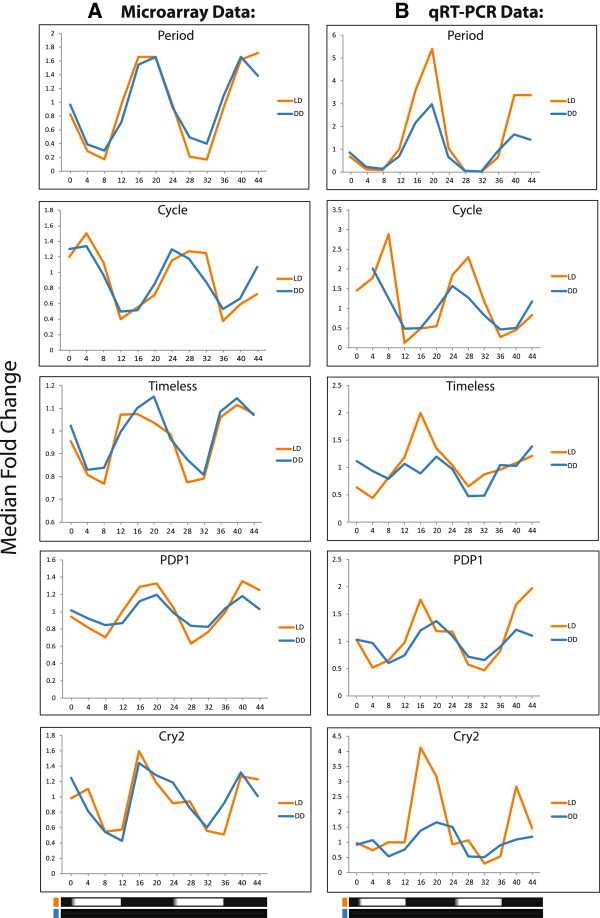
The mosquito species Aedes aegypti is the primary vector of many arboviral diseases, including dengue and yellow fevers, that are responsible for a large worldwide health burden. The biological rhythms of mosquitoes regulate many of the physiological processes and behaviors that influence the transmission of these diseases. For insight into the molecular basis of biological rhythms, diel and circadian gene expression profiling has been carried out for many species. To bring these resources to Aedes aegypti researchers, we used microarray technology to carry out a genome wide assessment of gene expression during the 24 hour light/dark (LD) cycle and during constant darkness (DD). The purpose of this report is to describe the methods, the validation of the results, and the organization of this database resource.
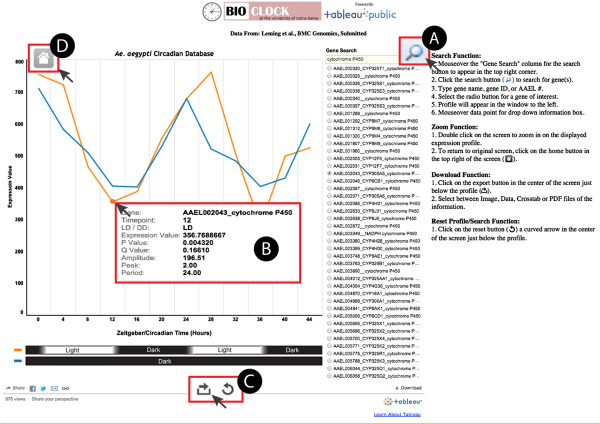
The Aedes aegypti Circadian Database is a publicly accessible database that can be searched via a text-based query to visualize 44 hour temporal expression patterns of a given gene in Ae. aegypti heads under diel (observed under a 12 hour/12 hour LD cycle) and circadian (observed under DD) conditions. Profiles of gene expression under these conditions were assayed by Nimblegen 12-plex microarrays and rhythmicity was objectively assessed by the JTK_CYCLE algorithm. The output of the search is a graphical representation of the expression data along with computed period length, the time-of-day of gene expression peaks, and statistical determination for rhythmicity.
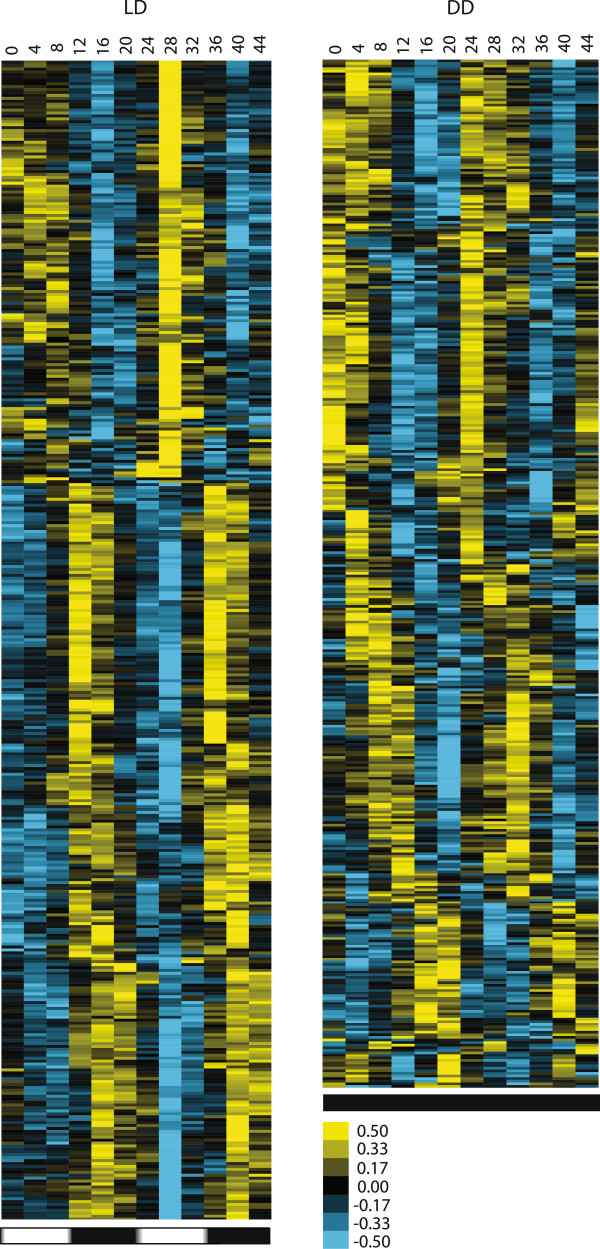
Our results show that at least 7.9% of the gene set present in the Aedes aegypti head are rhythmic under LD conditions and 6.7% can be considered circadian, oscillating under constant dark conditions. We present these results in the Aedes aegypti Circadian Database through Bioclock, a public website hosted by the University of Notre Dame at http://www.nd.edu/~bioclock/. This website allows searchable browsing of this quantitative gene expression information. The visualization allows for gene-by-gene comparison of transcript expression under both diel and circadian conditions, and the results are presented graphically in a plot profile of gene expression. The Ae. aegypti Circadian Database provides a community resource for observing diel and circadian fluctuations in gene expression across the Ae. aegypti genome.
埃及伊蚊是包括登革热和黄热病在内的多种虫媒病毒疾病的主要传播媒介,这些疾病在全球范围内造成了巨大的健康负担。蚊子的生物节律调节着许多影响这些疾病传播的生理过程和行为。为了深入了解生物节律的分子基础,已经对许多物种进行了昼夜和昼夜节律基因表达谱分析。为了将这些资源提供给埃及伊蚊研究人员,我们使用微阵列技术对24小时光/暗(LD)周期和持续黑暗(DD)期间的基因表达进行了全基因组评估。本报告的目的是描述该数据库资源的方法、结果验证及组织情况。
埃及伊蚊昼夜节律数据库是一个可公开访问的数据库,可通过基于文本的查询进行搜索,以可视化给定基因在埃及伊蚊头部在昼夜(在12小时/12小时LD周期下观察)和昼夜节律(在DD下观察)条件下的44小时时间表达模式。这些条件下的基因表达谱通过Nimblegen 12重微阵列进行测定,并通过JTK_CYCLE算法客观评估节律性。搜索结果是表达数据的图形表示,以及计算出的周期长度、基因表达峰值的时间点和节律性的统计判定。
我们的结果表明,在LD条件下,埃及伊蚊头部至少7.9%的基因集具有节律性,6.7%的基因集可被视为昼夜节律性,即在持续黑暗条件下振荡。我们通过由圣母大学托管的公共网站Bioclock(http://www.nd.edu/~bioclock/)在埃及伊蚊昼夜节律数据库中展示这些结果。该网站允许对这些定量基因表达信息进行可搜索浏览。可视化功能允许对昼夜和昼夜节律条件下的转录本表达进行逐基因比较,结果以基因表达的绘图轮廓形式以图形方式呈现。埃及伊蚊昼夜节律数据库为观察埃及伊蚊基因组中基因表达的昼夜和昼夜节律波动提供了一个社区资源。