Wang Sheng-Jun, Wang Zhen, Jin Tao, Boccaletti Stefano
Department of Physics, Shaanxi Normal University, Xi'An City, ShaanXi Province, China.
1] Department of Physics, Hong Kong Baptist University, Kowloon Tong, Hong Kong SRA, China [2] Center for Nonlinear Studies and the Beijing-Hong Kong-Singapore Joint Center for Nonlinear and Complex Systems, Hong Kong Baptist University, Kowloon Tong, Hong Kong SRA, China.
Sci Rep. 2014 Dec 18;4:7536. doi: 10.1038/srep07536.
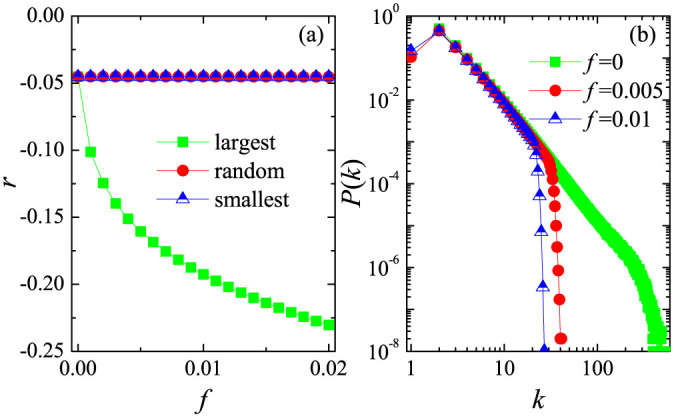
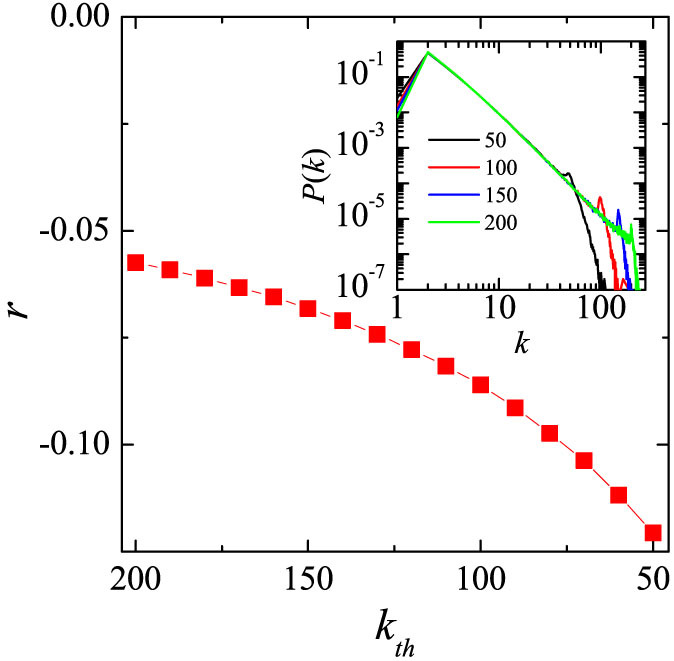
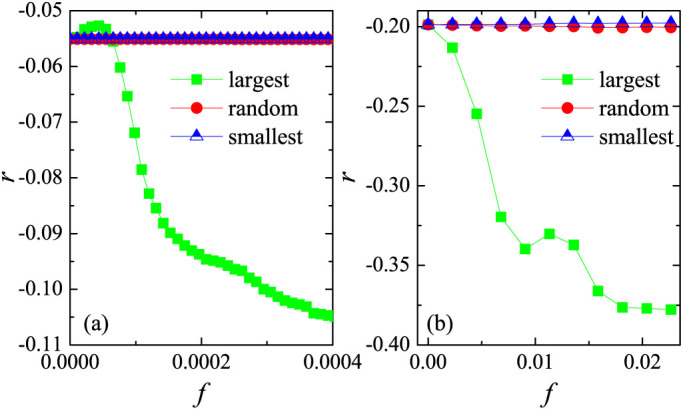
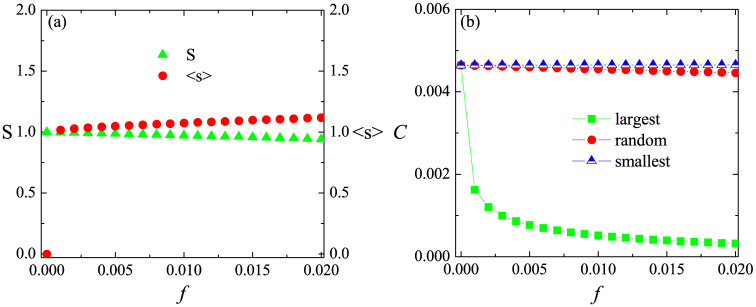
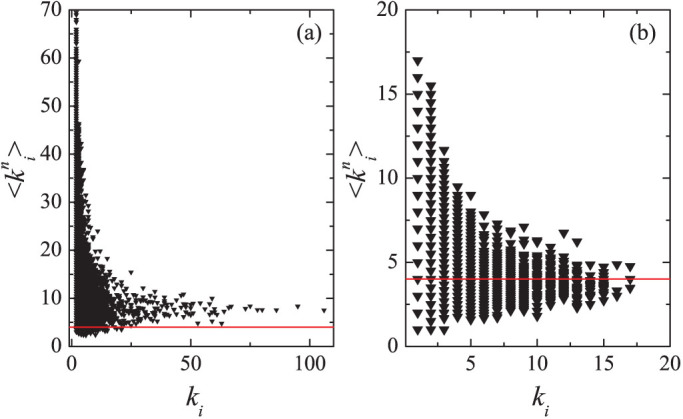
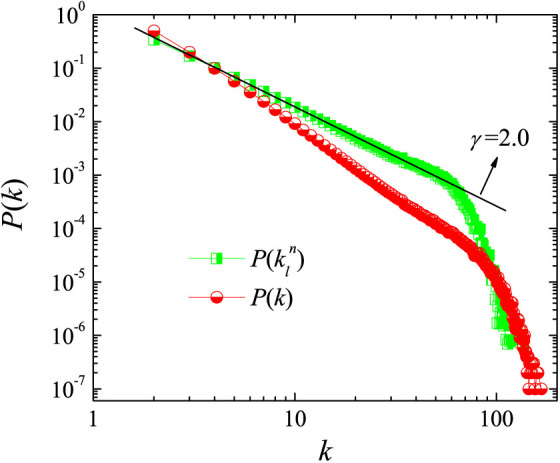
Disassortative mixing is ubiquitously found in technological and biological networks, while the corresponding interpretation of its origin remains almost virgin. We here give evidence that pruning the largest-degree nodes of a growing scale-free network has the effect of decreasing the degree correlation coefficient in a controllable and tunable way, while keeping both the trait of a power-law degree distribution and the main properties of network's resilience and robustness under failures or attacks. The essence of these observations can be attributed to the fact the deletion of large-degree nodes affects the delicate balance of positive and negative contributions to degree correlation in growing scale-free networks, eventually leading to the emergence of disassortativity. Moreover, these theoretical prediction will get further validation in the empirical networks. We support our claims via numerical results and mathematical analysis, and we propose a generative model for disassortative growing scale-free networks.
非同类混合在技术网络和生物网络中普遍存在,但其起源的相应解释几乎仍是空白。我们在此提供证据表明,修剪不断增长的无标度网络中度数最大的节点具有以可控且可调的方式降低度相关系数的效果,同时保持幂律度分布的特性以及网络在故障或攻击下的弹性和鲁棒性的主要属性。这些观察结果的本质可归因于这样一个事实,即删除大度节点会影响不断增长的无标度网络中对度相关的正负贡献的微妙平衡,最终导致非同类混合的出现。此外,这些理论预测将在实证网络中得到进一步验证。我们通过数值结果和数学分析来支持我们的观点,并提出了一个用于非同类增长的无标度网络的生成模型。