Abbott Penelope, Rosenkranz Sara, Hu Wendy, Gunasekera Hasantha, Reath Jennifer
Department of General Practice, University of Western Sydney, Locked Bag 1797, Penrith, NSW, 2751, Australia.
Department of Human Nutrition, Kansas State University, Manhattan, USA.
BMC Fam Pract. 2014 Dec 12;15:181. doi: 10.1186/s12875-014-0181-x.
Tympanometry and pneumatic otoscopy are recommended for diagnosis of otitis media, but are not frequently used by general practitioners (GPs). We examined how, after targeted short training, GP diagnosis and management of childhood ear disease was changed by the addition of these techniques to non-pneumatic otoscopy. We further explored factors influencing the uptake of these techniques.
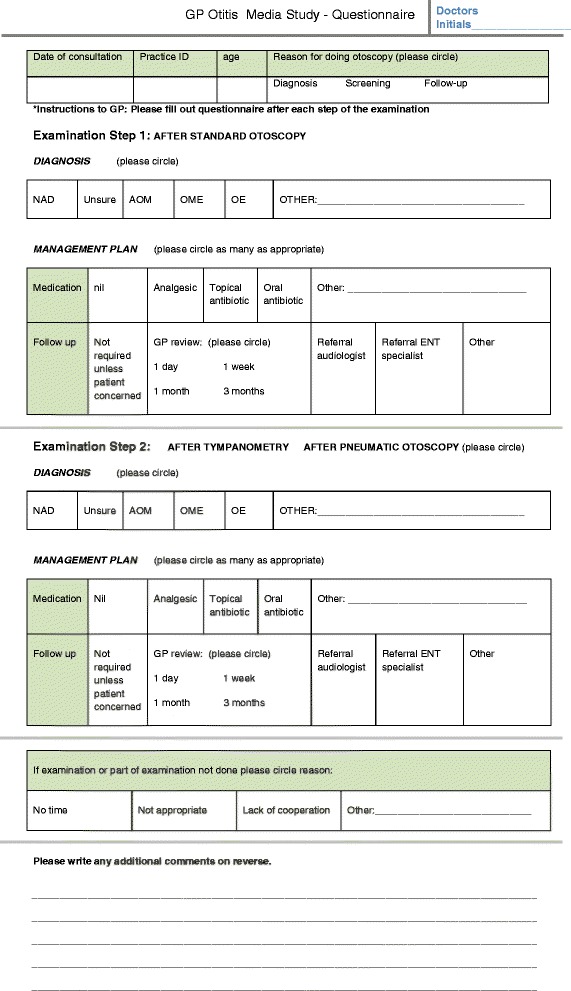
Between 2011 and 2012, we used a crossover experimental design to determine associations between tympanometry and pneumatic otoscopy and the GP diagnosis and management of ear disease in children aged 6 months to 6 years. GPs recorded a diagnosis and management plan after examining ears using non-pneumatic otoscopy, and another after using either tympanometry or pneumatic otoscopy. We compared diagnosis, prescription of oral antibiotics and planned GP follow-up at these two steps between the tympanometry and pneumatic otoscopy groups. We interviewed participants about their views regarding these techniques and analysed these data thematically.
Thirteen GPs recorded 694 ear examinations on 347 children: 347 examinations with non-pneumatic otoscopy; then 196 using tympanometry; and 151 using pneumatic otoscopy. Tympanometry was more likely to be associated with changes in diagnosis (χ (2) = 28.64, df 1, p < 0.001) and planned GP follow-up (χ (2) = 9.24, df 1, p < 0.01) than pneumatic otoscopy. Change in oral antibiotic prescription was no different between the two techniques. GPs preferred tympanometry to pneumatic otoscopy, but cost was a barrier to ongoing use. Pneumatic otoscopy was considered the more difficult skill. GPs were not convinced that the increased detection of middle ear effusion afforded by tympanometry and pneumatic otoscopy resulted in benefit to general practice patients.
Tympanometry was more likely than pneumatic otoscopy to change GP diagnoses and follow-up plans of childhood ear disease. Tympanometry may require less training than pneumatic otoscopy. GPs preferred tympanometry due to ease of use and interpretation; however, perceived high cost inhibited their intent to use it in the future. Training, cost and perceived lack of patient benefit are barriers to the use of tympanometry and pneumatic otoscopy in general practice.
鼓室导抗图和声导抗耳镜检查被推荐用于中耳炎的诊断,但全科医生(GP)并不经常使用。我们研究了在进行有针对性的短期培训后,将这些检查技术添加到非充气耳镜检查中,如何改变全科医生对儿童耳部疾病的诊断和管理。我们还进一步探讨了影响这些技术应用的因素。
在2011年至2012年期间,我们采用交叉实验设计来确定鼓室导抗图和声导抗耳镜检查与6个月至6岁儿童耳部疾病的全科医生诊断和管理之间的关联。全科医生在使用非充气耳镜检查耳朵后记录诊断和管理计划,在使用鼓室导抗图或声导抗耳镜检查后再记录一次。我们比较了鼓室导抗图组和声导抗耳镜检查组在这两个步骤中的诊断、口服抗生素处方情况以及计划的全科医生随访情况。我们就参与者对这些技术的看法进行了访谈,并对这些数据进行了主题分析。
13名全科医生对347名儿童进行了694次耳部检查:347次使用非充气耳镜检查;然后196次使用鼓室导抗图检查;151次使用声导抗耳镜检查。与声导抗耳镜检查相比,鼓室导抗图检查更有可能与诊断变化(χ(2)=28.64,自由度1,p<0.001)和计划的全科医生随访变化(χ(2)=9.24,自由度1,p<0.01)相关。两种技术在口服抗生素处方变化方面没有差异。全科医生更喜欢鼓室导抗图检查而不是声导抗耳镜检查,但成本是持续使用的障碍。声导抗耳镜检查被认为是更难掌握的技术。全科医生不相信鼓室导抗图和声导抗耳镜检查所带来的中耳积液检测增加会给全科医疗患者带来益处。
与声导抗耳镜检查相比,鼓室导抗图检查更有可能改变全科医生对儿童耳部疾病的诊断和随访计划。鼓室导抗图检查可能比声导抗耳镜检查需要更少的培训。由于使用和解读方便,全科医生更喜欢鼓室导抗图检查;然而,高昂的成本阻碍了他们未来使用它的意愿。培训、成本以及认为对患者没有益处是鼓室导抗图和声导抗耳镜检查在全科医疗中应用的障碍。