Mosher Catherine E, Ott Mary A, Hanna Nasser, Jalal Shadia I, Champion Victoria L
Department of Psychology, Indiana University-Purdue University Indianapolis, 402 North Blackford Street, LD 124, Indianapolis, IN, 46202, USA,
Support Care Cancer. 2015 Jul;23(7):2053-60. doi: 10.1007/s00520-014-2566-8. Epub 2014 Dec 20.
Advanced lung cancer patients have high rates of multiple physical and psychological symptoms, and many of their family caregivers experience significant distress. However, little is known about strategies that these patients and their family caregivers employ to cope with physical and psychological symptoms. This study aimed to identify strategies for coping with various physical and psychological symptoms among advanced, symptomatic lung cancer patients and their primary family caregivers.
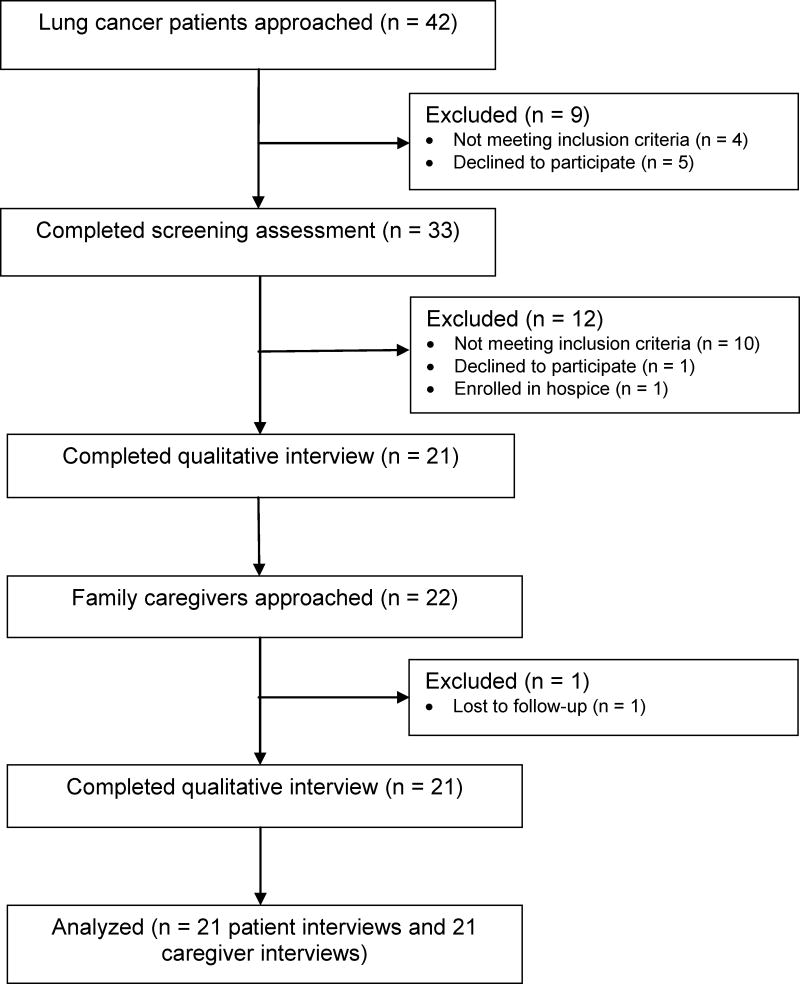
Patients identified their primary family caregiver. Individual semi-structured qualitative interviews were conducted with 21 advanced, symptomatic lung cancer patients and primary family caregivers. Thematic analysis of interview data was framed by stress and coping theory.
Patients and caregivers reported maintaining a normal routine and turning to family and friends for support with symptom management, which often varied in its effectiveness. Whereas support from health-care professionals and complementary and alternative medicine were viewed favorably, reactions to Internet and in-person support groups were mixed due to the tragic nature of participants' stories. Several cognitive coping strategies were frequently reported (i.e., changing expectations, maintaining positivity, and avoiding illness-related thoughts) as well as religious coping strategies.
Results suggest that advanced lung cancer patients and caregivers may be more receptive to cognitive and religious approaches to symptom management and less receptive to peer support. Interventions should address the perceived effectiveness of support from family and friends.
晚期肺癌患者出现多种生理和心理症状的比例很高,他们的许多家庭照顾者也经历着巨大的痛苦。然而,对于这些患者及其家庭照顾者用以应对生理和心理症状的策略,我们却知之甚少。本研究旨在确定晚期有症状肺癌患者及其主要家庭照顾者应对各种生理和心理症状的策略。
患者确定其主要家庭照顾者。对21名晚期有症状肺癌患者及其主要家庭照顾者进行了个体半结构化定性访谈。访谈数据的主题分析以压力与应对理论为框架。
患者和照顾者报告称,他们通过维持正常日常生活以及向家人和朋友寻求支持来管理症状,但其效果往往各不相同。虽然来自医疗保健专业人员以及补充和替代医学的支持受到好评,但由于参与者故事的悲剧性质,对互联网和面对面支持小组的反应不一。经常报告的几种认知应对策略(即改变期望、保持积极心态以及避免与疾病相关的想法)以及宗教应对策略。
结果表明,晚期肺癌患者和照顾者可能对症状管理的认知和宗教方法反应更为积极,而对同伴支持的反应则较弱。干预措施应解决来自家人和朋友的支持的感知效果问题。