Department of Industrial and Systems Engineering, University of Wisconsin-Madison, Madison, WI, USA.
Palliat Med. 2013 Jun;27(6):533-43. doi: 10.1177/0269216312457213. Epub 2012 Sep 17.
Using available communication technologies, clinicians may offer timely support to family caregivers in managing symptoms in patients with advanced cancer at home.
To assess the effects of an online symptom reporting system on caregiver preparedness, physical burden, and negative mood.
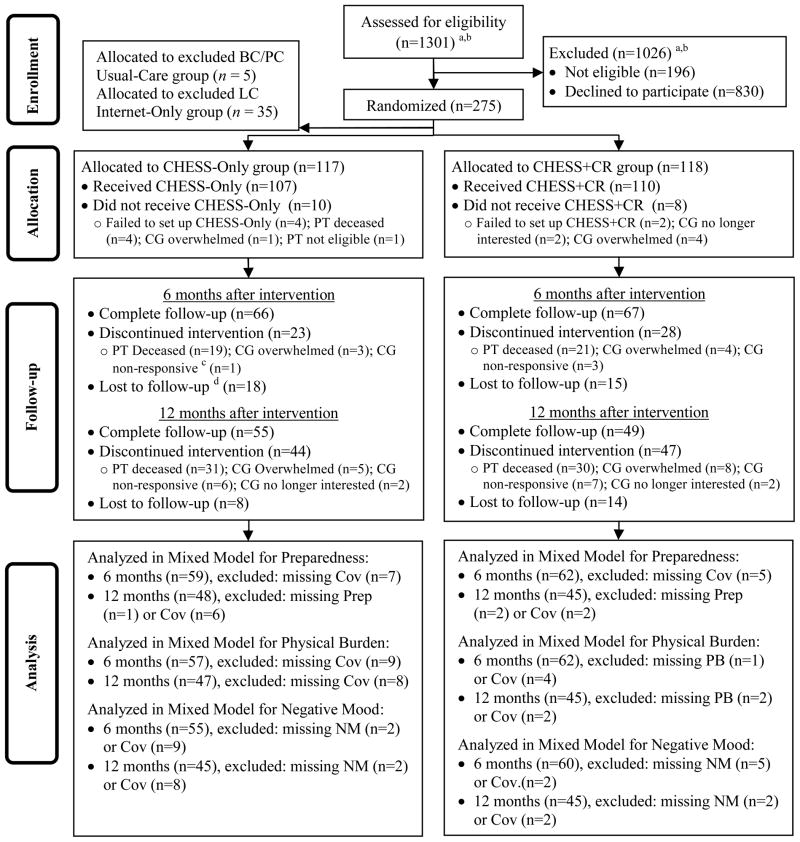
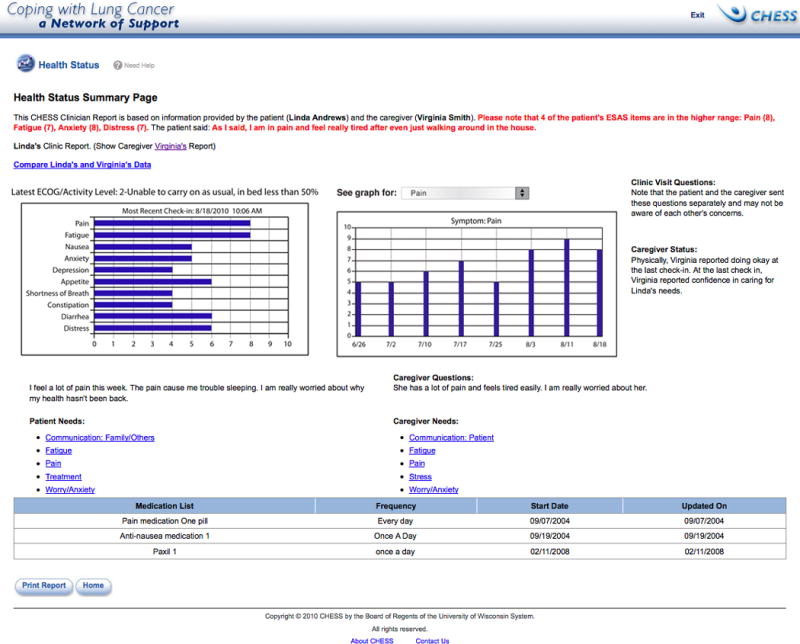
A pooled analysis of two randomized trials (NCT00214162 and NCT00365963) was conducted to compare caregiver outcomes at 6 and 12 months after intervention between two randomized, unblinded groups using General Linear Mixed Modeling. Caregivers in one group (Comprehensive Health Enhancement Support System-Only) were given access to an interactive cancer communication system, the Comprehensive Health Enhancement Support System. Those in the other group (Comprehensive Health Enhancement Support System + Clinician Report) received access to Comprehensive Health Enhancement Support System plus an online symptom reporting system called the Clinician Report. Clinicians of patients in the Comprehensive Health Enhancement Support System + Clinician Report group received e-mail alerts notifying them when a symptom distress was reported over a predetermined threshold.
SETTING/PARTICIPANTS: Dyads (n = 235) of advanced-stage lung, breast, and prostate cancer patients and their adult caregivers were recruited at five outpatient oncology clinics in the United States.
Caregivers in the Comprehensive Health Enhancement Support System + Clinician Report group reported less negative mood than those in the Comprehensive Health Enhancement Support System-Only group at both 6 months (p = 0.009) and 12 months (p = 0.004). Groups were not significantly different on caregiver preparedness or physical burden at either time point.
This study provides new evidence that by using an online symptom reporting system, caregivers may experience less emotional distress due to the Clinician Report's timely communication of caregiving needs in symptom management to clinicians.
利用现有的通讯技术,临床医生可以为在家中照顾晚期癌症患者的家属提供及时的支持,以帮助他们管理患者的症状。
评估在线症状报告系统对照顾者准备情况、身体负担和负面情绪的影响。
对两项随机试验(NCT00214162 和 NCT00365963)进行汇总分析,使用一般线性混合模型比较干预后 6 个月和 12 个月时两组随机、非盲组之间的照顾者结局。一组(综合健康增强支持系统-仅)的照顾者可以使用综合健康增强支持系统(Comprehensive Health Enhancement Support System,CHESS)获得交互式癌症通讯系统。另一组(综合健康增强支持系统+临床医生报告)的照顾者可以获得综合健康增强支持系统和名为临床医生报告(Clinician Report)的在线症状报告系统。综合健康增强支持系统+临床医生报告组的患者临床医生在症状困扰报告超过预定阈值时会收到电子邮件警报。
地点/参与者:在美国的五家门诊肿瘤诊所招募了晚期肺癌、乳腺癌和前列腺癌患者及其成年照顾者的 235 对二人组。
在 6 个月(p = 0.009)和 12 个月(p = 0.004)时,综合健康增强支持系统+临床医生报告组的照顾者报告的负面情绪比综合健康增强支持系统-仅组的照顾者报告的负面情绪少。在任何时间点,两组在照顾者准备情况或身体负担方面均无显著差异。
这项研究提供了新的证据,即通过使用在线症状报告系统,临床医生可以通过及时沟通症状管理中的护理需求,使照顾者在情绪上的困扰可能会减少。