Institute of Neuroepidemiology and Tropical Parasitology INSERM UMR 1094, Faculties of Medicine and Pharmacy, 2 Docteur Raymond Marcland Street, 87025, Limoges, France.
Faculty of Health Sciences, University of Montagnes, P.B 208, Banganté, Cameroon.
BMC Evol Biol. 2014 Dec 21;14:271. doi: 10.1186/s12862-014-0271-3.
Snails species belonging to the genus Bulinus (Planorbidae) serve as intermediate host for flukes belonging to the genus Schistosoma (Digenea, Platyhelminthes). Despite its importance in the transmission of these parasites, the evolutionary history of this genus is still obscure. In the present study, we used the partial mitochondrial cytochrome oxidase subunit I (cox1) gene, and the nuclear ribosomal ITS, 18S and 28S genes to investigate the haplotype diversity and phylogeny of seven Bulinus species originating from three endemic countries in Africa (Cameroon, Senegal and Egypt).
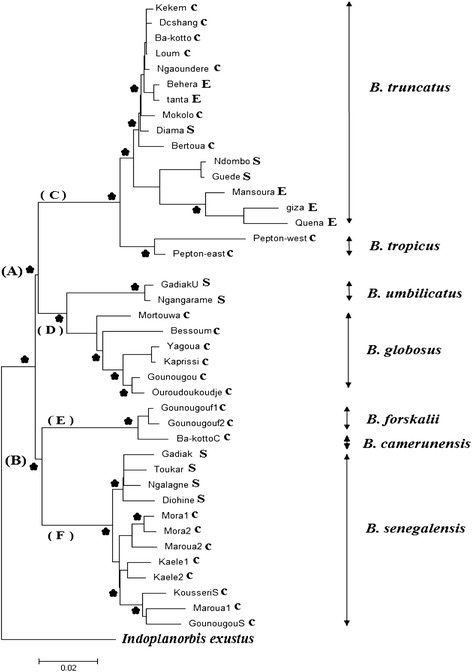
The cox1 region showed much more variation than the ribosomal markers within Bulinus sequences. High levels of genetic diversity were detected at all loci in the seven studied species, with clear segregation between individuals and appearance of different haplotypes, even within same species from the same locality. Sequences clustered into two lineages; (A) groups Bulinus truncatus, B. tropicus, B. globosus and B. umbilicatus; while (B) groups B. forskalii, B. senegalensis and B. camerunensis. Interesting patterns emerge regarding schistosome susceptibility: Bulinus species with lower genetic diversity are predicted to have higher infection prevalence than those with greater diversity in host susceptibility.
The results reported in this study are very important since a detailed understanding of the population genetic structure of Bulinus is essential to understand the epidemiology of many schistosome parasites.
属于椎实螺属(Planorbidae)的蜗牛物种是吸虫属(Schistosoma)(吸虫纲,扁形动物门)的中间宿主。尽管它在这些寄生虫的传播中很重要,但该属的进化历史仍然不清楚。在本研究中,我们使用了部分线粒体细胞色素氧化酶亚基 I(cox1)基因和核核糖体 ITS、18S 和 28S 基因,来研究来自非洲三个特有国家(喀麦隆、塞内加尔和埃及)的七种椎实螺物种的单倍型多样性和系统发育。
cox1 区域的变异比核糖体标记在椎实螺序列内多得多。在七种研究的物种的所有基因座中都检测到了高水平的遗传多样性,个体之间有明显的分离,并且出现了不同的单倍型,即使是来自同一地点的同种蜗牛也是如此。序列聚类为两个谱系;(A)组包括椎实螺、热带椎实螺、圆椎实螺和脐实螺;而(B)组包括福氏椎实螺、塞内加尔椎实螺和喀麦隆椎实螺。关于血吸虫易感性出现了有趣的模式:遗传多样性较低的椎实螺物种比那些宿主易感性多样性更高的物种更有可能出现更高的感染率。
本研究报告的结果非常重要,因为详细了解椎实螺的种群遗传结构对于理解许多血吸虫寄生虫的流行病学至关重要。