Castagno Victor Delpizzo, Fassa Anaclaudia Gastal, Carret Maria Laura Vidal, Vilela Manuel Augusto Pereira, Meucci Rodrigo Dalke
Department of Specialized Medicine - Ophthalmology, Federal University of Pelotas, Rua Marechal Deodoro, 1160, Centro, 96020-220, Pelotas, RS, Brazil.
Department of Social Medicine, Rua Marechal Deodoro, 1160, Centro, 96020-220, Pelotas, RS, Brazil.
BMC Ophthalmol. 2014 Dec 23;14:163. doi: 10.1186/1471-2415-14-163.
Studies show great variability in the prevalence of hyperopia among children. This study aimed to synthesize the existing knowledge about hyperopia prevalence and its associated factors in school children and to explore the reasons for this variability.
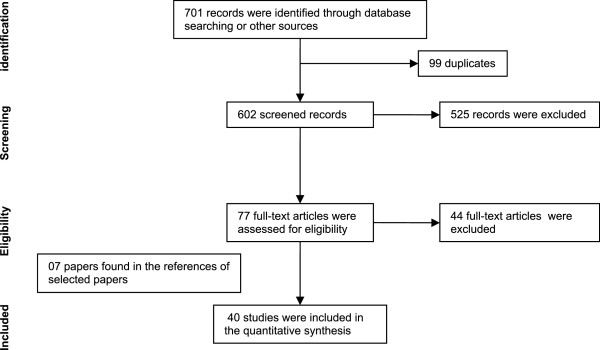
This systematic review followed PRISMA guidelines. Searching several international databases, the review included population- or school-based studies assessing hyperopia through cycloplegic autorefraction or cycloplegic retinoscopy. Meta-analysis of hyperopia prevalence was performed following MOOSE guidelines and using the random effects model.
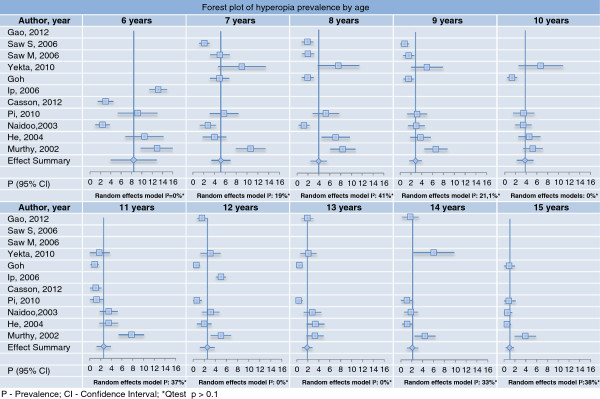
The review included 40 cross-sectional studies. The prevalence of hyperopia ranged from 8.4% at age six, 2-3% from 9 to 14 years and approximately 1% at 15 years. With regard to associated factors, age has an inverse association with hyperopia. The frequency of hyperopia is higher among White children and those who live in rural areas. There is no consensus about the association between hyperopia and gender, family income and parental schooling.
Future studies should use standardized methods to classify hyperopia and sufficient sample size when evaluating age-specific prevalence. Furthermore, it is necessary to deepen the understanding about the interactions among hyperopic refractive error and accommodative and binocular functions as a way of identifying groups of hyperopic children at risk of developing visual, academic and even cognitive function sequelae.
研究表明儿童远视患病率存在很大差异。本研究旨在综合关于学龄儿童远视患病率及其相关因素的现有知识,并探究这种差异的原因。
本系统评价遵循PRISMA指南。通过检索多个国际数据库,该评价纳入了通过睫状肌麻痹验光或睫状肌麻痹视网膜检影评估远视的基于人群或学校的研究。按照MOOSE指南并使用随机效应模型对远视患病率进行荟萃分析。
该评价纳入了40项横断面研究。远视患病率在6岁时为8.4%,9至14岁为2 - 3%,15岁时约为1%。关于相关因素,年龄与远视呈负相关。白人儿童以及居住在农村地区的儿童远视发生率更高。关于远视与性别、家庭收入和父母受教育程度之间的关联尚无共识。
未来研究在评估特定年龄患病率时应使用标准化方法对远视进行分类并采用足够的样本量。此外,有必要加深对远视屈光不正与调节及双眼功能之间相互作用的理解,以此来识别有发生视觉、学业甚至认知功能后遗症风险的远视儿童群体。