Jackson-Morris Angela M, Chowdhury Ishrat, Warner Valerie, Bleymann Kayleigh
Department of Tobacco Control, The International Union against Tuberculosis and Lung Disease, 8 Randolph Crescent, Edinburgh EH3 7TH, UK.
Int J Environ Res Public Health. 2015 Jan 7;12(1):474-87. doi: 10.3390/ijerph120100474.
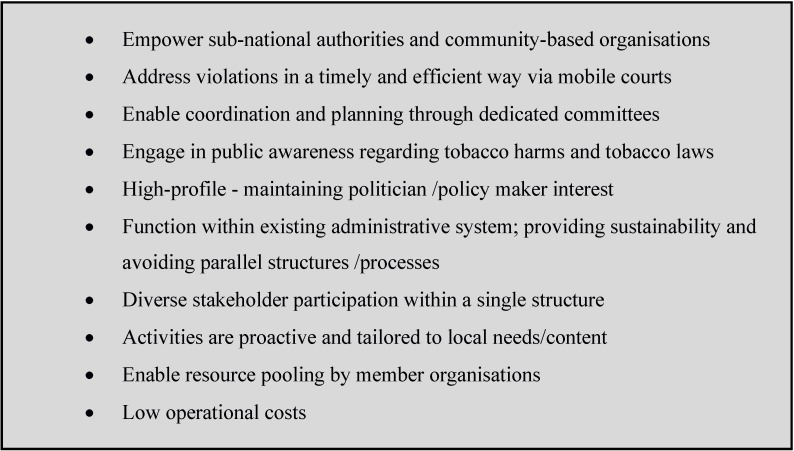
The MPOWER policy package enables countries to implement effective, evidence-based strategies to address the threat posed to their population by tobacco. All countries have challenges to overcome when implementing tobacco control policy. Some are generic such as tobacco industry efforts to undermine and circumvent legislation; others are specific to national or local context. Various factors influence how successfully challenges are addressed, including the legal-political framework for enforcement, public and administrative attitudes towards the law, and whether policy implementation measures are undertaken. This paper examines District Tobacco Control Taskforces, a flexible policy mechanism developed in Bangladesh to support the implementation of the Smoking and Tobacco Products Usage (Control) Act 2005 and its 2013 Amendment. At the time of this study published research and/or data was not available and understanding about these structures, their role, contribution, limitations and potential, was limited. We consider Taskforce characteristics and suggest that the "package" comprises a distinctive tobacco control implementation model. Qualitative data is presented from interviews with key informants in ten districts with activated taskforces (n = 70) to provide insight from the perspectives of taskforce members and non-members. In all ten districts taskforces were seen as a crucial tool for tobacco control implementation. Where taskforces were perceived to be functioning well, current positive impacts were perceived, including reduced smoking in public places and tobacco advertising, and increased public awareness and political profile. In districts with less well established taskforces, interviewees believed in their taskforce's 'potential' to deliver similar benefits once their functioning was improved. Recommendations to improve functioning and enhance impact were made. The distinctive taskforce concept and lessons from their development may provide other countries with a flexible local implementation model for tobacco control.
MPOWER政策包使各国能够实施有效、基于证据的战略,以应对烟草对其民众构成的威胁。在实施烟草控制政策时,所有国家都有挑战需要克服。有些挑战是普遍存在的,比如烟草行业试图破坏和规避立法;其他挑战则因国家或地方情况而异。各种因素影响着应对挑战的成功程度,包括执法的法律政治框架、公众和行政部门对法律的态度,以及是否采取了政策实施措施。本文研究了地区烟草控制特别工作组,这是孟加拉国为支持实施2005年《吸烟和烟草制品使用(控制)法》及其2013年修正案而建立的一种灵活的政策机制。在本研究发表之时,关于这些机构及其作用、贡献、局限性和潜力的研究和/或数据并不存在,人们对它们的了解也很有限。我们分析了特别工作组的特点,并认为这个“组合”构成了一个独特的烟草控制实施模式。本文提供了对十个已启动特别工作组地区的关键信息提供者(n = 70)的访谈定性数据,以从特别工作组成员和非成员的角度提供见解。在所有十个地区,特别工作组都被视为烟草控制实施的关键工具。在那些被认为运作良好的特别工作组所在地区,人们感受到了当前的积极影响,包括公共场所吸烟和烟草广告减少,以及公众意识和政治关注度提高。在特别工作组设立不完善的地区,受访者相信一旦其运作得到改善,他们的特别工作组有“潜力”带来类似的好处。文中还提出了改善运作和增强影响的建议。独特的特别工作组概念及其发展经验教训可能为其他国家提供一个灵活的地方烟草控制实施模式。