Jung Hyun Ah, Karki Subash, Ehom Na-Yeon, Yoon Mi-Hee, Kim Eon Ji, Choi Jae Sue
Department of Food Science and Human Nutrition, Chonbuk National University, Jeonbuk 561-756, Korea.
Department of Food Science and Nutrition, Pukyong National University, Busan 608-737, Korea.
Prev Nutr Food Sci. 2014 Dec;19(4):281-90. doi: 10.3746/pnf.2014.19.4.281. Epub 2014 Dec 31.
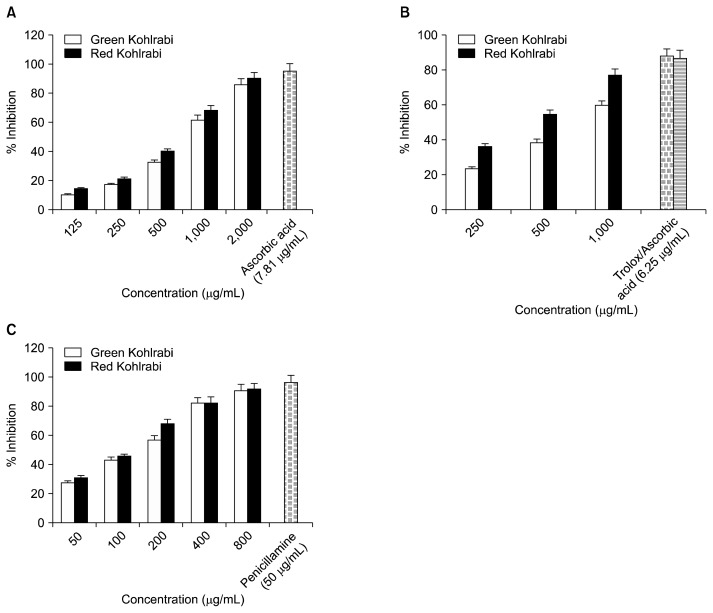
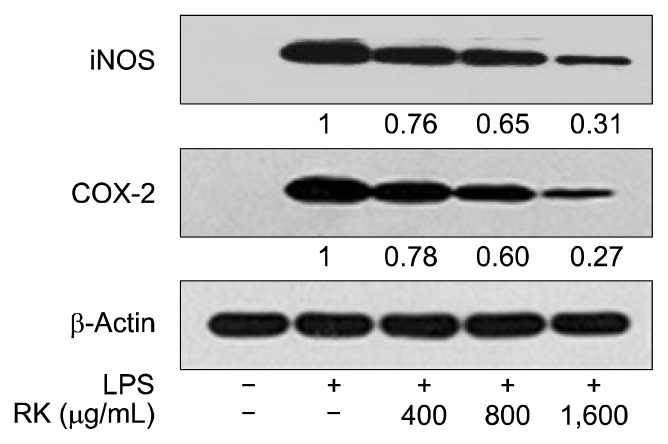
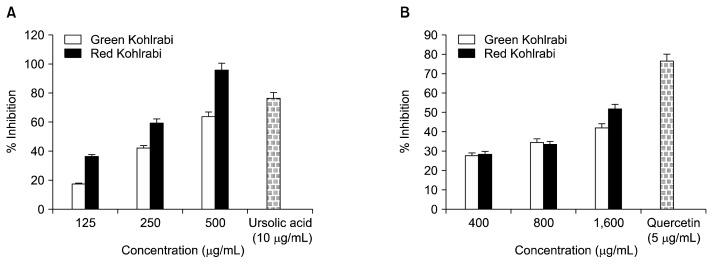
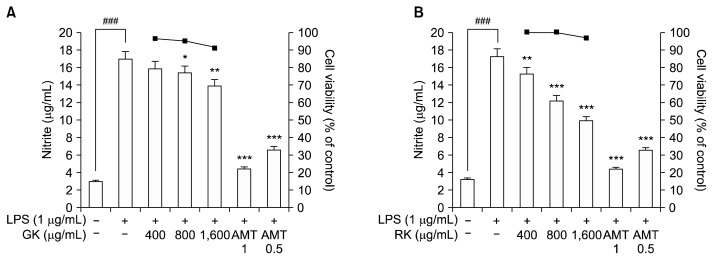
The aim of the present study was to evaluate the anti-diabetic, anti-inflammatory, antioxidant potential, and total phenolic content (TPC) of green and red kohlrabi cultivars. Anti-diabetic and anti-inflammatory activities were evaluated via protein tyrosine phosphatase (PTP1B) and rat lens aldose reductase inhibitory assays and cell-based lipopolysaccharide (LPS)-induced nitric oxide (NO) inhibitory assays in RAW 264.7 murine macrophages. In addition, scavenging assays using 1,1-diphenyl-2-picrylhydrazyl (DPPH) radical, 2,2'-azino-bis(3-ethylbenzothiazoline-6-sulfonic acid) diammonium salt (ABTS) radical, and peroxynitrite (ONOO(-)) were used to evaluate antioxidant potential and TPC was selected to assess phytochemical characteristics. Between the two kohlrabi cultivars, red kohlrabi (RK) had two times more TPC than green kohlrabi (GK) and showed significant antioxidant effects in DPPH, ABTS, and ONOO(-) scavenging assays. Likewise, methanol (MeOH) extracts of RK and GK inhibited LPS-induced NO production in a dose dependent manner that was further clarified by suppression of iNOS and COX-2 protein production. The MeOH extracts of RK and GK exhibited potent inhibitory activities against PTP1B with the corresponding IC50 values of 207±3.48 and 287±3.22 μg/mL, respectively. Interestingly, the RK MeOH extract exhibited significantly stronger anti-inflammatory, anti-diabetic, and antioxidant effects than that of GK MeOH extract. As a result, our study establishes that RK extract with a higher TPC might be useful as a potent anti-diabetic, antioxidant, and anti-inflammatory agent.
本研究的目的是评估绿色和红色大头菜品种的抗糖尿病、抗炎、抗氧化潜力以及总酚含量(TPC)。通过蛋白质酪氨酸磷酸酶(PTP1B)和大鼠晶状体醛糖还原酶抑制试验以及基于细胞的脂多糖(LPS)诱导的RAW 264.7小鼠巨噬细胞中一氧化氮(NO)抑制试验来评估抗糖尿病和抗炎活性。此外,使用1,1-二苯基-2-苦基肼(DPPH)自由基、2,2'-联氮-双-(3-乙基苯并噻唑啉-6-磺酸)二铵盐(ABTS)自由基和过氧亚硝酸盐(ONOO(-))清除试验来评估抗氧化潜力,并选择TPC来评估植物化学特征。在这两个大头菜品种中,红色大头菜(RK)的TPC是绿色大头菜(GK)的两倍,并且在DPPH、ABTS和ONOO(-)清除试验中显示出显著的抗氧化作用。同样,RK和GK的甲醇(MeOH)提取物以剂量依赖性方式抑制LPS诱导的NO产生,通过抑制诱导型一氧化氮合酶(iNOS)和环氧化酶-2(COX-2)蛋白产生进一步得到证实。RK和GK的MeOH提取物对PTP1B表现出强效抑制活性,相应的半数抑制浓度(IC50)值分别为207±3.48和287±3.22μg/mL。有趣的是,RK的MeOH提取物比GK的MeOH提取物表现出更强的抗炎、抗糖尿病和抗氧化作用。因此,我们的研究表明,具有较高TPC的RK提取物可能作为一种强效的抗糖尿病、抗氧化和抗炎剂。