Reimhult Erik, Höök Fredrik
Institute for Biologically Inspired Materials, Department of Nanobiotechnology, University of Natural Resources and Life Sciences, Vienna, Muthgasse 11, A-1190 Vienna, Austria.
Biological Physics, Department of Applied Physics, Chalmers University of Technology, Fysikgränd 3, SE-411 33 Göteborg, Sweden.
Sensors (Basel). 2015 Jan 14;15(1):1635-75. doi: 10.3390/s150101635.
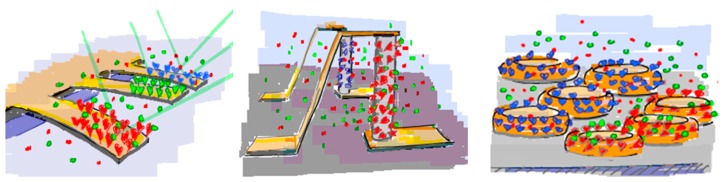
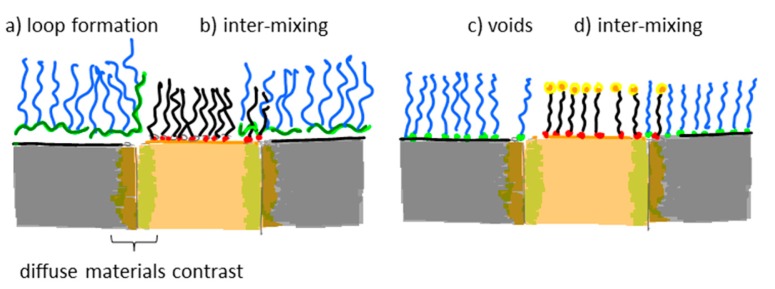
Nanoscale biosensors provide the possibility to miniaturize optic, acoustic and electric sensors to the dimensions of biomolecules. This enables approaching single-molecule detection and new sensing modalities that probe molecular conformation. Nanoscale sensors are predominantly surface-based and label-free to exploit inherent advantages of physical phenomena allowing high sensitivity without distortive labeling. There are three main criteria to be optimized in the design of surface-based and label-free biosensors: (i) the biomolecules of interest must bind with high affinity and selectively to the sensitive area; (ii) the biomolecules must be efficiently transported from the bulk solution to the sensor; and (iii) the transducer concept must be sufficiently sensitive to detect low coverage of captured biomolecules within reasonable time scales. The majority of literature on nanoscale biosensors deals with the third criterion while implicitly assuming that solutions developed for macroscale biosensors to the first two, equally important, criteria are applicable also to nanoscale sensors. We focus on providing an introduction to and perspectives on the advanced concepts for surface functionalization of biosensors with nanosized sensor elements that have been developed over the past decades (criterion (iii)). We review in detail how patterning of molecular films designed to control interactions of biomolecules with nanoscale biosensor surfaces creates new possibilities as well as new challenges.
纳米级生物传感器使光学、声学和电学传感器能够小型化至生物分子的尺寸。这使得接近单分子检测以及探测分子构象的新传感方式成为可能。纳米级传感器主要基于表面且无需标记,以利用物理现象的固有优势,从而在不进行有干扰性标记的情况下实现高灵敏度。在设计基于表面且无需标记的生物传感器时,有三个主要标准需要优化:(i)目标生物分子必须以高亲和力和选择性结合到敏感区域;(ii)生物分子必须有效地从本体溶液传输到传感器;(iii)换能器概念必须足够灵敏,以便在合理的时间尺度内检测到捕获生物分子的低覆盖率。关于纳米级生物传感器的大多数文献都涉及第三个标准,同时隐含地假设为宏观生物传感器开发的解决方案对于同样重要的前两个标准也适用于纳米级传感器。我们专注于介绍过去几十年中开发的具有纳米尺寸传感元件的生物传感器表面功能化的先进概念并展望其前景(标准(iii))。我们详细回顾了旨在控制生物分子与纳米级生物传感器表面相互作用的分子膜图案化如何创造新的可能性以及新的挑战。