Department of Nursing, University of Montreal. Centre for Training and Expertise in Nursing Administration Research (FERASI), Université du Québec en Outaouais, St-Jérôme Campus, 5 Saint-Joseph Street, Room 3212, Saint-Jérôme, Québec, J7Z 0B7 Canada.
University of Montreal, Montreal, Quebec Canada.
BMC Nurs. 2014 Dec 31;13(1):50. doi: 10.1186/s12912-014-0050-x. eCollection 2014.
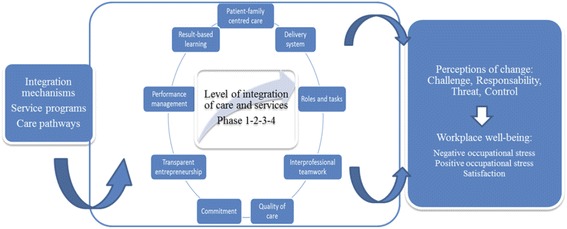
To respond better to population needs, in recent years Quebec has invested in improving the integration of services and care pathways. Nurses are on the front lines of these transformation processes, which require them to adopt new clinical practices. This updating of practices can be a source of both satisfaction and stress. The aim of this study was to gain a better understanding of the relationship between the transformation processes underlying services integration and nurses' workplace well-being.
This study was based on a descriptive cross-sectional correlational design. The target population included all nurses working in four care pathways in a Quebec healthcare establishment: palliative oncology services, mental health services, autonomy support for the elderly, and chronic obstructive pulmonary disease. In all, 107 nurses took part in the study and completed a questionnaire sent to them. Hierarchical linear regression analyses were used to examine the relationship between level of integration, measured using the Development Model for Integrated Care; nurses' perceptions of organizational change, measured on four dimensions (challenge, responsibility, threat, control); and nurses' workplace well-being, measured on three dimensions (negative stress, positive stress, satisfaction), as defined by the Flexihealth model.
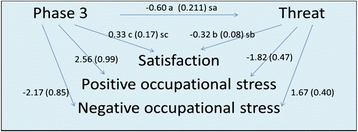
Nurses in the palliative oncology care pathway, which was at a more advanced level of integration, presented a lower negative stress level and a higher positive stress level than did nurses in other care pathways. Their mean satisfaction score was also higher. More advanced integration was associated with nurses' feeling less threatened, as well as improved workplace well-being. The perception of threat appeared to be a significant mediating variable in the relationship between level of integration and well-being.
The association observed between level of services integration and workplace well-being contributes to a better understanding of nurses' experiences in such situations. These results provide new perspectives on interventions that could be implemented to remedy the potential negative consequences of these types of transformations.
为了更好地满足人口需求,近年来魁北克省投资改善了服务和护理途径的整合。护士处于这些转型过程的前沿,这要求他们采用新的临床实践。这种实践的更新既可以带来满足感,也可能带来压力。本研究的目的是更好地理解服务整合背后的转型过程与护士工作场所幸福感之间的关系。
本研究基于描述性的横截面相关性设计。目标人群包括魁北克省一家医疗机构的四个护理途径中的所有护士:姑息肿瘤服务、心理健康服务、老年人自主支持和慢性阻塞性肺疾病。共有 107 名护士参与了这项研究,并填写了寄给他们的问卷。使用分层线性回归分析检验了整合水平(使用综合护理发展模型衡量)、护士对组织变革的看法(从四个维度衡量:挑战、责任、威胁和控制)以及护士的工作场所幸福感(由 Flexihealth 模型衡量,包括负向压力、正向压力和满意度三个维度)之间的关系。
在姑息肿瘤护理途径中,整合程度较高的护士的负向压力水平较低,正向压力水平较高,满意度也较高,而在其他护理途径中,护士的负向压力水平较高,正向压力水平较低,满意度也较低。更先进的整合与护士的威胁感降低以及工作场所幸福感提高有关。威胁感似乎是整合程度和幸福感之间关系的一个重要中介变量。
观察到的服务整合水平与工作场所幸福感之间的关联有助于更好地理解护士在这种情况下的体验。这些结果为可以实施的干预措施提供了新的视角,以补救这些类型的转型可能带来的潜在负面影响。