Division of Social and Administrative Sciences, School of Pharmacy, University of Wisconsin-Madison, Madison, Wisconsin, USA.
Department of Pharmacy Practice, College of Pharmacy, South Dakota State University, Brookings, South Dakota, USA.
BMJ Open. 2015 Jan 19;5(1):e006086. doi: 10.1136/bmjopen-2014-006086.
To describe patients' perceived value and use of quality measures in evaluating and choosing community pharmacies.
Focus group methodology was combined with a survey tool. During the focus groups, participants assessed the value of the Pharmacy Quality Alliance's quality measures in evaluating and choosing a pharmacy. Also, participants completed questionnaires rating their perceived value of quality measures in evaluating a pharmacy (1 being low value and 5 being high) or choosing a pharmacy (yes/no). Thematic analysis and descriptive statistics were used to analyse the focus groups and surveys, respectively.
Semistructured focus groups were conducted in a private meeting space of an urban and a rural area of a Mid-western State in the USA.
Thirty-four adults who filled prescription medications in community pharmacies for a chronic illness were recruited in community pharmacies, senior centres and public libraries.
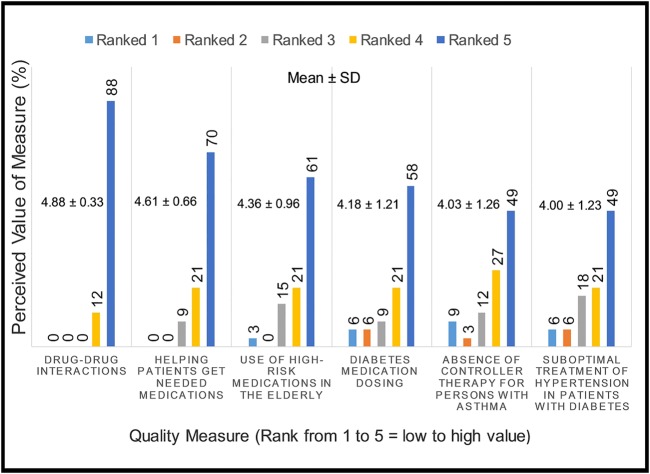
While comments indicated that all measures were important, medication safety measures (eg, drug-drug interactions) were valued more highly than others. Rating of quality measure utility in evaluating a pharmacy ranged from a mean of 4.88 ('drug-drug interactions') to a mean of 4.0 ('absence of controller therapy for patients with asthma'). Patients were hesitant to use quality information in choosing a pharmacy (depending on the participant's location) but might consider if moving to a new area or having had a negative pharmacy experience. Use of select quality measures to choose a pharmacy ranged from 97.1% of participants using 'drug-drug interactions' (medication safety measure) to 55.9% using 'absence of controller therapy for patients with asthma'.
The study participants valued quality measures in evaluating and selecting a community pharmacy, with medication safety measures valued highest. The participants reported that the quality measures would not typically cause a switch in pharmacy but might influence their selection in certain situations.
描述患者对质量措施在评估和选择社区药店中的感知价值和使用情况。
采用焦点小组方法与调查工具相结合。在焦点小组中,参与者评估了药房质量联盟(Pharmacy Quality Alliance)的质量措施在评估和选择药店方面的价值。此外,参与者还完成了评估质量措施在评估药店(1 表示价值低,5 表示价值高)或选择药店(是/否)方面的感知价值的问卷。分别使用主题分析和描述性统计对焦点小组和调查进行分析。
在美国中西部一个州的城市和农村地区的一个私人会议空间中进行了半结构化焦点小组讨论。
在社区药店、老年人中心和公共图书馆招募了 34 名患有慢性病并在社区药店配药的成年人。
虽然评论表明所有措施都很重要,但药物安全措施(例如,药物相互作用)比其他措施更受重视。在评估药店方面,质量措施的实用性评分范围从平均值 4.88(“药物相互作用”)到平均值 4.0(“哮喘患者无控制器治疗”)。患者在选择药店时对使用质量信息犹豫不决(取决于参与者的所在地),但如果搬到新的地区或有过负面的药店体验,可能会考虑。在选择药店时使用某些质量措施的情况从 97.1%的参与者使用“药物相互作用”(药物安全措施)到 55.9%的参与者使用“哮喘患者无控制器治疗”不等。
研究参与者重视评估和选择社区药店的质量措施,其中药物安全措施的价值最高。参与者报告说,这些质量措施通常不会导致药店的转换,但在某些情况下可能会影响他们的选择。