Holton Nicholas, Nekrasov Vladimir, Ronald Pamela C, Zipfel Cyril
The Sainsbury Laboratory, Norwich Research Park, Norwich, United Kingdom.
Department of Plant Pathology and the Genome Center, University of California, Davis, Davis, California, United States of America.
PLoS Pathog. 2015 Jan 21;11(1):e1004602. doi: 10.1371/journal.ppat.1004602. eCollection 2015 Jan.
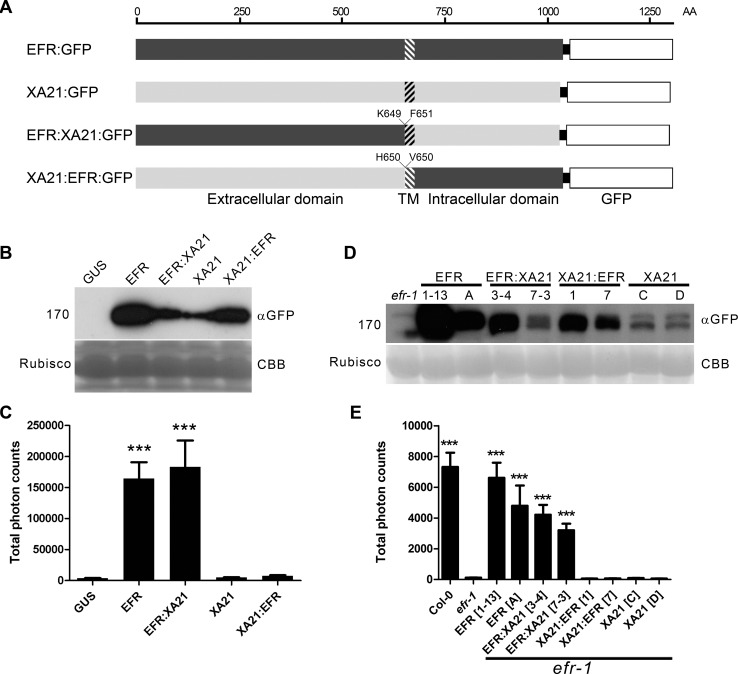
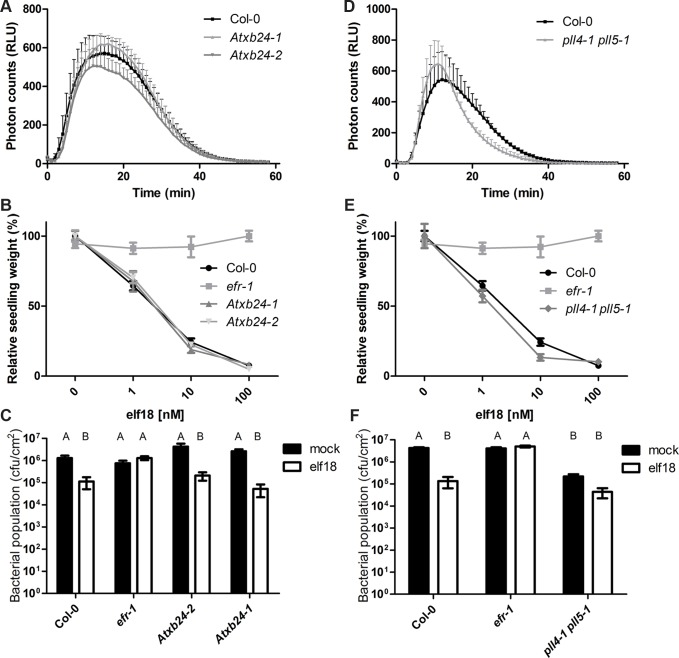
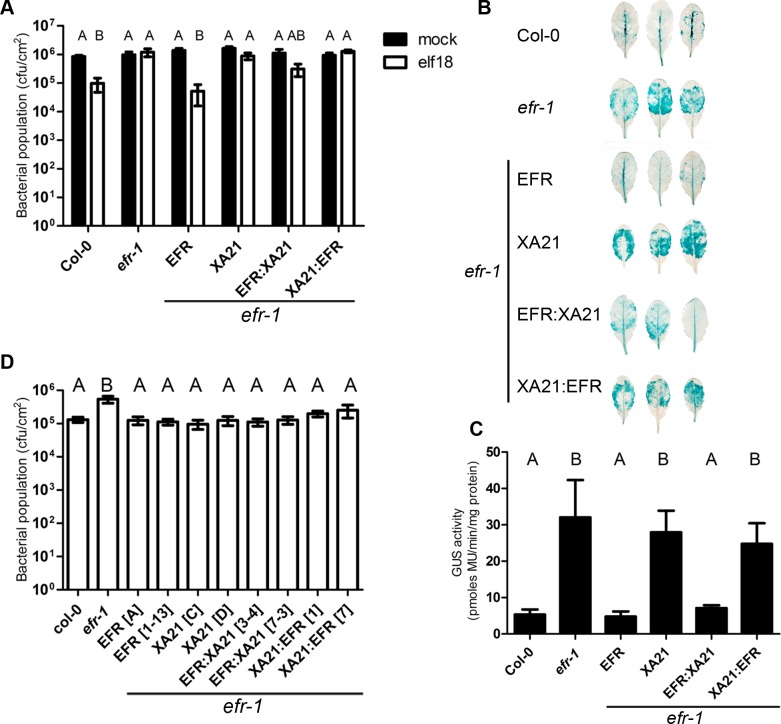
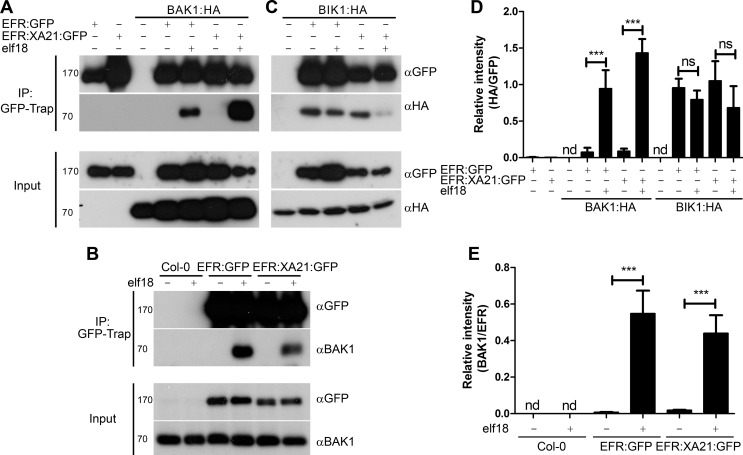
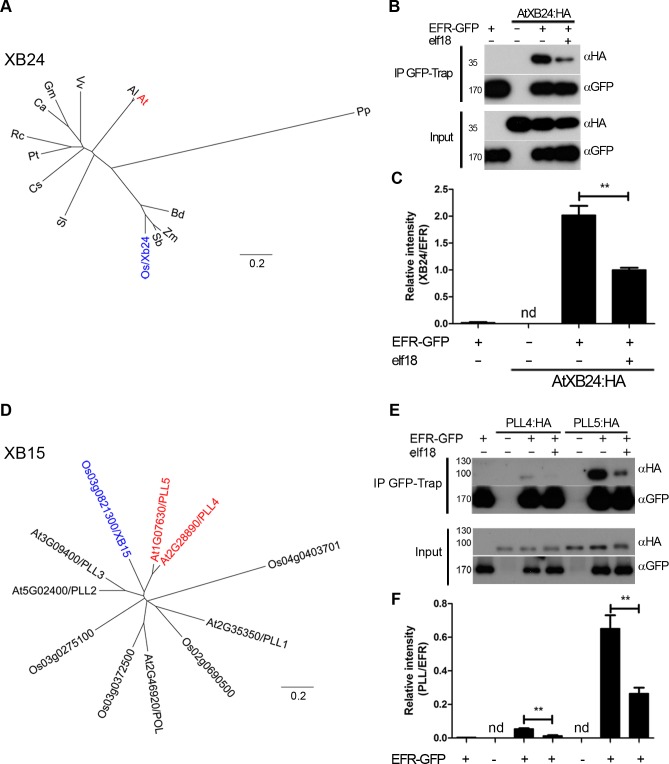
During plant immunity, surface-localized pattern recognition receptors (PRRs) recognize pathogen-associated molecular patterns (PAMPs). The transfer of PRRs between plant species is a promising strategy for engineering broad-spectrum disease resistance. Thus, there is a great interest in understanding the mechanisms of PRR-mediated resistance across different plant species. Two well-characterized plant PRRs are the leucine-rich repeat receptor kinases (LRR-RKs) EFR and XA21 from Arabidopsis thaliana (Arabidopsis) and rice, respectively. Interestingly, despite being evolutionary distant, EFR and XA21 are phylogenetically closely related and are both members of the sub-family XII of LRR-RKs that contains numerous potential PRRs. Here, we compared the ability of these related PRRs to engage immune signaling across the monocots-dicots taxonomic divide. Using chimera between Arabidopsis EFR and rice XA21, we show that the kinase domain of the rice XA21 is functional in triggering elf18-induced signaling and quantitative immunity to the bacteria Pseudomonas syringae pv. tomato (Pto) DC3000 and Agrobacterium tumefaciens in Arabidopsis. Furthermore, the EFR:XA21 chimera associates dynamically in a ligand-dependent manner with known components of the EFR complex. Conversely, EFR associates with Arabidopsis orthologues of rice XA21-interacting proteins, which appear to be involved in EFR-mediated signaling and immunity in Arabidopsis. Our work indicates the overall functional conservation of immune components acting downstream of distinct LRR-RK-type PRRs between monocots and dicots.
在植物免疫过程中,位于表面的模式识别受体(PRRs)识别病原体相关分子模式(PAMPs)。植物物种间PRRs的转移是工程化广谱抗病性的一种有前景的策略。因此,人们对了解不同植物物种中PRR介导的抗性机制非常感兴趣。两种特征明确的植物PRRs分别是来自拟南芥和水稻的富含亮氨酸重复序列的受体激酶(LRR-RKs)EFR和XA21。有趣的是,尽管在进化上距离较远,但EFR和XA21在系统发育上密切相关,并且都是包含众多潜在PRRs的LRR-RKs亚家族XII的成员。在这里,我们比较了这些相关PRRs跨越单子叶植物-双子叶植物分类界限参与免疫信号传导的能力。利用拟南芥EFR和水稻XA21之间的嵌合体,我们表明水稻XA21的激酶结构域在触发elf18诱导的信号传导以及对拟南芥中丁香假单胞菌番茄致病变种(Pto)DC3000和根癌农杆菌的定量免疫方面具有功能。此外,EFR:XA21嵌合体以配体依赖的方式与EFR复合物的已知组分动态结合。相反,EFR与水稻XA21相互作用蛋白的拟南芥直系同源物结合,这些蛋白似乎参与拟南芥中EFR介导的信号传导和免疫。我们的工作表明单子叶植物和双子叶植物中不同LRR-RK型PRRs下游起作用的免疫组分在整体功能上具有保守性。