Mercado-Pagán Ángel E, Stahl Alexander M, Shanjani Yaser, Yang Yunzhi
Department of Orthopedic Surgery, Stanford University, 300 Pasteur Drive, Edwards R155, Stanford, CA, 94305, USA.
Ann Biomed Eng. 2015 Mar;43(3):718-29. doi: 10.1007/s10439-015-1253-3. Epub 2015 Jan 24.
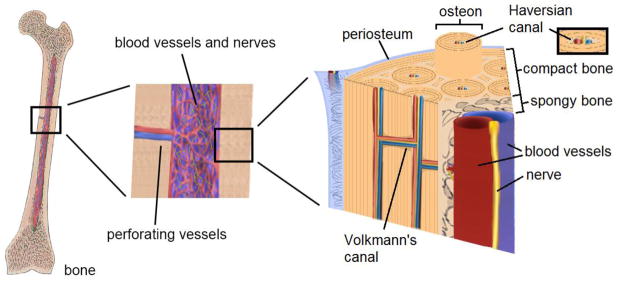
Vascularization of large bone grafts is one of the main challenges of bone tissue engineering (BTE), and has held back the clinical translation of engineered bone constructs for two decades so far. The ultimate goal of vascularized BTE constructs is to provide a bone environment rich in functional vascular networks to achieve efficient osseointegration and accelerate restoration of function after implantation. To attain both structural and vascular integration of the grafts, a large number of biomaterials, cells, and biological cues have been evaluated. This review will present biological considerations for bone function restoration, contemporary approaches for clinical salvage of large bone defects and their limitations, state-of-the-art research on the development of vascularized bone constructs, and perspectives on evaluating and implementing novel BTE grafts in clinical practice. Success will depend on achieving full graft integration at multiple hierarchical levels, both between the individual graft components as well as between the implanted constructs and their surrounding host tissues. The paradigm of vascularized tissue constructs could not only revolutionize the progress of BTE, but could also be readily applied to other fields in regenerative medicine for the development of new innovative vascularized tissue designs.
大段骨移植的血管化是骨组织工程(BTE)的主要挑战之一,迄今为止,这一问题已阻碍工程化骨构建体的临床转化长达二十年。血管化骨组织工程构建体的最终目标是提供一个富含功能性血管网络的骨环境,以实现有效的骨整合,并加速植入后功能的恢复。为实现移植体的结构和血管整合,人们已对大量生物材料、细胞和生物学信号进行了评估。本综述将阐述骨功能恢复的生物学考量、大段骨缺损临床救治的当代方法及其局限性、血管化骨构建体开发的前沿研究,以及在临床实践中评估和应用新型骨组织工程移植体的前景。成功将取决于在多个层次水平上实现完全的移植体整合,包括单个移植体组件之间以及植入的构建体与其周围宿主组织之间。血管化组织构建体的范例不仅可以彻底改变骨组织工程的进程,还可以很容易地应用于再生医学的其他领域,以开发新的创新型血管化组织设计。