Tristão Gabriel B, Assunção Leandro do Prado, Dos Santos Luiz Paulo A, Borges Clayton L, Silva-Bailão Mirelle Garcia, Soares Célia M de Almeida, Cavallaro Gabriele, Bailão Alexandre M
Biochemistry and Molecular Biology, Laboratório de Biologia Molecular, Universidade Federal de Goiás Goiânia, Brazil.
Magnetic Resonance Center, University of Florence Sesto Fiorentino, Italy.
Front Microbiol. 2015 Jan 9;5:761. doi: 10.3389/fmicb.2014.00761. eCollection 2014.
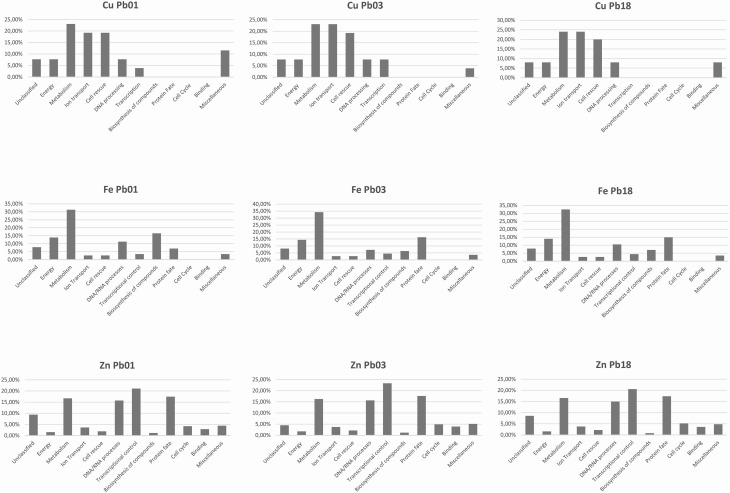
Approximately one-third of all proteins have been estimated to contain at least one metal cofactor, and these proteins are referred to as metalloproteins. These represent one of the most diverse classes of proteins, containing metal ions that bind to specific sites to perform catalytic, regulatory and structural functions. Bioinformatic tools have been developed to predict metalloproteins encoded by an organism based only on its genome sequence. Its function and the type of metal binder can also be predicted via a bioinformatics approach. Paracoccidioides complex includes termodimorphic pathogenic fungi that are found as saprobic mycelia in the environment and as yeast, the parasitic form, in host tissues. They are the etiologic agents of Paracoccidioidomycosis, a prevalent systemic mycosis in Latin America. Many metalloproteins are important for the virulence of several pathogenic microorganisms. Accordingly, the present work aimed to predict the copper, iron and zinc proteins encoded by the genomes of three phylogenetic species of Paracoccidioides (Pb01, Pb03, and Pb18). The metalloproteins were identified using bioinformatics approaches based on structure, annotation and domains. Cu-, Fe-, and Zn-binding proteins represent 7% of the total proteins encoded by Paracoccidioides spp. genomes. Zinc proteins were the most abundant metalloproteins, representing 5.7% of the fungus proteome, whereas copper and iron proteins represent 0.3 and 1.2%, respectively. Functional classification revealed that metalloproteins are related to many cellular processes. Furthermore, it was observed that many of these metalloproteins serve as virulence factors in the biology of the fungus. Thus, it is concluded that the Cu, Fe, and Zn metalloproteomes of the Paracoccidioides spp. are of the utmost importance for the biology and virulence of these particular human pathogens.
据估计,所有蛋白质中约有三分之一至少含有一种金属辅因子,这些蛋白质被称为金属蛋白。它们是最多样化的蛋白质类别之一,含有与特定位点结合以执行催化、调节和结构功能的金属离子。已经开发了生物信息学工具,仅根据生物体的基因组序列来预测其编码的金属蛋白。其功能和金属结合剂的类型也可以通过生物信息学方法来预测。副球孢子菌复合体包括嗜温双相致病真菌,在环境中以腐生菌丝体形式存在,在宿主组织中以酵母(寄生形式)存在。它们是副球孢子菌病的病原体,副球孢子菌病是拉丁美洲一种普遍的系统性真菌病。许多金属蛋白对几种致病微生物的毒力很重要。因此,本研究旨在预测副球孢子菌三个系统发育种(Pb01、Pb03和Pb18)基因组中编码的铜、铁和锌蛋白。使用基于结构、注释和结构域的生物信息学方法鉴定金属蛋白。铜、铁和锌结合蛋白占副球孢子菌属基因组编码的总蛋白的7%。锌蛋白是最丰富的金属蛋白,占真菌蛋白质组的5.7%,而铜蛋白和铁蛋白分别占0.3%和1.2%。功能分类显示,金属蛋白与许多细胞过程有关。此外,还观察到许多这些金属蛋白在真菌生物学中作为毒力因子。因此,可以得出结论,副球孢子菌属的铜、铁和锌金属蛋白质组对这些特定人类病原体的生物学和毒力至关重要。