Park Young-Sook, Chung Sook-Hee, Lee Seong-Kyu, Kim Ja-Hyun, Kim Jun-Bong, Kim Tae-Kyun, Kim Dong-Shin, Baik Haing-Woon
Department of Gastroenterology, School of Medicine, Eulji University, Daejeon 301-746, Republic of Korea.
Department of Gastroenterology, Ajou University School of Medicine, Suwon 443-721, Republic of Korea.
Int J Mol Med. 2015 Apr;35(4):979-86. doi: 10.3892/ijmm.2015.2080. Epub 2015 Jan 27.
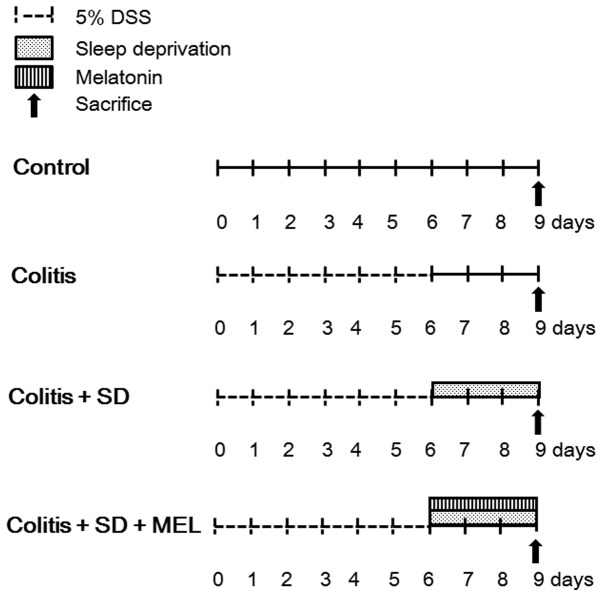
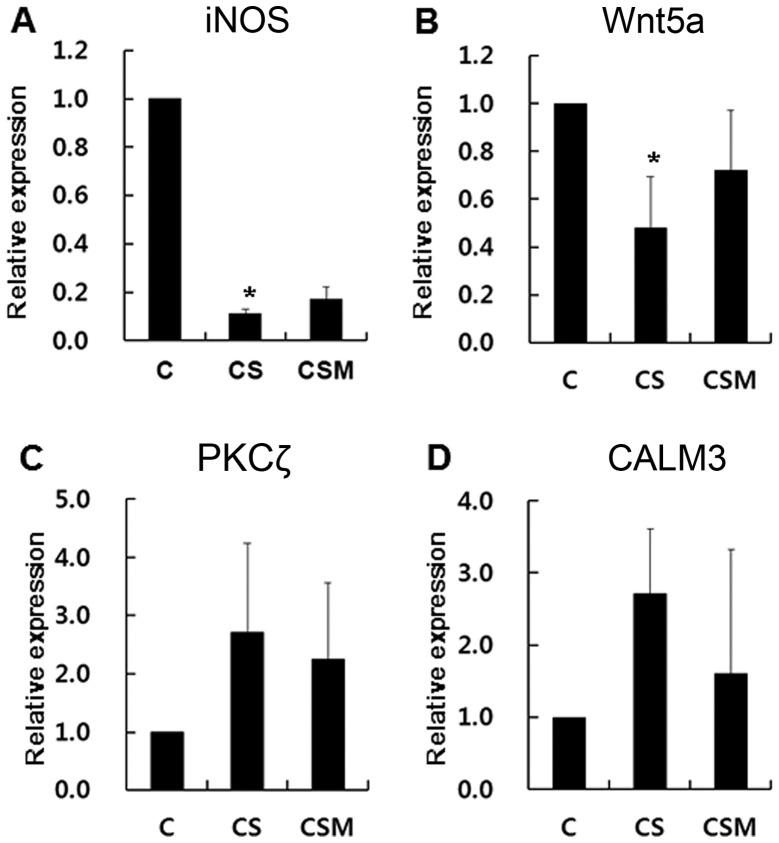
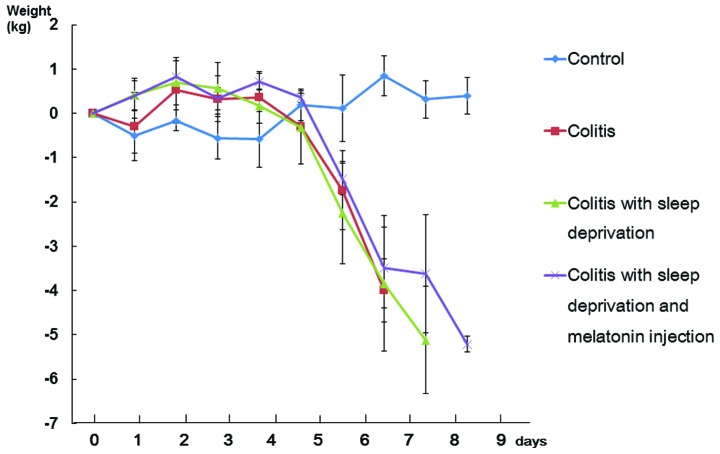
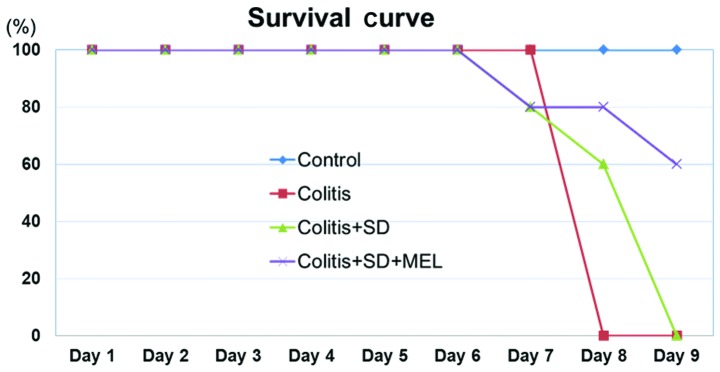
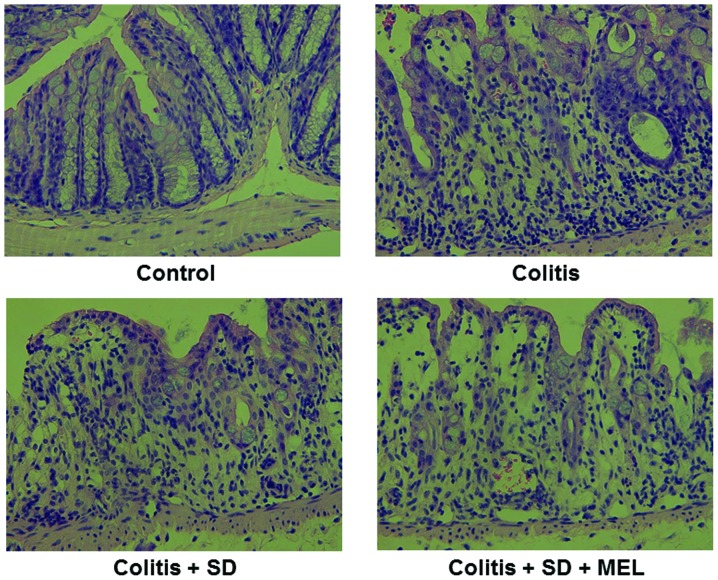
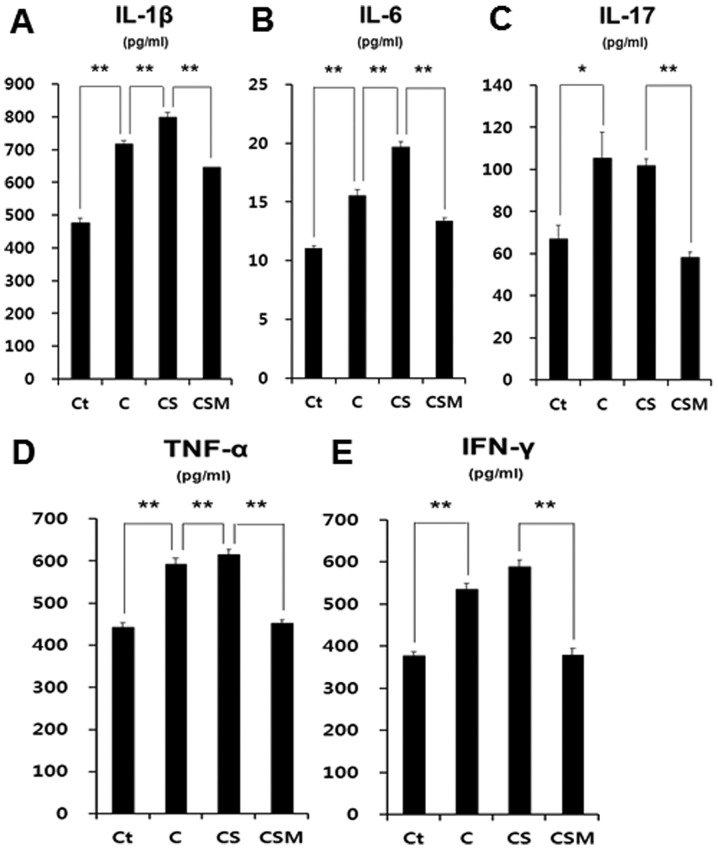
Sleep deprivation (SD) is an epidemic phenomenon in modern countries, and its harmful effects are well known. SD acts as an aggravating factor in inflammatory bowel disease. Melatonin is a sleep-related neurohormone, also known to have antioxidant and anti-inflammatory effects in the gastrointestinal tract; however, the effects of melatonin on colitis have been poorly characterized. Thus, in this study, we assessed the measurable effects of SD on experimental colitis and the protective effects of melatonin. For this purpose, male imprinting control region (ICR) mice (n = 24) were used; the mice were divided into 4 experimental groups as follows: the control, colitis, colitis with SD and colitis with SD and melatonin groups. Colitis was induced by the administration of 5% dextran sulfate sodium (DSS) in the drinking water for 6 days. The mice were sleep-deprived for 3 days. Changes in body weight, histological analyses of colon tissues and the expression levels of pro-inflammatory cytokines and genes were evaluated. SD aggravated inflammation and these effects were reversed by melatonin in the mice with colitis. In addition, weight loss in the mice with colitis with SD was significantly reduced by the injection of melatonin. Treatment with melatonin led to high survival rates in the mice, in spite of colitis with SD. The levels of pro-inflammatory cytokines, such as interleukin (IL)-1β, IL-6, IL-17, interferon-γ and tumor necrosis factor-α, in the serum of mice were significantly increased by SD and reduced by melatonin treatment. The melatonin-treated group showed a histological improvement of inflammation. Upon gene analysis, the expression of the inflammatory genes, protein kinase Cζ (PKCζ) and calmodulin 3 (CALM3), was increased by SD, and the levels decreased following treatment with melatonin. The expression levels of the apoptosis-related inducible nitric oxide synthase (iNOS) and wingless-type MMTV integration site family, member 5A (Wnt5a) genes was decreased by SD, but increased following treatment with melatonin. Treatment with melatonin reduced weight loss and prolonged survival in mice with colitis with SD. Melatonin exerted systemic anti-inflammatory effects. Gene analysis revealed a possible mechanism of action of melatonin in inflammation and sleep disturbance. Thus, melatonin may be clinically applicable for patients with inflammatory bowel disease, particularly those suffering from sleep disturbances.
睡眠剥夺(SD)在现代国家是一种普遍现象,其有害影响众所周知。SD是炎症性肠病的一个加重因素。褪黑素是一种与睡眠相关的神经激素,在胃肠道中也具有抗氧化和抗炎作用;然而,褪黑素对结肠炎的影响尚未得到充分描述。因此,在本研究中,我们评估了SD对实验性结肠炎的可测量影响以及褪黑素的保护作用。为此,使用了雄性印记控制区(ICR)小鼠(n = 24);将小鼠分为4个实验组,如下:对照组、结肠炎组、SD合并结肠炎组和SD合并褪黑素组。通过在饮用水中给予5%硫酸葡聚糖钠(DSS)6天来诱导结肠炎。将小鼠睡眠剥夺3天。评估体重变化、结肠组织的组织学分析以及促炎细胞因子和基因的表达水平。SD加重了炎症,而褪黑素在结肠炎小鼠中逆转了这些影响。此外,注射褪黑素显著降低了SD合并结肠炎小鼠的体重减轻。尽管存在SD合并结肠炎,褪黑素治疗仍使小鼠具有较高的存活率。SD显著增加了小鼠血清中促炎细胞因子如白细胞介素(IL)-1β、IL-6、IL-17、干扰素-γ和肿瘤坏死因子-α的水平,而褪黑素治疗降低了这些水平。褪黑素治疗组的炎症在组织学上有所改善。基因分析显示,炎症基因蛋白激酶Cζ(PKCζ)和钙调蛋白3(CALM3)的表达因SD而增加,而褪黑素治疗后水平降低。凋亡相关的诱导型一氧化氮合酶(iNOS)和无翅型MMTV整合位点家族成员5A(Wnt5a)基因的表达水平因SD而降低,但褪黑素治疗后增加。褪黑素治疗减少了SD合并结肠炎小鼠的体重减轻并延长了其存活时间。褪黑素发挥了全身抗炎作用。基因分析揭示了褪黑素在炎症和睡眠障碍中的可能作用机制。因此,褪黑素可能在临床上适用于炎症性肠病患者,尤其是那些患有睡眠障碍的患者。