De Carli Angelo, Lanzetti Riccardo Maria, Ciompi Alessandro, Lupariello Domenico, Rota Pierpaolo, Ferretti Andrea
Orthopaedic Unit and "Kirk Kilgour" Sports Injury Centre, S. Andrea Hospital, University of Rome "La Sapienza", Italy, Via di Grottarossa 1035, 00189, Rome, Italy.
J Orthop Surg Res. 2015 Jan 28;10:13. doi: 10.1186/s13018-014-0150-z.
The management of acute Rockwood type III acromioclavicular joint (ACJ) dislocation remains controversial, and the debate about whether patients should be conservatively or surgically treated continues. This study aims to compare conservative and surgical treatment of acute type III ACJ injuries in active sport participants (<35 years of age) by analysing clinical and radiological results after a minimum of 24 months follow-up.
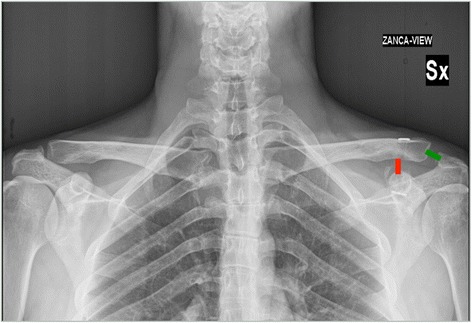
The records of 72 patients with acute type III ACJ dislocations who were treated from January 2006 to December 2011 were retrospectively evaluated. Patients were categorised into two groups. group A included 25 patients treated conservatively, and group B included 30 patients treated surgically with the TightRope™ system. Seventeen patients were lost to follow-up. All patients were evaluated at final follow-up with these clinical scores: Constant, University of California Los Angeles scale (UCLA), American Shoulder and Elbow Surgeons Scale (ASES) and Acromioclavicular Joint Instability (ACJI) and with a subjective evaluation of the patient satisfaction, aesthetic results and shoulder function. The distance between the acromion and clavicle and between the coracoid process and clavicle were evaluated radiographically and compared with preoperative values. Δ, the difference in mm between the distance at the final follow-up and at T0 in the injured shoulder, and α, the side-to-side difference in mm at follow-up, were calculated. Heterotopic ossification and postoperative osteolysis were evaluated in both groups.
There were no major intraoperative complications in the surgical group. The subjective parameters significantly differed between the two groups. Constant, ASES and UCLA scores were similar in both groups (P > 0.05), whereas ACJI results favoured the surgical group (group A, 72.4; group B, 87.9; P < 0.05). All measurements of radiographic evaluation were significantly reduced in the surgical group compared with the conservative group. In group A, we detected calcifications in 30% of patients; in group B we detected two cases of moderate osteolysis and calcifications in 70% of patients.
Although better subjective and radiographic results were achieved in surgically treated patients, traditional objective scores did not show significant differences between the two groups. Our results cannot support routine use of surgery to treat type III ACJ dislocations.
急性Rockwood III型肩锁关节(ACJ)脱位的治疗仍存在争议,关于患者应接受保守治疗还是手术治疗的争论仍在继续。本研究旨在通过分析至少24个月随访后的临床和影像学结果,比较保守治疗和手术治疗对活跃运动参与者(<35岁)急性III型ACJ损伤的效果。
回顾性评估2006年1月至2011年12月期间接受治疗的72例急性III型ACJ脱位患者的记录。患者分为两组。A组包括25例接受保守治疗的患者,B组包括30例采用TightRope™系统进行手术治疗的患者。17例患者失访。所有患者在最终随访时采用以下临床评分进行评估:Constant评分、加利福尼亚大学洛杉矶分校(UCLA)评分、美国肩肘外科医生评分(ASES)和肩锁关节不稳定(ACJI)评分,并对患者满意度、美学效果和肩部功能进行主观评估。通过影像学评估肩峰与锁骨之间以及喙突与锁骨之间的距离,并与术前值进行比较。计算受伤肩部最终随访时与T0时距离的差值Δ(单位为mm),以及随访时两侧之间的差值α(单位为mm)。评估两组患者的异位骨化和术后骨质溶解情况。
手术组术中无重大并发症。两组之间的主观参数存在显著差异。两组的Constant、ASES和UCLA评分相似(P>0.05),而ACJI结果显示手术组更优(A组,72.4;B组,87.9;P<0.05)。与保守组相比,手术组影像学评估的所有测量值均显著降低。在A组中,我们在30%的患者中检测到钙化;在B组中,我们在70%的患者中检测到2例中度骨质溶解和钙化。
尽管手术治疗的患者在主观和影像学方面取得了更好的结果,但传统的客观评分在两组之间并未显示出显著差异。我们的结果不支持常规使用手术治疗III型ACJ脱位。