Yu Guangxia, Wu Weixiang, Pan Xiaoqi, Zhao Qiang, Wei Xiaoyun, Lu Qing
Key Laboratory of Environment and Health, Ministry of Education & Ministry of Environmental Protection, and State Key Laboratory of Environmental Health (Incubating), School of Public Health, Tongji Medical College, Huazhong University of Science and Technology, Wuhan 430030, China.
Sensors (Basel). 2015 Jan 26;15(2):2709-22. doi: 10.3390/s150202709.
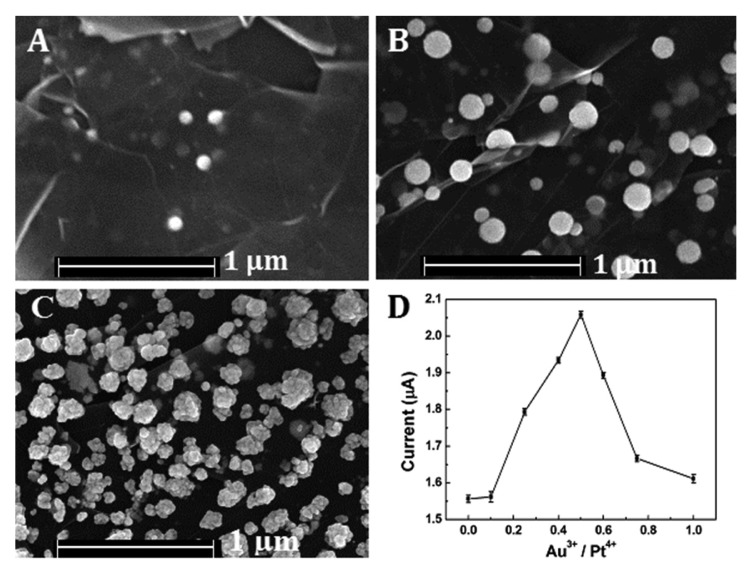
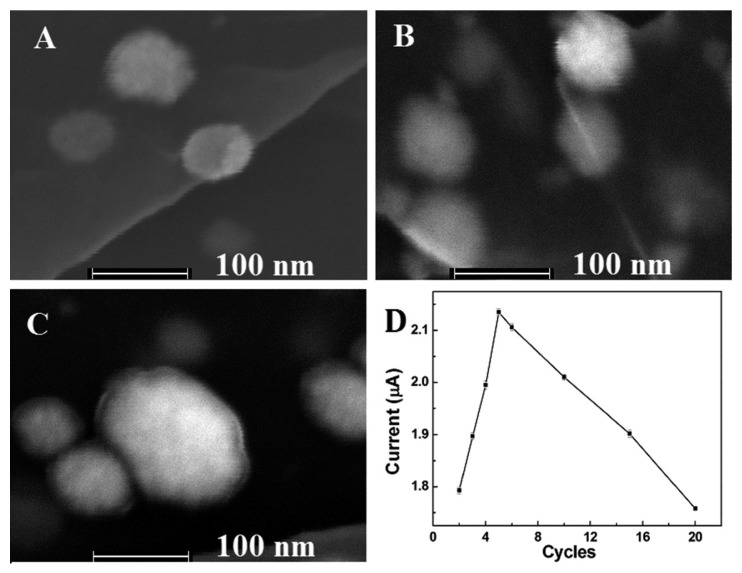
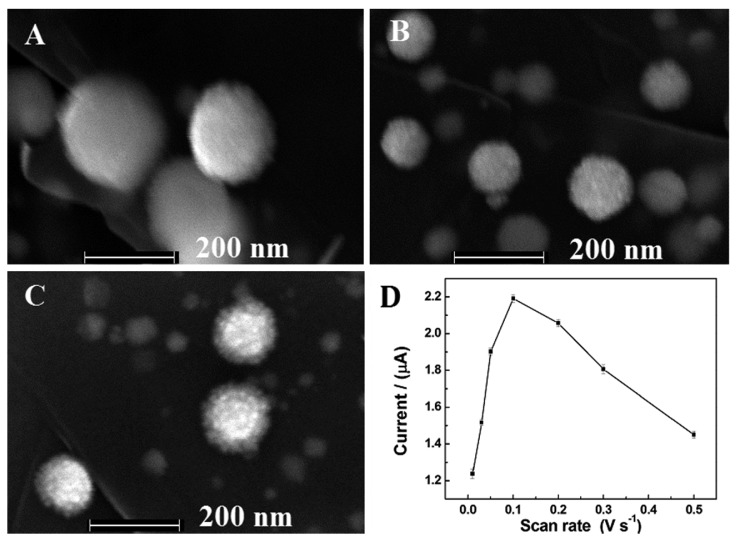
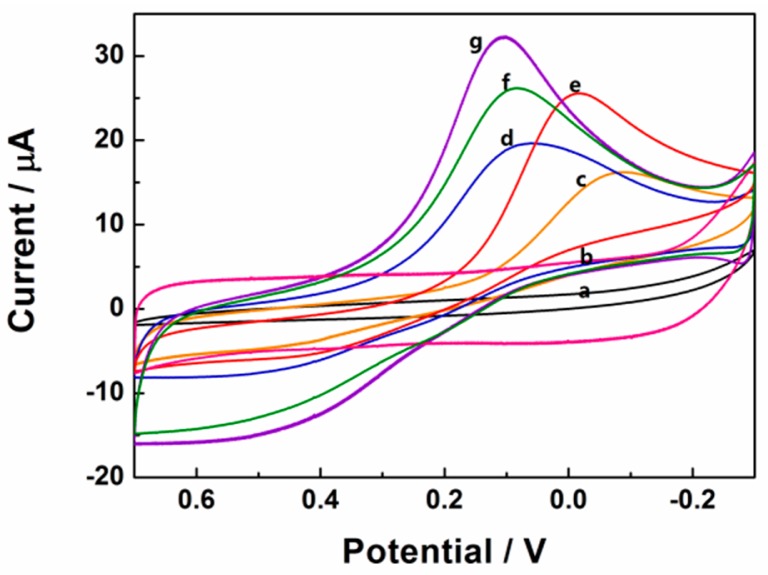
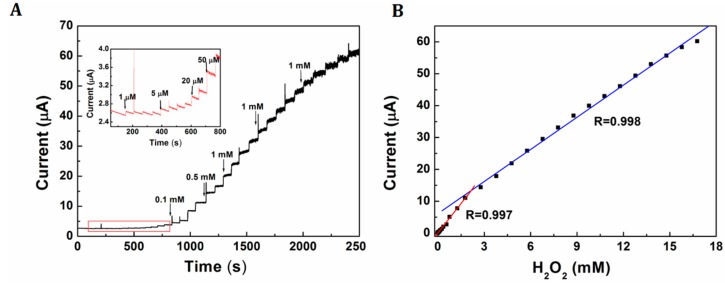
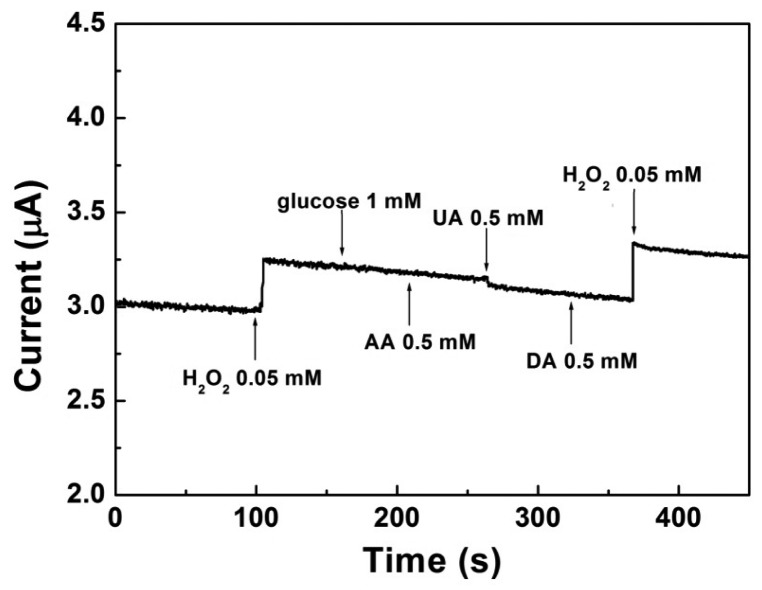
In this study, a high sensitive and selective hydrogen peroxide (H2O2) sensor was successfully constructed with Pt-Au bimetallic nanoparticles (Pt-Au NPs)/reduced graphene sheets (rGSs) hybrid films. Various molar ratios of Au to Pt and different electrodeposition conditions were evaluated to control the morphology and electrocatalytic activity of the Pt-Au bimetallic nanoparticles. Upon optimal conditions, wide linear ranges from 1 µM to 1.78 mM and 1.78 mM to 16.8 mM were obtained, with a detection limit as low as 0.31 µM. Besides, due to the synergetic effects of the bimetallic NPs and rGSs, the amperometric H2O2 sensor could operate at a low potential of 0 V. Under this potential, not only common anodic interferences induced from ascorbic acid, uric acid and dopamine, but also the cathodic interference induced from endogenous O2 could be effectively avoided. Furthermore, with rat pheochromocytoma cells (PC 12) as model, the proposed sensor had been successfully used in the detection of H2O2 released from the cancer cells. This method with wide linear ranges and excellent selectivity can provide a promising alternative for H2O2 monitoring in vivo in the fields of physiology, pathology and diagnosis.
在本研究中,采用铂 - 金双金属纳米颗粒(Pt - Au NPs)/还原氧化石墨烯片(rGSs)混合膜成功构建了一种高灵敏度和选择性的过氧化氢(H₂O₂)传感器。评估了不同金与铂的摩尔比以及不同的电沉积条件,以控制铂 - 金双金属纳米颗粒的形态和电催化活性。在最佳条件下,获得了1 μM至1.78 mM和1.78 mM至16.8 mM的宽线性范围,检测限低至0.31 μM。此外,由于双金属纳米颗粒和还原氧化石墨烯片的协同效应,电流型H₂O₂传感器可在0 V的低电位下工作。在此电位下,不仅可以有效避免由抗坏血酸、尿酸和多巴胺引起的常见阳极干扰,还可以避免由内源性O₂引起的阴极干扰。此外,以大鼠嗜铬细胞瘤细胞(PC 12)为模型,所提出的传感器已成功用于检测癌细胞释放的H₂O₂。这种具有宽线性范围和优异选择性的方法可为生理学、病理学和诊断领域的体内H₂O₂监测提供一种有前景的替代方案。