Arthur M, Johnson C E, Rubin R H, Arbeit R D, Campanelli C, Kim C, Steinbach S, Agarwal M, Wilkinson R, Goldstein R
Maxwell Finland Laboratory for Infectious Diseases, Boston University School of Medicine, Massachusetts 02118.
Infect Immun. 1989 Feb;57(2):303-13. doi: 10.1128/iai.57.2.303-313.1989.
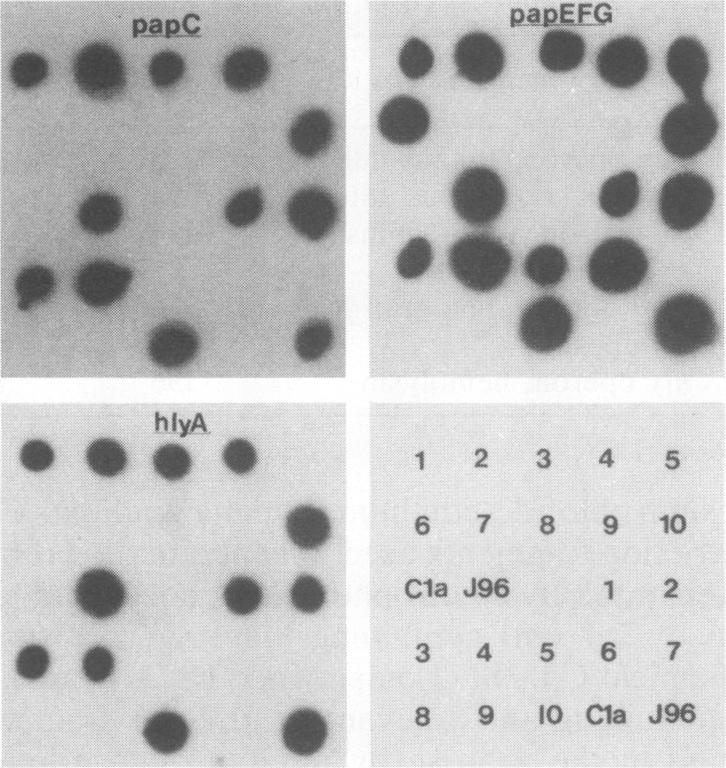
The pap, prs, pil, and hly operons of the pyelonephritic Escherichia coli isolate J96 code for the expression of P, F, and type 1 adhesins and the production of hemolysin, respectively; the afaI operon of the pyelonephritic E. coli KS52 encodes an X adhesin. Using different segments of these operons as probes, colony hybridizations were performed on 97 E. coli urinary tract and 40 fecal clinical isolates to determine (i) the presence in the infecting bacteria of nucleotide sequences related to virulence operons, and (ii) the phenotypic properties associated with such sequences. Coexpression of P and F adhesins encoded by pap-related sequences was detected more frequently among isolates from patients with pyelonephritis (32 of 49, 65%) than among those with cystitis (11 of 48, 23%; P less than 0.0001) or from fecal specimens (6 of 40, 15%; P less than 0.0001). Therefore, the expression of both adhesins appears to be critical in the colonization of the upper urinary tract. In contrast, afaI-related sequences were detected significantly more frequently among isolates from patients with cystitis, suggesting that this class of X adhesin may have a role in lower urinary tract infections. Urinary tract isolates differed from fecal isolates by a low incidence of type 1 adhesin expression among pil probe-positive isolates. hly-related sequences were only detected in pap probe-positive isolates. The frequency of hemolysin production among pap probe-positive isolates was not associated with a particular pattern of infection. The distribution of these virulence factors was similar in the presence or absence of reflux, indicating that structural abnormalities of the urinary tract did not facilitate colonization by adhesin-negative isolates.
肾盂肾炎大肠杆菌分离株J96的pap、prs、pil和hly操纵子分别编码P、F和1型黏附素的表达以及溶血素的产生;肾盂肾炎大肠杆菌KS52的afaI操纵子编码一种X黏附素。使用这些操纵子的不同片段作为探针,对97株大肠杆菌尿路感染临床分离株和40株粪便临床分离株进行菌落杂交,以确定:(i)感染细菌中与毒力操纵子相关的核苷酸序列的存在情况,以及(ii)与此类序列相关的表型特性。在肾盂肾炎患者的分离株中(49株中有32株,65%),由pap相关序列编码的P和F黏附素的共表达比膀胱炎患者的分离株(48株中有11株,23%;P<0.0001)或粪便标本的分离株(40株中有6株,15%;P<0.0001)中更频繁地被检测到。因此,两种黏附素的表达似乎对上尿路的定植至关重要。相比之下,在膀胱炎患者的分离株中,afaI相关序列被检测到的频率明显更高,这表明这类X黏附素可能在下尿路感染中起作用。尿路感染分离株与粪便分离株的不同之处在于,pil探针阳性分离株中1型黏附素表达的发生率较低。hly相关序列仅在pap探针阳性分离株中被检测到。pap探针阳性分离株中溶血素产生的频率与特定的感染模式无关。在有或无反流的情况下,这些毒力因子的分布相似,这表明尿路的结构异常并没有促进黏附素阴性分离株的定植。