
延迟性肌肉酸痛:一项评估镇痛研究设计特征的初步研究。
Delayed-onset muscle soreness: a pilot study to assess analgesic study design features.
作者信息
Singla Neil, Desjardins Paul J, Cosca Evelyn B, Parulan Cherri, Arriaga Anne, Poole Kelly C, Batz Dan M, Chang Phoebe D
机构信息
Department of Anesthesia, Lotus Clinical Research, Huntington Hospital, Pasadena, CA, USA, Department of Diagnostic Sciences, Rutgers School of Dental Medicine, Newark, NJ, USA.
出版信息
Pain. 2015 Jun;156(6):1036-1045. doi: 10.1097/j.pain.0000000000000109.
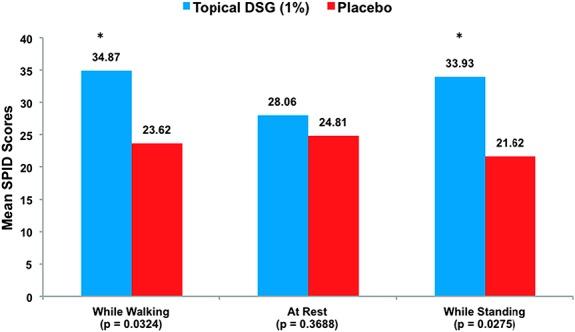
Based on a thorough review of the available literature in the delayed-onset muscle soreness (DOMS) model, we identified multiple study design characteristics that are considered to be normative in acute pain research but have not been followed in a majority of published DOMS experiments. We designed an analgesic investigation using the DOMS model that both complied with current scientifically accepted standards for the conduct of analgesic studies and demonstrated reasonable assay sensitivity. This randomized, double-blind, placebo-controlled within-subject study compared the efficacy of topical diclofenac sodium 1% with a matching placebo in reducing pain associated with DOMS. After exercise, subjects reporting DOMS received topical diclofenac sodium gel 1% (DSG 1%) applied to one leg and placebo to the other every 6 hours for 48 hours. Pain intensity was assessed at rest, upon standing, and when walking in the 48 hours after initial drug application (T0). The primary end point was the reduction in pain intensity (SPID 24) on walking. Subjects receiving DSG 1% had less pain while walking compared with those receiving placebo at 24 hours (SPID 24 = 34.9 [22.9] and 23.6 [19.4], respectively; P = 0.032). This investigation used experimental techniques that have been vetted in the field of exercise physiology and superimposed techniques that are considered to be best practice in the field of analgesic research. Over time and with the help of colleagues in both fields of study, similar investigations will validate design features that impact the assay sensitivity of analgesic end points in DOMS models. In addition, the study confirmed the analgesic efficacy of topical DSG 1% over placebo in subjects experiencing DOMS.
基于对延迟性肌肉酸痛(DOMS)模型现有文献的全面回顾,我们确定了多个研究设计特征,这些特征在急性疼痛研究中被认为是规范的,但在大多数已发表的DOMS实验中并未遵循。我们使用DOMS模型设计了一项镇痛研究,该研究既符合当前科学上公认的镇痛研究标准,又显示出合理的检测灵敏度。这项随机、双盲、安慰剂对照的受试者内研究比较了1%双氯芬酸钠局部用药与匹配安慰剂在减轻与DOMS相关疼痛方面的疗效。运动后,报告有DOMS的受试者每6小时在一条腿上涂抹1%双氯芬酸钠凝胶(DSG 1%),另一条腿涂抹安慰剂,持续48小时。在初次用药后48小时(T0),于静息、站立和行走时评估疼痛强度。主要终点是行走时疼痛强度的降低(SPID 24)。与接受安慰剂的受试者相比,接受DSG 1%的受试者在24小时行走时疼痛较轻(SPID 24分别为34.9 [22.9]和23.6 [19.4];P = 0.032)。本研究采用了运动生理学领域已审核的实验技术以及镇痛研究领域被认为是最佳实践的叠加技术。随着时间的推移,并在两个研究领域同事的帮助下,类似的研究将验证影响DOMS模型中镇痛终点检测灵敏度的设计特征。此外,该研究证实了局部使用DSG 1%在患有DOMS的受试者中比安慰剂具有镇痛效果。

 Zotero 插件