1] Frontier Institute of Science and Technology, Xi'an Jiaotong University, Xi'an710054, China [2] Department of Materials Science and Engineering, University of Utah, Salt Lake City, UT84112, USA.
Department of Materials Science and Engineering, University of Utah, Salt Lake City, UT84112, USA.
Sci Rep. 2015 Feb 3;5:8212. doi: 10.1038/srep08212.
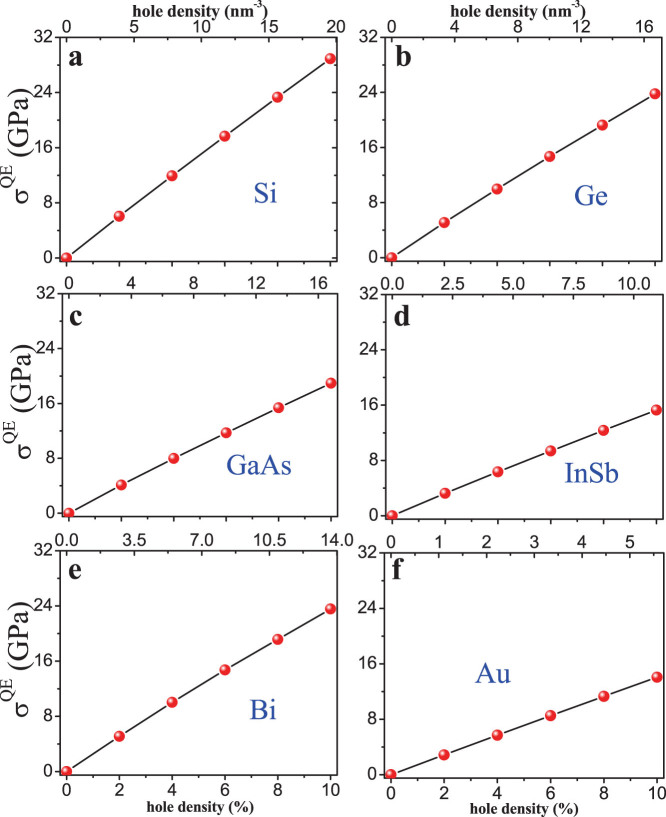
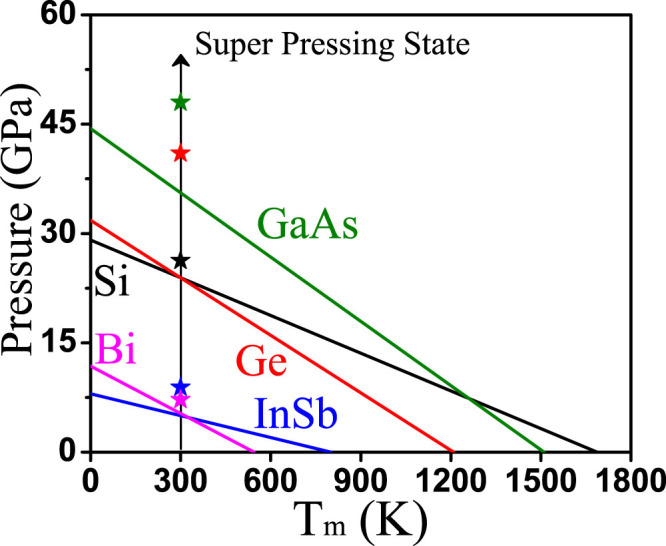
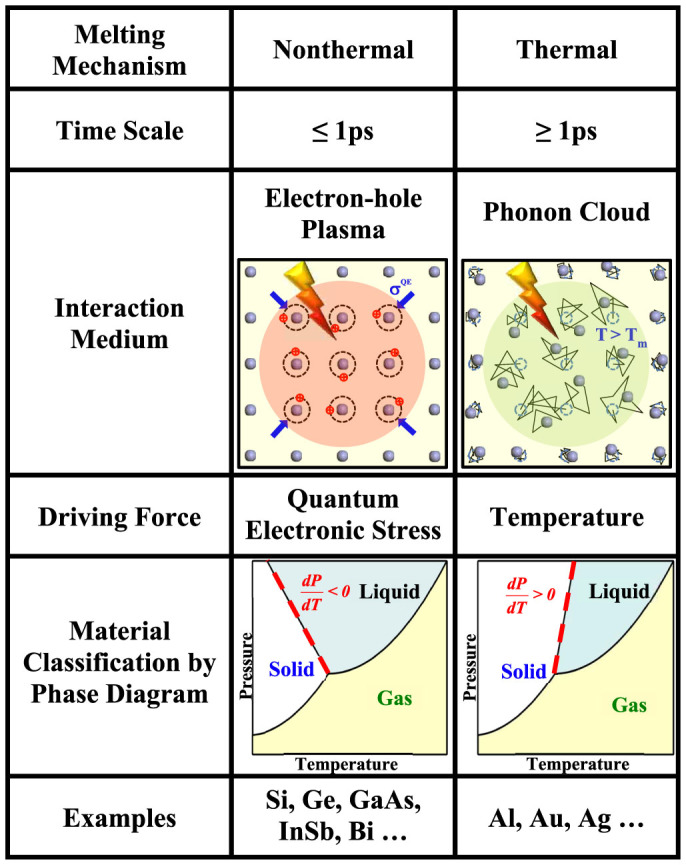
Ultrafast crystal-to-liquid phase transition induced by femtosecond pulse laser excitation is an interesting material's behavior manifesting the complexity of light-matter interaction. There exist two types of such phase transitions: one occurs at a time scale shorter than a picosecond via a nonthermal process mediated by electron-hole plasma formation; the other at a longer time scale via a thermal melting process mediated by electron-phonon interaction. However, it remains unclear what material would undergo which process and why? Here, by exploiting the property of quantum electronic stress (QES) governed by quantum Hooke's law, we classify the transitions by two distinct classes of materials: the faster nonthermal process can only occur in materials like ice having an anomalous phase diagram characterized with dTm/dP < 0, where Tm is the melting temperature and P is pressure, above a high threshold laser fluence; while the slower thermal process may occur in all materials. Especially, the nonthermal transition is shown to be induced by the QES, acting like a negative internal pressure, which drives the crystal into a "super pressing" state to spontaneously transform into a higher-density liquid phase. Our findings significantly advance fundamental understanding of ultrafast crystal-to-liquid phase transitions, enabling quantitative a priori predictions.
飞秒脉冲激光激发诱导的超快晶体-液相相变是一种有趣的材料行为,体现了光与物质相互作用的复杂性。存在两种类型的这种相变:一种是通过电子空穴等离子体形成介导的非热过程在皮秒时间尺度以下发生;另一种是通过电子-声子相互作用介导的热熔融过程在较长时间尺度上发生。然而,目前尚不清楚哪种材料会经历哪种过程以及为什么?在这里,通过利用量子胡克定律(quantum Hooke's law)控制的量子电子应力(quantum electronic stress,QES)特性,我们根据两种不同类型的材料对相变进行分类:更快的非热过程只能在具有异常相图的材料中发生,该相图的特征是 dTm/dP < 0,其中 Tm 是熔点,P 是压力,超过高阈值激光通量;而较慢的热过程可能发生在所有材料中。特别是,非热跃迁被证明是由 QES 诱导的,它的作用类似于负内压,将晶体推向“超级压缩”状态,自发转化为更高密度的液相。我们的发现极大地促进了对超快晶体-液相相变的基本理解,实现了定量的先验预测。