Hoven H, Wahrendorf M, Siegrist J
Faculty of Medicine, Senior Professorship on Work Stress Research, University of Duesseldorf, Duesseldorf, Germany Centre for Health and Society, Institute for Medical Sociology, University of Duesseldorf, Duesseldorf, Germany.
Centre for Health and Society, Institute for Medical Sociology, University of Duesseldorf, Duesseldorf, Germany.
J Epidemiol Community Health. 2015 May;69(5):447-52. doi: 10.1136/jech-2014-205206. Epub 2015 Feb 3.
Several studies tested whether stressful work mediates the association between socioeconomic position (SEP) and health. Although providing moderate support, evidence is still inconclusive, partly due to a lack of theory-based measures of SEP and work stress, and because of methodological limitations. This contribution aims at overcoming these limitations.
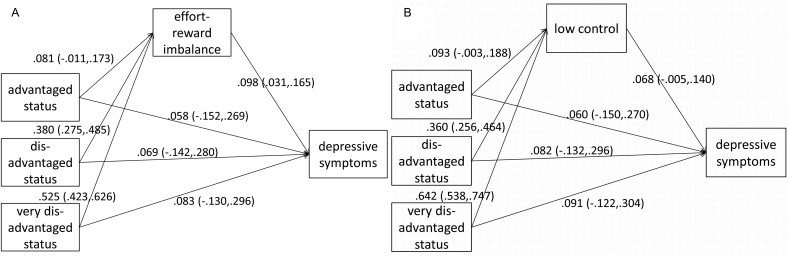
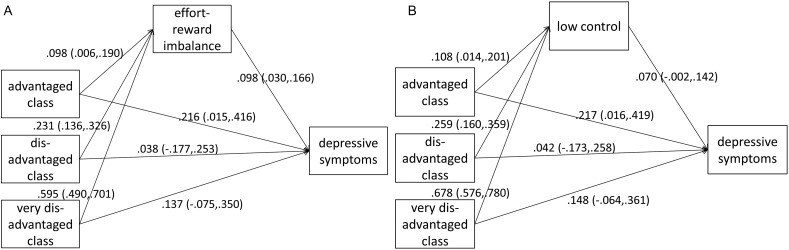
We conduct pathway analysis and investigate indirect effects of SEP on mental health via stressful work. Data are derived from the first two waves of the 'Survey of Health, Ageing and Retirement in Europe' (SHARE) with information from employed men and women aged 50-64 across 11 European countries (N=2798). SEP is measured according to two alternative measures of occupational position: occupational class (focus on employment relations) and occupational status (focus on prestige). We assess work stress according to the effort-reward imbalance and the demand-control model (wave 1), and we use newly occurring depressive symptoms as health outcome (wave 2).
Effort-reward imbalance and, less consistently, low control mediate the effect of occupational class and occupational status on depressive symptoms.
Our findings point to two important aspects of work stress (effort-reward imbalance and low control) in explaining socioeconomic differences in health. Further, we illustrate the significance of two alternative dimensions of occupational position, occupational class and occupational status.
多项研究检验了工作压力是否介导社会经济地位(SEP)与健康之间的关联。尽管有一定支持证据,但结果仍不明确,部分原因是缺乏基于理论的社会经济地位和工作压力测量方法,以及方法上的局限性。本研究旨在克服这些局限性。
我们进行路径分析,研究社会经济地位通过工作压力对心理健康的间接影响。数据来自“欧洲健康、老龄化与退休调查”(SHARE)的前两波调查,涉及11个欧洲国家50至64岁的在职男女(N = 2798)。社会经济地位根据两种职业地位替代测量方法进行衡量:职业阶层(关注雇佣关系)和职业地位(关注声望)。我们根据付出回报失衡和需求控制模型评估工作压力(第一波),并将新出现的抑郁症状作为健康结果(第二波)。
付出回报失衡以及不太一致的低控制感介导了职业阶层和职业地位对抑郁症状的影响。
我们的研究结果指出了工作压力的两个重要方面(付出回报失衡和低控制感)在解释健康方面的社会经济差异中的作用。此外,我们阐明了职业地位的两个替代维度,即职业阶层和职业地位的重要性。