Adrion Emily R, Aucott John, Lemke Klaus W, Weiner Jonathan P
Department of Health Policy and Management, Johns Hopkins Bloomberg School of Public Health, Baltimore, Maryland, United States of America.
Johns Hopkins University School of Medicine, Division of Rheumatology, Johns Hopkins at Greenspring Station, 10755 Falls Road, Suite 200, Lutherville, Maryland, 21093, United States of America.
PLoS One. 2015 Feb 4;10(2):e0116767. doi: 10.1371/journal.pone.0116767. eCollection 2015.
Lyme disease is the most frequently reported vector borne infection in the United States. The Centers for Disease Control have estimated that approximately 10% to 20% of individuals may experience Post-Treatment Lyme Disease Syndrome - a set of symptoms including fatigue, musculoskeletal pain, and neurocognitive complaints that persist after initial antibiotic treatment of Lyme disease. Little is known about the impact of Lyme disease or post-treatment Lyme disease symptoms (PTLDS) on health care costs and utilization in the United States.
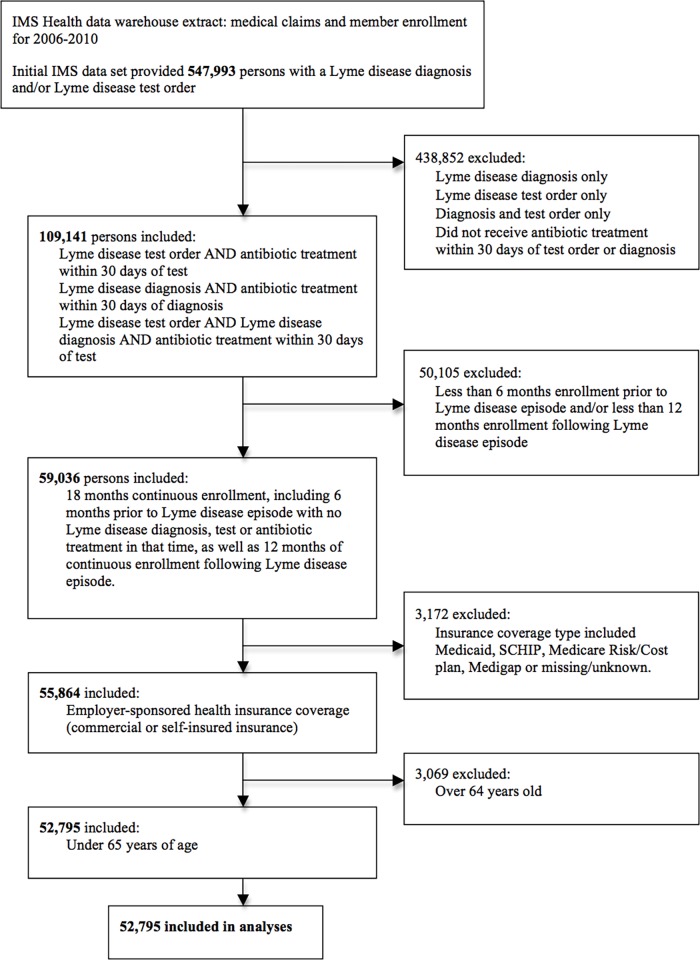
This study utilizes retrospective data on medical claims and member enrollment for persons aged 0-64 years who were enrolled in commercial health insurance plans in the United States between 2006-2010. 52,795 individuals treated for Lyme disease were compared to 263,975 matched controls with no evidence of Lyme disease exposure.
Lyme disease is associated with $2,968 higher total health care costs (95% CI: 2,807-3,128, p<.001) and 87% more outpatient visits (95% CI: 86%-89%, p<.001) over a 12-month period, and is associated with 4.77 times greater odds of having any PTLDS-related diagnosis, as compared to controls (95% CI: 4.67-4.87, p<.001). Among those with Lyme disease, having one or more PTLDS-related diagnosis is associated with $3,798 higher total health care costs (95% CI: 3,542-4,055, p<.001) and 66% more outpatient visits (95% CI: 64%-69%, p<.001) over a 12-month period, relative to those with no PTLDS-related diagnoses.
Lyme disease is associated with increased costs above what would be expected for an easy to treat infection. The presence of PTLDS-related diagnoses after treatment is associated with significant health care costs and utilization.
莱姆病是美国报告最多的媒介传播感染疾病。美国疾病控制中心估计,约10%至20%的患者可能会出现莱姆病治疗后综合征,即一组症状,包括疲劳、肌肉骨骼疼痛以及在莱姆病初始抗生素治疗后仍持续存在的神经认知症状。在美国,关于莱姆病或莱姆病治疗后症状(PTLDS)对医疗保健成本和利用率的影响知之甚少。
1)研究莱姆病对医疗保健成本和利用率的影响;2)了解莱姆病与发生PTLDS可能性之间的关系;3)了解PTLDS如何影响医疗保健成本和利用率。
本研究利用了2006年至2010年期间参加美国商业健康保险计划的0至64岁人群的医疗理赔和参保登记的回顾性数据。将52795例接受莱姆病治疗的个体与263975例无莱姆病暴露证据的匹配对照进行比较。
与对照组相比,莱姆病在12个月期间使总医疗保健成本增加2968美元(95%置信区间:2807 - 3128美元,p <.001),门诊就诊次数增加87%(95%置信区间:86% - 89%,p <.001),且出现任何与PTLDS相关诊断的几率高4.77倍(95%置信区间:4.67 - 4.87,p <.001)。在患有莱姆病的人群中,与无PTLDS相关诊断的人群相比,并出现一项或多项与PTLDS相关诊断的人群在12个月期间总医疗保健成本增加3798美元(95%置信区间:3542 - 4055美元,p <.001),门诊就诊次数增加66%(95%置信区间:64% - 69%)。
莱姆病导致的成本增加高于易于治疗的感染所预期的成本。治疗后出现与PTLDS相关的诊断与显著的医疗保健成本和利用率相关。