Sancho Aintzane, Carrera Sergio, Arietaleanizbeascoa Marisol, Arce Veronica, Gallastegui Nere Mendizabal, Giné March Anna, Sanz-Guinea Aitor, Eskisabel Araceli, Rodriguez Ana Lopez, Martín Rosa A, Lopez-Vivanco Guillermo, Grandes Gonzalo
Department of Oncology, Cruces University Hospital, Basque Health Service (Osakidetza), Barakaldo, Bizkaia, Spain.
Primary Care Research Unit of Bizkaia, Basque Health Service (Osakidetza), Bilbao, Bizkaia, Spain.
BMC Cancer. 2015 Feb 6;15:40. doi: 10.1186/s12885-015-1055-x.
The optimal form of exercise for individuals with cancer has yet to be identified, but there is evidence that exercise improves their quality of life. The aim of this study is to assess the efficacy and efficiency of an innovative physical exercise programme, for individuals undergoing chemotherapy for breast, gastrointestinal or non-small cell lung tumours, for improving quality of life, reducing level of fatigue, and enhancing functional capacity over time.
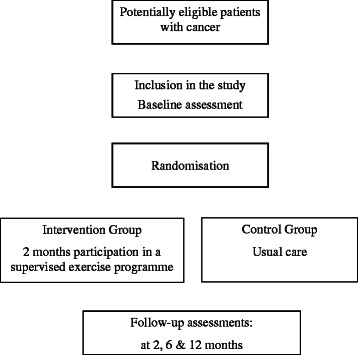
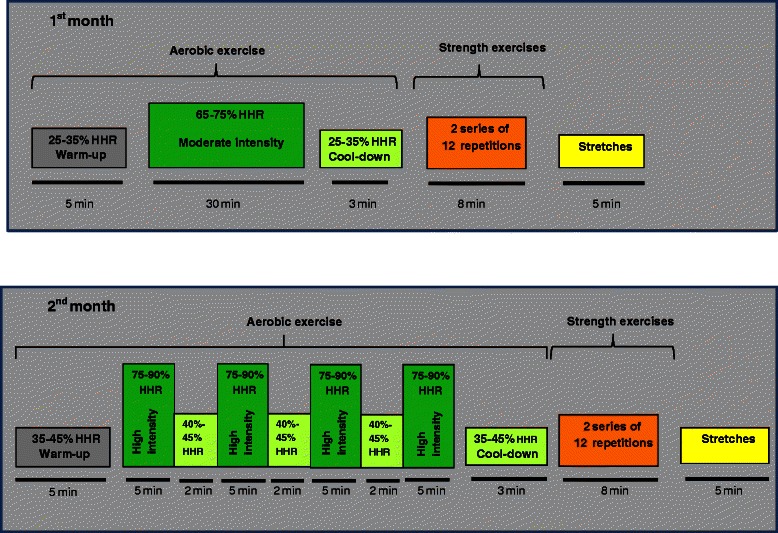
DESIGN/METHODS: We will conduct a clinical trial in 66 patients with stage IV breast, gastrointestinal or non-small cell lung cancer, recruited by the Department of Oncology of the referral hospital from 4 primary care health centres of the Basque Health Service (Osakidetza). These patients will be randomised to one of two groups. The treatment common to both groups will be the usual care for cancer: optimized usual drug therapies and strengthening of self-care; in addition, patients in the intervention group will participate in a 2-month exercise programme, including both aerobic and strength exercises, supervised by nurses in their health centre. The principal outcome variable is health-related quality of life, measured blindly with the 30-item European Organization for the Research and Treatment of Cancer Core Quality of Life Questionnaire and Short Form-36 four times: at baseline, and 2, 6 and 12 months later. The secondary outcome variables are fatigue (Functional Assessment of Chronic Illness Therapy-Fatigue questionnaire), functional capacity (6-Minute Walk Test and cardiorespiratory test), muscle strength (hand-held dynamometry and sit-to-stand test), radiological response to treatment (Response Evaluation Criteria In Solid Tumors) and progression-free and overall survival. Age, sex, diagnosis, chemotherapy regimen, Eastern Cooperative Oncology Group performance status and smoking status will be considered as predictive variables. Data will be analysed on an intention-to-treat basis, comparing changes at each time point between groups, adjusting for baseline values by analysis of covariance.
As well as achieving the objectives set, this study will provide us with information on patient perception of the care received and an opportunity to develop a project based on collaborative action between the primary care and oncology professionals.
ClinicalTrials.gov Identifier: NCT01786122 Registration date: 02/05/2013.
针对癌症患者的最佳运动形式尚未确定,但有证据表明运动可改善他们的生活质量。本研究的目的是评估一项创新体育锻炼计划对接受乳腺癌、胃肠道癌或非小细胞肺癌化疗的患者在改善生活质量、降低疲劳程度以及随着时间推移增强功能能力方面的疗效和效率。
设计/方法:我们将对66例IV期乳腺癌、胃肠道癌或非小细胞肺癌患者进行一项临床试验,这些患者由转诊医院的肿瘤科从巴斯克卫生服务机构(Osakidetza)的4个初级保健健康中心招募。这些患者将被随机分为两组。两组的共同治疗措施将是癌症的常规护理:优化常规药物治疗并加强自我护理;此外,干预组的患者将参加一个为期2个月的锻炼计划,包括有氧运动和力量训练,由其健康中心的护士进行监督。主要结局变量是与健康相关的生活质量,使用30项欧洲癌症研究与治疗组织核心生活质量问卷和简短健康调查问卷-36进行盲法测量,共测量4次:在基线时,以及之后的2、6和12个月。次要结局变量包括疲劳(慢性病治疗功能评估-疲劳问卷)、功能能力(6分钟步行试验和心肺试验)、肌肉力量(握力计和坐立试验)、对治疗的放射学反应(实体瘤疗效评价标准)以及无进展生存期和总生存期。年龄、性别、诊断、化疗方案、东部肿瘤协作组体能状态和吸烟状况将被视为预测变量。数据将按照意向性分析原则进行分析,比较两组在每个时间点的变化,并通过协方差分析对基线值进行调整。
除了实现既定目标外,本研究还将为我们提供有关患者对所接受护理的看法的信息,以及一个基于初级保健和肿瘤学专业人员之间合作行动开展项目的机会。
ClinicalTrials.gov标识符:NCT01786122 注册日期:2013年5月2日。