Lerner Henrik, Berg Charlotte
Department of Health Care Sciences, Ersta Sköndal University College, Stockholm, Sweden;
Department of Animal Environment and Health, Swedish University of Agricultural Sciences, Skara, Sweden.
Infect Ecol Epidemiol. 2015 Feb 6;5:25300. doi: 10.3402/iee.v5.25300. eCollection 2015.
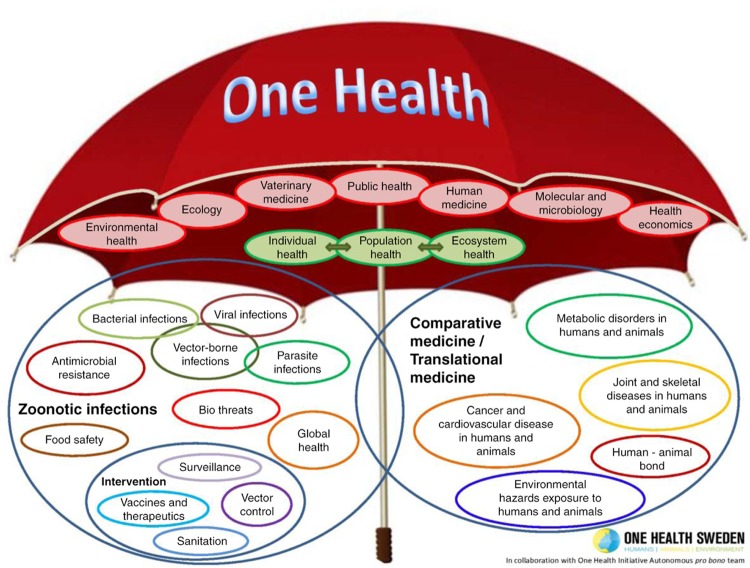
From a strict biological point of view, humans are just one species among other species, albeit one with very special capacities, characteristics, and skills. Among scientists, it is generally acknowledged that we share many features with other animal species, which are certainly relevant when the concepts of health and disease are discussed. The term 'One Health' is used in many different contexts and by people with varying backgrounds. However, there appears to be some confusion as to what the term really means, and it is used in a wide range of contexts, often including or bordering concepts such as infection biology, contagious diseases, zoonotic infections, evolutionary medicine, comparative medicine, and translational medicine. Without claiming to present the one and only true interpretation, we will argue for a wide approach using the 'umbrella' depiction developed by One Health Sweden. We argue that this one should, compared to other demarcations, be more useful to science. We will also analyze the concept of health on different levels: individual, population, and ecosystem health, and describe how these levels inherently influence each other for both humans and animals. Both these choices are normative and have practical consequences for research and education, a way of reasoning which we develop further in this paper. Finally, we conclude that the choice of term for the approach might be normative in deciding which disciplines or parts of disciplines that may be included.
从严格的生物学角度来看,人类只是众多物种中的一种,尽管是具有非常特殊能力、特征和技能的一种。在科学家当中,人们普遍承认我们与其他动物物种有许多共同特征,在讨论健康和疾病概念时,这些特征肯定是相关的。“同一健康”(One Health)这个术语在许多不同背景下被不同背景的人使用。然而,对于这个术语的真正含义似乎存在一些混淆,它被用于广泛的背景中,常常包括或接近诸如感染生物学、传染病、人畜共患感染、进化医学、比较医学和转化医学等概念。在不宣称给出唯一正确解释的情况下,我们将支持采用瑞典同一健康组织提出的“伞形”描述的宽泛方法。我们认为,与其他划分相比,这种方法对科学更有用。我们还将在个体、群体和生态系统健康等不同层面分析健康概念,并描述这些层面如何对人类和动物相互产生内在影响。这两种选择都是规范性的,对研究和教育都有实际影响,我们将在本文中进一步阐述这种推理方式。最后,我们得出结论,该方法术语的选择在决定哪些学科或学科的哪些部分可能被纳入方面可能具有规范性。