Tsukamoto Masaya, Akutsu Hidenori
Center for Regenerative Medicine, National Center for Child Health and Development, 2-10-1 Okura, Setagaya, Tokyo 157-8535, Japan.
Department of Advanced Pathobiology, Graduate School of Veterinary Science, Osaka Metropolitan University, Izumisano, Osaka 598-8531, Japan.
Regen Ther. 2025 Jan 8;28:314-320. doi: 10.1016/j.reth.2024.12.013. eCollection 2025 Mar.
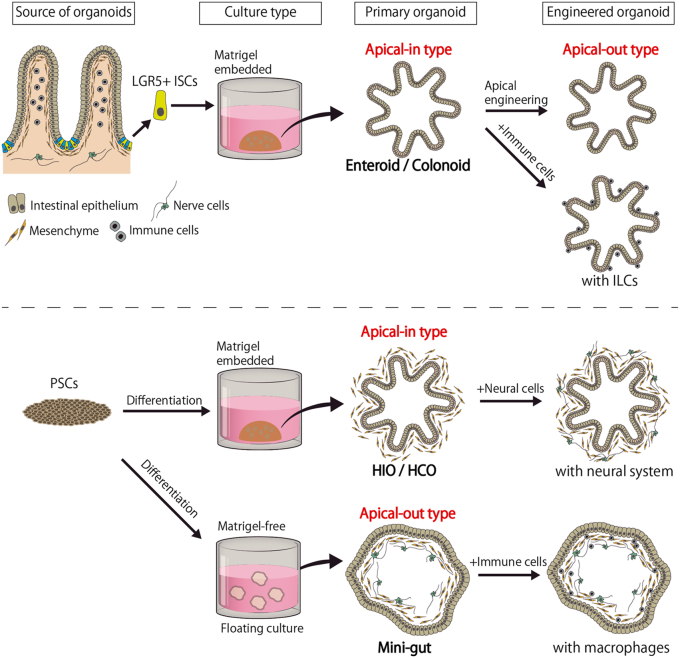
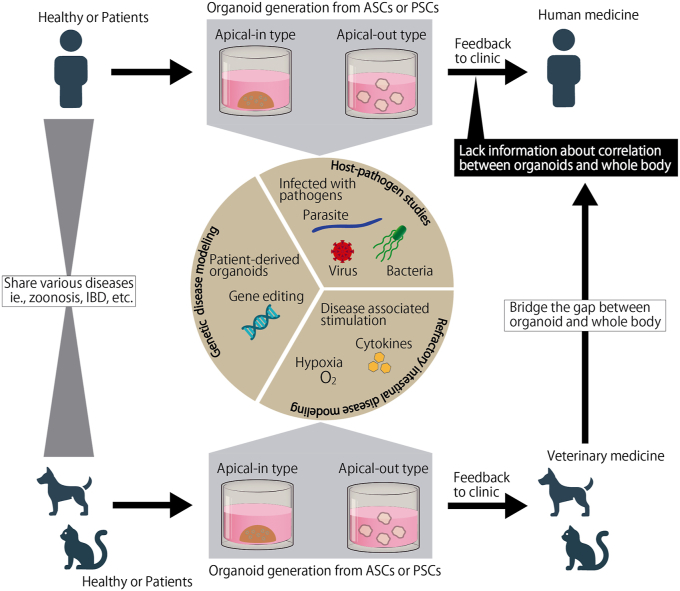
Gastrointestinal (GI) health underpins systemic well-being, yet the complexity of gut physiology poses significant challenges to understanding disease mechanisms and developing effective, personalized therapies. Traditional models often fail to capture the intricate interplay between epithelial, mesenchymal, immune, and neuronal cells that govern gut homeostasis and disease. Over the past five years, advances in organoid technology have created physiologically relevant, three-dimensional GI models that replicate native tissue architecture and function. These models have revolutionized the study of autoimmune disorders, homeostatic dysfunction, and pathogen infections, such as norovirus and , which affect millions of humans and animals globally. In this review, we explore how organoids, derived from intestinal and pluripotent stem cells, are transforming our understanding of GI development, disease etiology, and therapeutic innovation. Through the "Zoobiquity" paradigm and "One Health" framework, we highlight the integration of companion animal organoids, which provide invaluable insights into shared disease mechanisms and preclinical therapeutic development. Despite their promise, challenges remain in achieving organoid maturation, expanding immune and neuronal integration, and bridging the gap between organoid responses and outcomes. By refining these cutting-edge platforms, we can advance human and veterinary medicine alike, fostering a holistic approach to health and disease.
胃肠道(GI)健康是全身健康的基础,然而肠道生理学的复杂性给理解疾病机制以及开发有效、个性化治疗方法带来了重大挑战。传统模型往往无法捕捉到上皮细胞、间充质细胞、免疫细胞和神经元细胞之间复杂的相互作用,而这些细胞共同维持着肠道内环境稳定并影响疾病发生。在过去五年中,类器官技术的进步创造出了与生理相关的三维胃肠道模型,这些模型能够复制天然组织结构和功能。这些模型彻底改变了自身免疫性疾病、内环境稳态功能障碍以及病原体感染(如诺如病毒感染)等方面的研究,诺如病毒感染在全球影响着数百万人类和动物。在本综述中,我们探讨了源自肠道干细胞和多能干细胞的类器官如何正在改变我们对胃肠道发育、疾病病因以及治疗创新的理解。通过“动物共患病”范式和“同一健康”框架,我们强调了伴侣动物类器官的整合,其为共享疾病机制和临床前治疗开发提供了宝贵见解。尽管类器官前景广阔,但在实现类器官成熟、扩大免疫和神经元整合以及弥合类器官反应与实际结果之间的差距方面仍存在挑战。通过完善这些前沿平台,我们可以推动人类医学和兽医学的发展,促进对健康和疾病采取整体方法。