Zeldin Oliver B, Brewster Aaron S, Hattne Johan, Uervirojnangkoorn Monarin, Lyubimov Artem Y, Zhou Qiangjun, Zhao Minglei, Weis William I, Sauter Nicholas K, Brunger Axel T
Department of Molecular and Cellular Physiology, Stanford University, USA.
Physical Biosciences Division, Lawrence Berkeley National Laboratory, Berkeley, CA 94720, USA.
Acta Crystallogr D Biol Crystallogr. 2015 Feb;71(Pt 2):352-6. doi: 10.1107/S1399004714025875. Epub 2015 Jan 23.
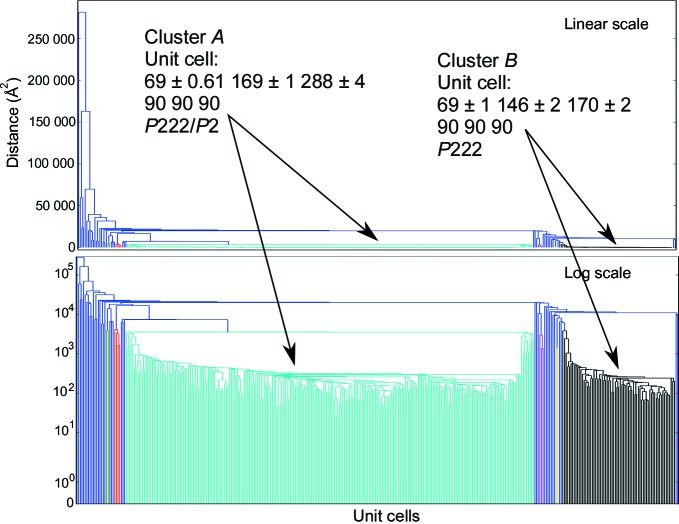
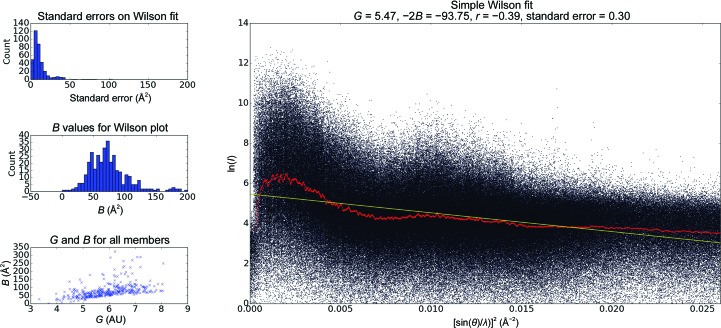
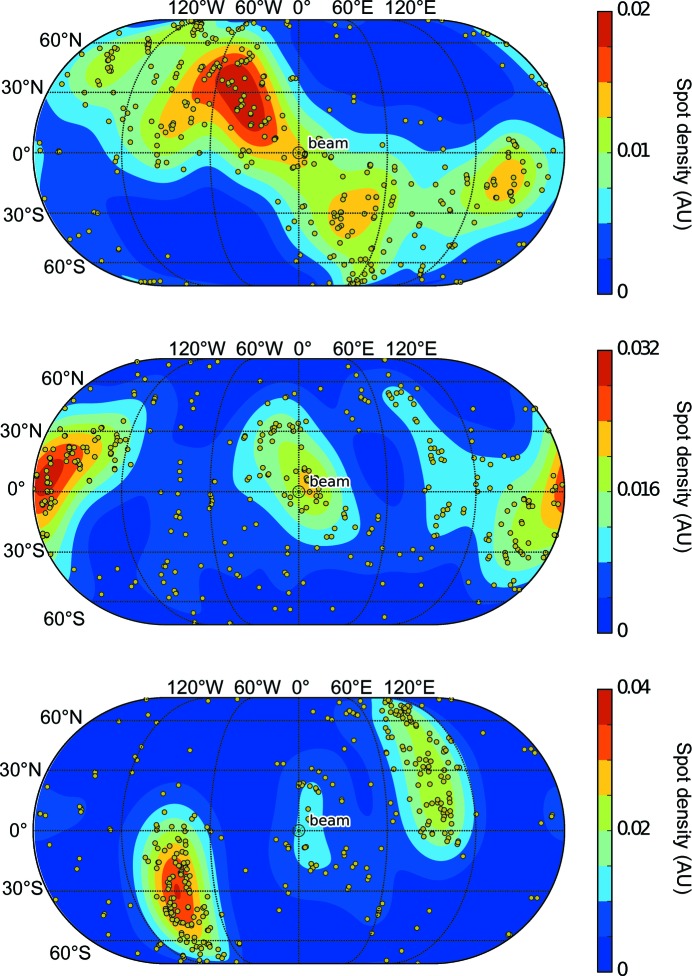
Ultrafast diffraction at X-ray free-electron lasers (XFELs) has the potential to yield new insights into important biological systems that produce radiation-sensitive crystals. An unavoidable feature of the `diffraction before destruction' nature of these experiments is that images are obtained from many distinct crystals and/or different regions of the same crystal. Combined with other sources of XFEL shot-to-shot variation, this introduces significant heterogeneity into the diffraction data, complicating processing and interpretation. To enable researchers to get the most from their collected data, a toolkit is presented that provides insights into the quality of, and the variation present in, serial crystallography data sets. These tools operate on the unmerged, partial intensity integration results from many individual crystals, and can be used on two levels: firstly to guide the experimental strategy during data collection, and secondly to help users make informed choices during data processing.
X射线自由电子激光(XFEL)的超快衍射有潜力为产生辐射敏感晶体的重要生物系统带来新的见解。这些实验“破坏前衍射”性质的一个不可避免的特点是,图像是从许多不同的晶体和/或同一晶体的不同区域获得的。再加上XFEL逐次脉冲变化的其他来源,这给衍射数据引入了显著的异质性,使处理和解释变得复杂。为了使研究人员能够从他们收集的数据中获得最大收益,本文介绍了一个工具包,该工具包可深入了解串行晶体学数据集的质量和其中存在的变化。这些工具基于许多单个晶体未合并的部分强度积分结果运行,可在两个层面上使用:首先在数据收集期间指导实验策略,其次帮助用户在数据处理期间做出明智的选择。