Oumeraci Tonio, Jensen Vanessa, Talbot Steven R, Hofmann Winfried, Kostrzewa Markus, Schlegelberger Brigitte, von Neuhoff Nils, Häussler Susanne
Institute of Cell and Molecular Pathology, Hannover Medical School (MHH), Hannover, Germany.
Department of Molecular Bacteriology, Helmholtz Center for Infection Research, Braunschweig, Germany; Institute of Molecular Bacteriology, Twincore, Center for Experimental and Clinical Infection Research, A joint venture of the Helmholtz Center for Infection Research Braunschweig and the MHH, Hannover, Germany.
PLoS One. 2015 Feb 9;10(2):e0117144. doi: 10.1371/journal.pone.0117144. eCollection 2015.
Pseudomonas aeruginosa is a gram-negative bacterium that is ubiquitously present in the aerobic biosphere. As an antibiotic-resistant facultative pathogen, it is a major cause of hospital-acquired infections. Its rapid and accurate identification is crucial in clinical and therapeutic environments.
In a large-scale MALDI-TOF mass spectrometry-based screen of the Harvard transposon insertion mutant library of P. aeruginosa strain PA14, intact-cell proteome profile spectra of 5547 PA14 transposon mutants exhibiting a plethora of different phenotypes were acquired and analyzed.
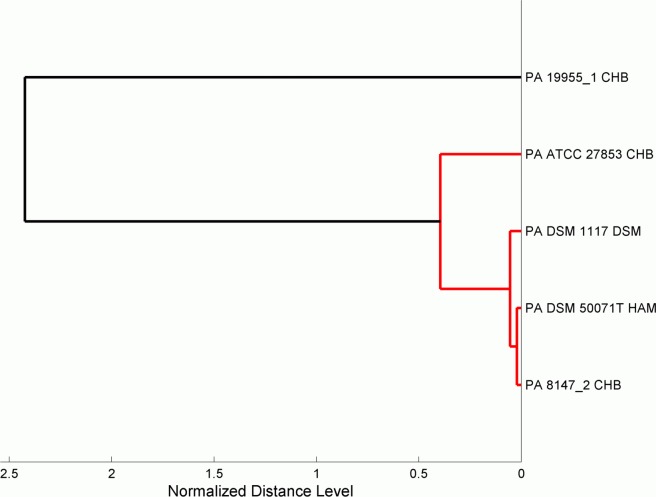
Of all P. aeruginosa PA14 mutant profiles 99.7% were correctly identified as P. aeruginosa with the Biotyper software on the species level. On the strain level, 99.99% of the profiles were mapped to five different individual P. aeruginosa Biotyper database entries. A principal component analysis-based approach was used to determine the most important discriminatory mass features between these Biotyper groups. Although technical replicas were consistently categorized to specific Biotyper groups in 94.2% of the mutant profiles, biological replicas were not, indicating that the distinct proteotypes are affected by growth conditions.
The PA14 mutant profile collection presented here constitutes the largest coherent P. aeruginosa MALDI-TOF spectral dataset publicly available today. Transposon insertions in thousands of different P. aeruginosa genes did not affect species identification from MALDI-TOF mass spectra, clearly demonstrating the robustness of the approach. However, the assignment of the individual spectra to sub-groups proved to be non-consistent in biological replicas, indicating that the differentiation between biotyper groups in this nosocomial pathogen is unassured.
铜绿假单胞菌是一种革兰氏阴性菌,广泛存在于需氧生物圈中。作为一种具有抗生素抗性的兼性病原体,它是医院获得性感染的主要原因。其快速准确的鉴定在临床和治疗环境中至关重要。
在基于基质辅助激光解吸电离飞行时间质谱(MALDI-TOF)的对铜绿假单胞菌PA14菌株的哈佛转座子插入突变体文库的大规模筛选中,获取并分析了5547个表现出大量不同表型的PA14转座子突变体的完整细胞蛋白质组图谱光谱。
在所有铜绿假单胞菌PA14突变体图谱中,99.7%在物种水平上通过Biotyper软件被正确鉴定为铜绿假单胞菌。在菌株水平上,99.99%的图谱被映射到五个不同的铜绿假单胞菌Biotyper数据库条目中。采用基于主成分分析的方法来确定这些Biotyper组之间最重要的鉴别质量特征。尽管技术重复在94.2%的突变体图谱中始终被归类到特定的Biotyper组,但生物重复并非如此,这表明不同的蛋白质型受生长条件影响。
本文展示的PA14突变体图谱集是目前公开可用的最大的连贯铜绿假单胞菌MALDI-TOF光谱数据集。数千个不同铜绿假单胞菌基因中的转座子插入并不影响从MALDI-TOF质谱中进行物种鉴定,清楚地证明了该方法的稳健性。然而,在生物重复中,将各个光谱分配到亚组的结果并不一致,这表明在这种医院病原体中,Biotyper组之间的区分并不确定。