Lau Susanna K P, Lam Clare S K, Ngan Antonio H Y, Chow Wang-Ngai, Wu Alan K L, Tsang Dominic N C, Tse Cindy W S, Que Tak-Lun, Tang Bone S F, Woo Patrick C Y
State Key Laboratory of Emerging Infectious Diseases, The University of Hong Kong, Hong Kong, China.
Research Centre of Infection and Immunology, The University of Hong Kong, University Pathology Building, Queen Mary Hospital, Hong Kong, China.
BMC Microbiol. 2016 Mar 10;16:36. doi: 10.1186/s12866-016-0656-0.
Penicillium marneffei is the most important thermal dimorphic fungus causing systemic mycosis in HIV-infected and other immunocompromised patients in Southeast Asia. However, laboratory diagnosis of penicilliosis, which relies on microscopic morphology and mycelial-to-yeast conversion, is time-consuming and expertise-dependent, thus delaying diagnosis and treatment. Although matrix -assisted laser desorption ionization time-of-flight mass spectrometry (MALDI-TOF MS) is useful for identification of various medically important fungi, its performance for identification of P. marneffei is less clear.
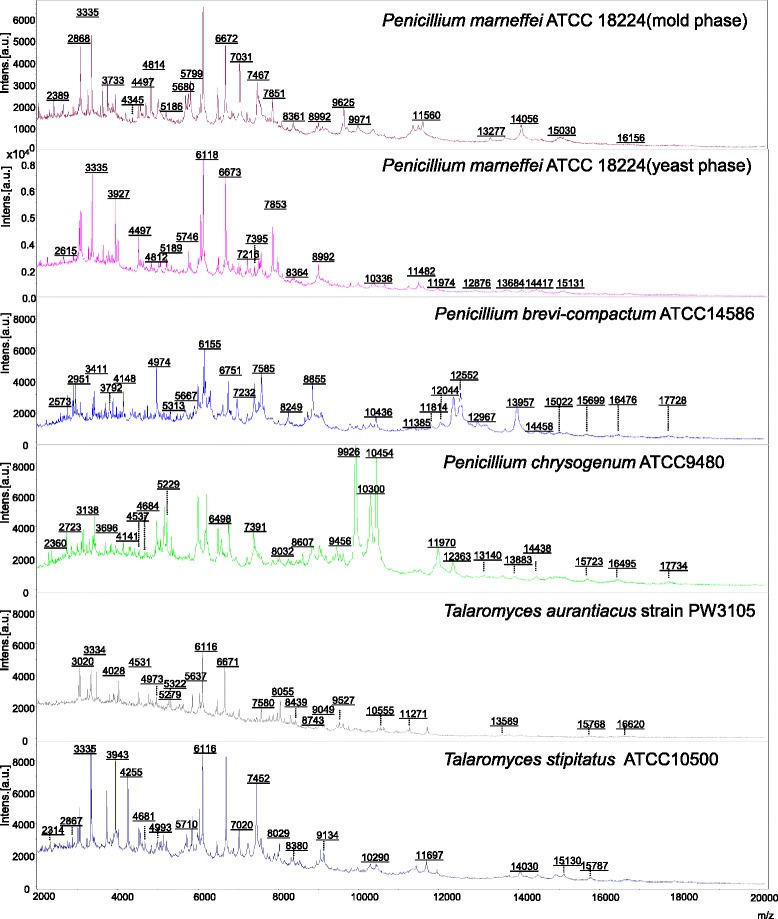
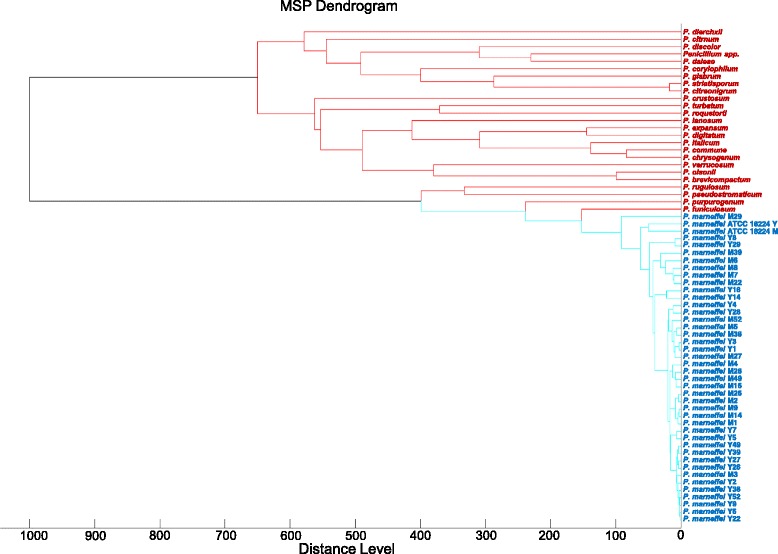
We evaluated the performance of the Bruker MALDI-TOF MS system for identification of mold and yeast cultures of 59 clinical strains and the type strain of P. marneffei using the direct transfer method, with results compared to four phylogenetically closely related species, P. brevi-compactum, P. chrysogenum, Talaromyces aurantiacus and T. stipitatus. Using the Bruker original database combined with BDAL v4.0.0.1 and Filamentous Fungi Library 1.0, MALDI-TOF MS failed to identify the 60 P. marneffei strains grown in mold and yeast phase (identified as P. funiculosum and P. purpurogenum with scores <1.7 respectively). However, when the combined database was expanded with inclusion of spectra from 21 P. marneffei strains in mold and/or yeast phase, all the remaining 39 P. marneffei strains grown in mold or phase were correctly identified to the species level with score >2.0. The MS spectra of P. marneffei exhibited significant difference to those of P. brevi-compactum, P. chrysogenum, T. aurantiacus and T. stipitatus. However, MALDI-TOF MS failed to identify these four fungi to the species level using the combined database with or without spectra from P. marneffei.
MALDI-TOF MS is useful for rapid identification of both yeast and mold cultures of P. marneffei and differentiation from related species. However, accurate identification to the species level requires database expansion using P. marneffei strains.
马尔尼菲青霉是东南亚地区导致HIV感染患者及其他免疫功能低下患者发生系统性真菌病的最重要的嗜热双相真菌。然而,马尔尼菲青霉病的实验室诊断依赖于显微镜形态学和菌丝体到酵母的转化,耗时且依赖专业知识,从而延误诊断和治疗。尽管基质辅助激光解吸电离飞行时间质谱(MALDI-TOF MS)可用于鉴定各种具有医学重要性的真菌,但其对马尔尼菲青霉的鉴定性能尚不清楚。
我们使用直接转移法评估了布鲁克MALDI-TOF MS系统对59株临床菌株和马尔尼菲青霉模式菌株的霉菌和酵母培养物的鉴定性能,并将结果与四种系统发育关系密切的物种进行比较,这四种物种分别是短密青霉、产黄青霉、桔黄篮状菌和柄篮状菌。使用布鲁克原始数据库结合BDAL v4.0.0.1和丝状真菌文库1.0,MALDI-TOF MS未能鉴定出在霉菌和酵母阶段生长的60株马尔尼菲青霉菌株(分别鉴定为绳状青霉和产紫青霉,得分均<1.7)。然而,当合并数据库通过纳入来自21株处于霉菌和/或酵母阶段的马尔尼菲青霉菌株的光谱进行扩展时,所有其余39株在霉菌或酵母阶段生长的马尔尼菲青霉菌株均被正确鉴定到种水平,得分>2.0。马尔尼菲青霉的质谱图与短密青霉、产黄青霉、桔黄篮状菌和柄篮状菌的质谱图存在显著差异。然而,使用包含或不包含马尔尼菲青霉光谱的合并数据库,MALDI-TOF MS未能将这四种真菌鉴定到种水平。
MALDI-TOF MS可用于快速鉴定马尔尼菲青霉酵母和霉菌培养物,并与相关物种进行区分。然而,要准确鉴定到种水平需要使用马尔尼菲青霉菌株扩展数据库