Suppr超能文献

通过牛舌菌和托氏柱锈菌的基因组序列揭示伞菌目新木材腐朽机制的进化

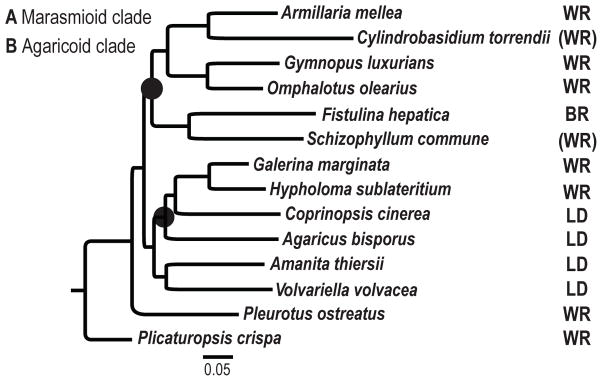
Evolution of novel wood decay mechanisms in Agaricales revealed by the genome sequences of Fistulina hepatica and Cylindrobasidium torrendii.

作者信息

Floudas Dimitrios, Held Benjamin W, Riley Robert, Nagy Laszlo G, Koehler Gage, Ransdell Anthony S, Younus Hina, Chow Julianna, Chiniquy Jennifer, Lipzen Anna, Tritt Andrew, Sun Hui, Haridas Sajeet, LaButti Kurt, Ohm Robin A, Kües Ursula, Blanchette Robert A, Grigoriev Igor V, Minto Robert E, Hibbett David S

机构信息

Department of Biology, Clark University, 950 Main St, Worcester 01610, MA, USA; MEMEG, Ecology Building Sölvegatan 37, 223 62, Lund, Sweden.

Department of Plant Pathology, University of Minnesota, 1991 Upper Buford Circle, St. Paul, MN 55108-6030, USA.

出版信息

Fungal Genet Biol. 2015 Mar;76:78-92. doi: 10.1016/j.fgb.2015.02.002. Epub 2015 Feb 12.

Abstract

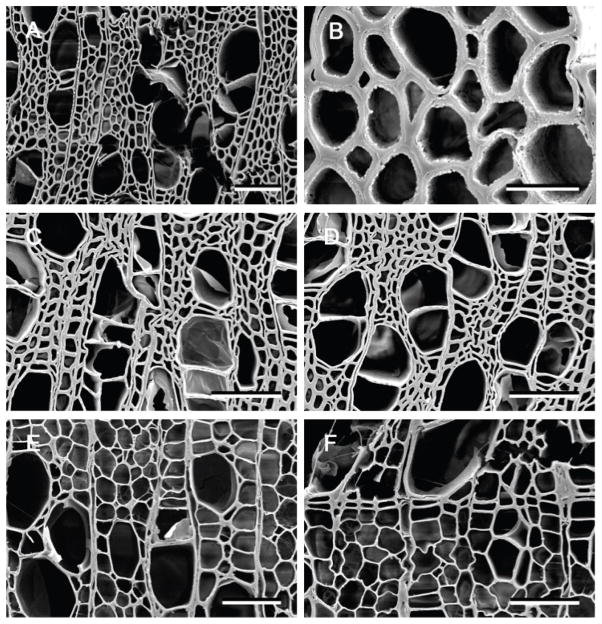
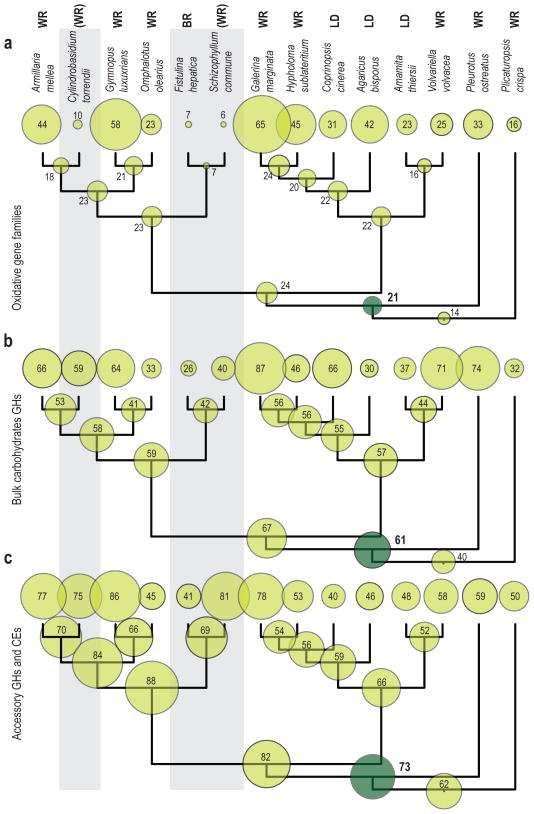
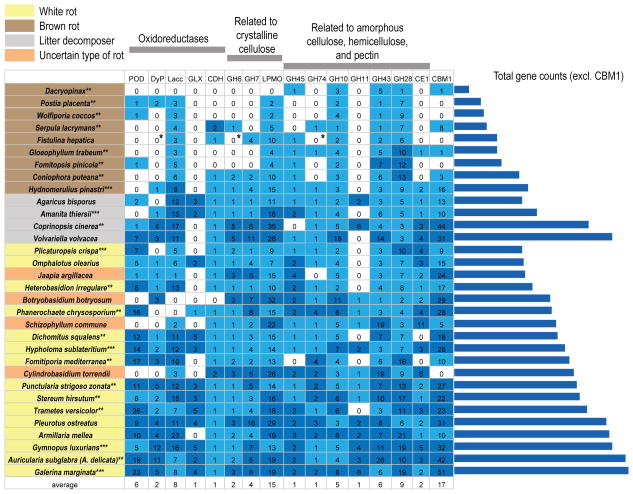
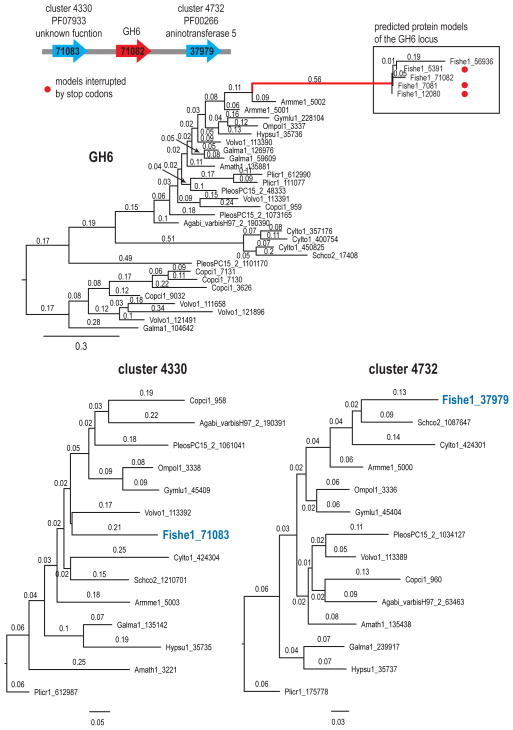
Wood decay mechanisms in Agaricomycotina have been traditionally separated in two categories termed white and brown rot. Recently the accuracy of such a dichotomy has been questioned. Here, we present the genome sequences of the white-rot fungus Cylindrobasidium torrendii and the brown-rot fungus Fistulina hepatica both members of Agaricales, combining comparative genomics and wood decay experiments. C. torrendii is closely related to the white-rot root pathogen Armillaria mellea, while F. hepatica is related to Schizophyllum commune, which has been reported to cause white rot. Our results suggest that C. torrendii and S. commune are intermediate between white-rot and brown-rot fungi, but at the same time they show characteristics of decay that resembles soft rot. Both species cause weak wood decay and degrade all wood components but leave the middle lamella intact. Their gene content related to lignin degradation is reduced, similar to brown-rot fungi, but both have maintained a rich array of genes related to carbohydrate degradation, similar to white-rot fungi. These characteristics appear to have evolved from white-rot ancestors with stronger ligninolytic ability. F. hepatica shows characteristics of brown rot both in terms of wood decay genes found in its genome and the decay that it causes. However, genes related to cellulose degradation are still present, which is a plesiomorphic characteristic shared with its white-rot ancestors. Four wood degradation-related genes, homologs of which are frequently lost in brown-rot fungi, show signs of pseudogenization in the genome of F. hepatica. These results suggest that transition toward a brown-rot lifestyle could be an ongoing process in F. hepatica. Our results reinforce the idea that wood decay mechanisms are more diverse than initially thought and that the dichotomous separation of wood decay mechanisms in Agaricomycotina into white rot and brown rot should be revisited.

摘要

传统上,伞菌亚纲中的木材腐朽机制分为白腐和褐腐两类。最近,这种二分法的准确性受到了质疑。在此,我们展示了白腐真菌圆柱担子菌(Cylindrobasidium torrendii)和褐腐真菌肝色牛排菌(Fistulina hepatica)的基因组序列,这两种菌均属于伞菌目,我们结合了比较基因组学和木材腐朽实验进行研究。圆柱担子菌与白腐根病原菌蜜环菌(Armillaria mellea)密切相关,而肝色牛排菌与裂褶菌(Schizophyllum commune)相关,裂褶菌曾被报道会引起白腐。我们的研究结果表明,圆柱担子菌和裂褶菌介于白腐菌和褐腐菌之间,但同时它们表现出类似软腐的腐朽特征。这两个物种都会导致木材轻度腐朽,降解所有木材成分,但中层薄片保持完整。它们与木质素降解相关的基因含量减少,类似于褐腐菌,但二者都保留了一系列丰富的与碳水化合物降解相关的基因,类似于白腐菌。这些特征似乎是从具有更强木质素分解能力的白腐祖先演化而来的。肝色牛排菌在其基因组中发现的木材腐朽基因以及它所引起的腐朽方面都表现出褐腐的特征。然而,与纤维素降解相关的基因仍然存在,这是与其白腐祖先共有的一个原始特征。四个与木材降解相关的基因,其同源基因在褐腐菌中经常丢失,在肝色牛排菌的基因组中显示出假基因化的迹象。这些结果表明,向褐腐生活方式的转变在肝色牛排菌中可能是一个正在进行的过程。我们的研究结果强化了这样一种观点,即木材腐朽机制比最初认为的更加多样,并且伞菌亚纲中木材腐朽机制分为白腐和褐腐的二分法应该重新审视。
相似文献

2
Coupling Secretomics with Enzyme Activities To Compare the Temporal Processes of Wood Metabolism among White and Brown Rot Fungi.
Appl Environ Microbiol. 2018 Aug 1;84(16). doi: 10.1128/AEM.00159-18. Print 2018 Aug 15.
3
Differences in crystalline cellulose modification due to degradation by brown and white rot fungi.
Fungal Biol. 2012 Oct;116(10):1052-63. doi: 10.1016/j.funbio.2012.07.009. Epub 2012 Aug 8.
4
Evolutionary dynamics of host specialization in wood-decay fungi.
BMC Evol Biol. 2018 Aug 3;18(1):119. doi: 10.1186/s12862-018-1229-7.
5
Extensive sampling of basidiomycete genomes demonstrates inadequacy of the white-rot/brown-rot paradigm for wood decay fungi.
Proc Natl Acad Sci U S A. 2014 Jul 8;111(27):9923-8. doi: 10.1073/pnas.1400592111. Epub 2014 Jun 23.
6
Comparative genomics reveals unique wood-decay strategies and fruiting body development in the Schizophyllaceae.
New Phytol. 2019 Oct;224(2):902-915. doi: 10.1111/nph.16032. Epub 2019 Aug 1.
8
Oxidative Damage Control during Decay of Wood by Brown Rot Fungus Using Oxygen Radicals.
Appl Environ Microbiol. 2018 Oct 30;84(22). doi: 10.1128/AEM.01937-18. Print 2018 Nov 15.
9
Gene Regulation Shifts Shed Light on Fungal Adaption in Plant Biomass Decomposers.
mBio. 2019 Nov 19;10(6):e02176-19. doi: 10.1128/mBio.02176-19.
10
Multi-omic Analyses of Extensively Decayed Pinus contorta Reveal Expression of a Diverse Array of Lignocellulose-Degrading Enzymes.
Appl Environ Microbiol. 2018 Oct 1;84(20). doi: 10.1128/AEM.01133-18. Print 2018 Oct 15.

引用本文的文献

3
Resistance of Cereal-Husk-Reinforced PVC Terrace Profiles to Fungi.
Materials (Basel). 2025 Jun 17;18(12):2860. doi: 10.3390/ma18122860.
4
Species diversity, taxonomic classification and ecological habits of polypore fungi in China.
Mycology. 2024 Nov 26;16(2):419-544. doi: 10.1080/21501203.2024.2384567. eCollection 2025.
5
Genomic Signatures of Domestication in a Fungus Obligately Farmed by Leafcutter Ants.
Mol Biol Evol. 2024 Oct 4;41(10). doi: 10.1093/molbev/msae197.
7
Extreme overall mushroom genome expansion in Mycena s.s. irrespective of plant hosts or substrate specializations.
Cell Genom. 2024 Jul 10;4(7):100586. doi: 10.1016/j.xgen.2024.100586. Epub 2024 Jun 27.
9
The alkynyl-containing compounds from mushrooms and their biological activities.
Nat Prod Bioprospect. 2023 Nov 10;13(1):50. doi: 10.1007/s13659-023-00416-w.
10
Vertical and horizontal gene transfer shaped plant colonization and biomass degradation in the fungal genus Armillaria.
Nat Microbiol. 2023 Sep;8(9):1668-1681. doi: 10.1038/s41564-023-01448-1. Epub 2023 Aug 7.

本文引用的文献

1
Extensive sampling of basidiomycete genomes demonstrates inadequacy of the white-rot/brown-rot paradigm for wood decay fungi.
Proc Natl Acad Sci U S A. 2014 Jul 8;111(27):9923-8. doi: 10.1073/pnas.1400592111. Epub 2014 Jun 23.
2
Transposable element dynamics among asymbiotic and ectomycorrhizal Amanita fungi.
Genome Biol Evol. 2014 Jun 12;6(7):1564-78. doi: 10.1093/gbe/evu121.
3
Genomics of wood-degrading fungi.
Fungal Genet Biol. 2014 Nov;72:82-90. doi: 10.1016/j.fgb.2014.05.001. Epub 2014 May 20.
4
MycoCosm portal: gearing up for 1000 fungal genomes.
Nucleic Acids Res. 2014 Jan;42(Database issue):D699-704. doi: 10.1093/nar/gkt1183. Epub 2013 Dec 1.
5
The carbohydrate-active enzymes database (CAZy) in 2013.
Nucleic Acids Res. 2014 Jan;42(Database issue):D490-5. doi: 10.1093/nar/gkt1178. Epub 2013 Nov 21.
6
Genomic and proteomic dissection of the ubiquitous plant pathogen, Armillaria mellea: toward a new infection model system.
J Proteome Res. 2013 Jun 7;12(6):2552-70. doi: 10.1021/pr301131t. Epub 2013 May 28.
7
Leucoagaricus gongylophorus produces diverse enzymes for the degradation of recalcitrant plant polymers in leaf-cutter ant fungus gardens.
Appl Environ Microbiol. 2013 Jun;79(12):3770-8. doi: 10.1128/AEM.03833-12. Epub 2013 Apr 12.
8
Sequencing and comparative analysis of the straw mushroom (Volvariella volvacea) genome.
PLoS One. 2013;8(3):e58294. doi: 10.1371/journal.pone.0058294. Epub 2013 Mar 19.
9
Mind the gap: upgrading genomes with Pacific Biosciences RS long-read sequencing technology.
PLoS One. 2012;7(11):e47768. doi: 10.1371/journal.pone.0047768. Epub 2012 Nov 21.
10
Genome sequence of the button mushroom Agaricus bisporus reveals mechanisms governing adaptation to a humic-rich ecological niche.
Proc Natl Acad Sci U S A. 2012 Oct 23;109(43):17501-6. doi: 10.1073/pnas.1206847109. Epub 2012 Oct 8.

文献AI研究员

20分钟写一篇综述,助力文献阅读效率提升50倍。

立即体验

用中文搜PubMed

大模型驱动的PubMed中文搜索引擎

马上搜索

文档翻译

学术文献翻译模型,支持多种主流文档格式。

立即体验