
抗氧化多酚丰富的提取物从药用植物 Antirhea borbonica、Doratoxylon apetalum 和 Gouania mauritiana 保护 3T3-L1 前脂肪细胞免受 H2O2、TNFα 和 LPS 炎症介质的影响,通过调节超氧化物歧化酶和 NF-κB 基因的表达。
Antioxidant polyphenol-rich extracts from the medicinal plants Antirhea borbonica, Doratoxylon apetalum and Gouania mauritiana protect 3T3-L1 preadipocytes against H2O2, TNFα and LPS inflammatory mediators by regulating the expression of superoxide dismutase and NF-κB genes.
机构信息
UMR Diabète athérothrombose Thérapies Réunion Océan Indien, Inserm U1188 - Université de La Réunion, Plateforme CYROI, 2 rue Maxime Rivière, 97490 Saint-Denis, La Réunion France.
Laboratoire de Chimie des Substances Naturelles et des Sciences des Aliments, EA 2212, Université de La Réunion, 15 avenue René Cassin, CS 92003, 97744 Saint-Denis, La Réunion France.
出版信息
J Inflamm (Lond). 2015 Feb 8;12:10. doi: 10.1186/s12950-015-0055-6. eCollection 2015.
BACKGROUND
Adipose cells responsible for fat storage are the targets of reactive oxygen species (ROS) like H2O2 and pro-inflammatory agents including TNFα and LPS. Such mediators contribute to oxidative stress and alter inflammatory processes in adipose tissue, leading to insulin resistance during obesity. Thus, the identification of natural compounds such as plant polyphenols able to increase the antioxidant and anti-inflammatory capacity of the body is of high interest. We aimed to evaluate the biological properties of polyphenol-rich extracts from the medicinal plants A. borbonica, D. apetalum and G. mauritiana on preadipocytes exposed to H2O2, TNFα or LPS mediators.
METHODS
Medicinal plant extracts were analysed for their polyphenol contents by Folin-Ciocalteu and UPLC-ESI-MS methods as well as for their free radical-scavenging activities by DPPH and ORAC assays. To assess the ability of polyphenol-rich extracts to protect 3T3-L1 preadipocytes against H2O2, TNFα or LPS mediators, several parameters including cell viability (MTT and LDH assays), ROS production (DCFH-DA test), IL-6 and MCP-1 secretion (ELISA) were evaluated. Moreover, the expression of superoxide dismutase, catalase and NF-κB genes was explored (RT-QPCR).
RESULTS
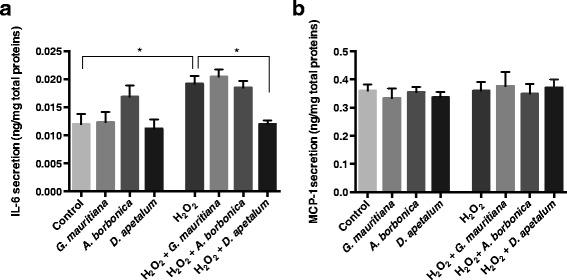
All medicinal plants exhibited high levels of polyphenols with free radical-scavenging capacities. Flavonoids such as quercetin, kaempferol, epicatechin and procyanidins, and phenolic acids derived from caffeic acid including chlorogenic acid, were detected. Polyphenol-rich plant extracts did not exert a cytotoxic effect on preadipocytes but protected them against H2O2 anti-proliferative action. Importantly, they down-regulated ROS production and the secretion of IL-6 and MCP-1 pro-inflammatory markers induced by H2O2, TNFα and LPS mediators. Such a protective action was associated with an increase in superoxide dismutase antioxidant enzyme gene expression and a decrease in mRNA levels of NF-κB pro-inflammatory transcription factor.
CONCLUSION
This study highlights that antioxidant strategies based on polyphenols derived from medicinal plants tested could contribute to regulate adipose tissue redox status and immune process, and thus participate to the improvement of obesity-related oxidative stress and inflammation.
背景
负责脂肪储存的脂肪细胞是活性氧(ROS)如 H2O2 和促炎剂(包括 TNFα 和 LPS)的靶标。这些介质会导致氧化应激,并改变脂肪组织中的炎症过程,导致肥胖期间的胰岛素抵抗。因此,鉴定能够增加身体抗氧化和抗炎能力的天然化合物,如植物多酚,具有很高的兴趣。我们旨在评估药用植物 A. borbonica、D. apetalum 和 G. mauritiana 的多酚丰富提取物对暴露于 H2O2、TNFα 或 LPS 介质的前体脂肪细胞的生物学特性。
方法
通过 Folin-Ciocalteu 和 UPLC-ESI-MS 方法分析药用植物提取物的多酚含量,并通过 DPPH 和 ORAC 测定法分析其自由基清除活性。为了评估多酚丰富提取物保护 3T3-L1 前体脂肪细胞免受 H2O2、TNFα 或 LPS 介质的能力,评估了包括细胞活力(MTT 和 LDH 测定)、ROS 产生(DCFH-DA 测试)、IL-6 和 MCP-1 分泌(ELISA)在内的几个参数。此外,还探索了超氧化物歧化酶、过氧化氢酶和 NF-κB 基因的表达(RT-QPCR)。
结果
所有药用植物都表现出高水平的多酚和自由基清除能力。检测到类黄酮如槲皮素、山奈酚、表儿茶素和原花青素,以及来源于咖啡酸的酚酸,包括绿原酸。多酚丰富的植物提取物对前体脂肪细胞没有细胞毒性作用,但可保护它们免受 H2O2 的抗增殖作用。重要的是,它们下调了由 H2O2、TNFα 和 LPS 介质诱导的 ROS 产生和 IL-6 和 MCP-1 促炎标志物的分泌。这种保护作用与抗氧化酶超氧化物歧化酶基因表达的增加和促炎转录因子 NF-κB 的 mRNA 水平的降低有关。
结论
本研究强调了基于测试的药用植物衍生的多酚的抗氧化策略可以有助于调节脂肪组织的氧化还原状态和免疫过程,从而有助于改善肥胖相关的氧化应激和炎症。




 Zotero 插件