Taïlé Janice, Arcambal Angélique, Clerc Patricia, Gauvin-Bialecki Anne, Gonthier Marie-Paule
Diabète athérothrombose Thérapies Réunion Océan Indien, INSERM, UMR 1188, Université de La Réunion, 2 rue Maxime Rivière, 97490 Sainte-Clotilde, La Réunion, France.
Laboratoire de Chimie et de Biotechnologie des Produits Naturels, Université de La Réunion, UR 2212, 15 Avenue René Cassin CS 92003, 97744 Saint-Denis CEDEX 9, La Réunion, France.
Antioxidants (Basel). 2020 Jul 2;9(7):573. doi: 10.3390/antiox9070573.
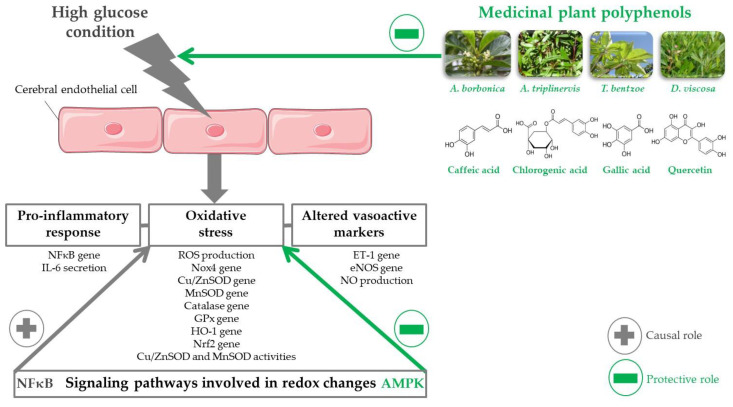
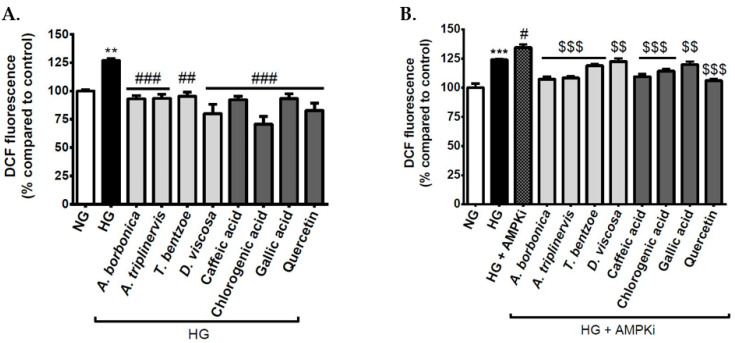
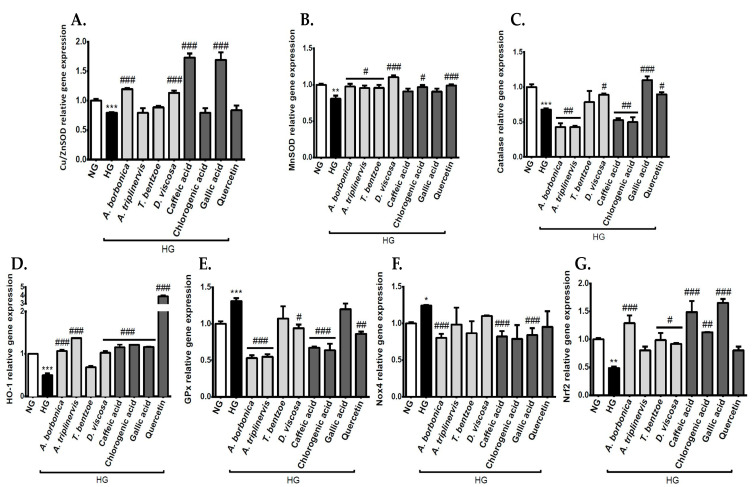
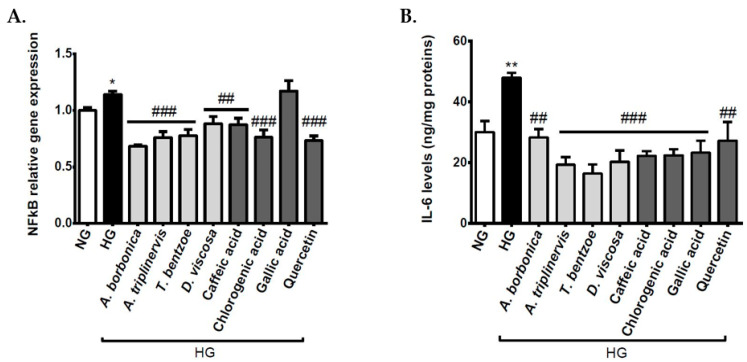
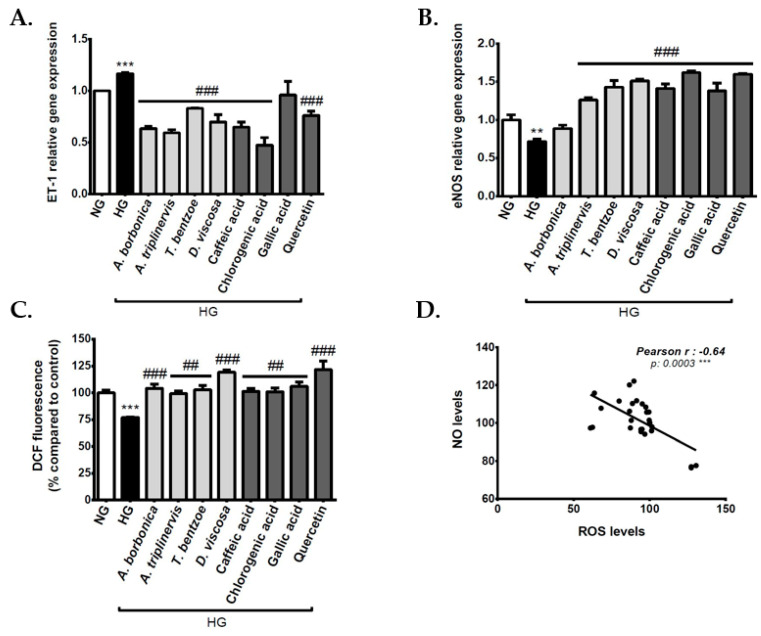
Blood-brain barrier endothelial cells are the main targets of diabetes-related hyperglycemia that alters endothelial functions and brain homeostasis. Hyperglycemia-mediated oxidative stress may play a causal role. This study evaluated the protective effects of characterized polyphenol-rich medicinal plant extracts on redox, inflammatory and vasoactive markers on murine bEnd3 cerebral endothelial cells exposed to high glucose concentration. The results show that hyperglycemic condition promoted oxidative stress through increased reactive oxygen species (ROS) levels, deregulated antioxidant superoxide dismutase (SOD) activity, and altered expression of genes encoding Cu/ZnSOD, MnSOD, catalase, glutathione peroxidase (GPx), heme oxygenase-1 (HO-1), NADPH oxidase 4 (Nox4), and nuclear factor erythroid 2-related factor 2 (Nrf2) redox factors. Cell preconditioning with inhibitors of signaling pathways highlights a causal role of nuclear factor kappa B (NFκB), while a protective action of AMP-activated protein kinase (AMPK) on redox changes. The hyperglycemic condition induced a pro-inflammatory response by elevating NFκB gene expression and interleukin-6 (IL-6) secretion, and deregulated the production of endothelin-1 (ET-1), endothelial nitric oxide synthase (eNOS), and nitric oxide (NO) vasoactive markers. Importantly, polyphenolic extracts from , , , and French medicinal plants, counteracted high glucose deleterious effects by exhibiting antioxidant and anti-inflammatory properties. In an innovative way, quercetin, caffeic, chlorogenic and gallic acids identified as predominant plant polyphenols, and six related circulating metabolites were found to exert similar benefits. Collectively, these findings demonstrate polyphenol protective action on cerebral endothelial cells during hyperglycemic condition.
血脑屏障内皮细胞是糖尿病相关高血糖的主要靶点,高血糖会改变内皮功能和脑内稳态。高血糖介导的氧化应激可能起因果作用。本研究评估了具有特征性的富含多酚的药用植物提取物对暴露于高葡萄糖浓度的小鼠bEnd3脑内皮细胞的氧化还原、炎症和血管活性标志物的保护作用。结果表明,高血糖状态通过增加活性氧(ROS)水平、使抗氧化超氧化物歧化酶(SOD)活性失调以及改变编码铜/锌超氧化物歧化酶、锰超氧化物歧化酶、过氧化氢酶、谷胱甘肽过氧化物酶(GPx)、血红素加氧酶-1(HO-1)、NADPH氧化酶4(Nox4)和核因子红细胞2相关因子2(Nrf2)氧化还原因子的基因表达来促进氧化应激。用信号通路抑制剂对细胞进行预处理突出了核因子κB(NFκB)的因果作用,而AMP激活的蛋白激酶(AMPK)对氧化还原变化具有保护作用。高血糖状态通过提高NFκB基因表达和白细胞介素-6(IL-6)分泌诱导促炎反应,并使内皮素-1(ET-1)、内皮型一氧化氮合酶(eNOS)和一氧化氮(NO)血管活性标志物的产生失调。重要的是,来自法国药用植物、、和的多酚提取物通过展现抗氧化和抗炎特性抵消了高葡萄糖的有害影响。以一种创新的方式发现,被鉴定为主要植物多酚的槲皮素、咖啡酸、绿原酸和没食子酸以及六种相关的循环代谢物发挥了类似的作用。总体而言,这些发现证明了多酚在高血糖状态下对脑内皮细胞的保护作用。