
来自小麦穗的解淀粉芽孢杆菌S76-3中伊枯草菌素A和多粘菌素A对禾谷镰刀菌的拮抗机制
Antagonistic mechanism of iturin A and plipastatin A from Bacillus amyloliquefaciens S76-3 from wheat spikes against Fusarium graminearum.
作者信息
Gong An-Dong, Li He-Ping, Yuan Qing-Song, Song Xiu-Shi, Yao Wei, He Wei-Jie, Zhang Jing-Bo, Liao Yu-Cai
机构信息
Molecular Biotechnology Laboratory of Triticeae Crops, Huazhong Agricultural University, Wuhan 430070, People's Republic of China; College of Plant Science and Technology, Huazhong Agricultural University, Wuhan 430070, People's Republic of China.
Molecular Biotechnology Laboratory of Triticeae Crops, Huazhong Agricultural University, Wuhan 430070, People's Republic of China; College of Life Science and Technology, Huazhong Agricultural University, Wuhan 430070, People's Republic of China.
出版信息
PLoS One. 2015 Feb 17;10(2):e0116871. doi: 10.1371/journal.pone.0116871. eCollection 2015.
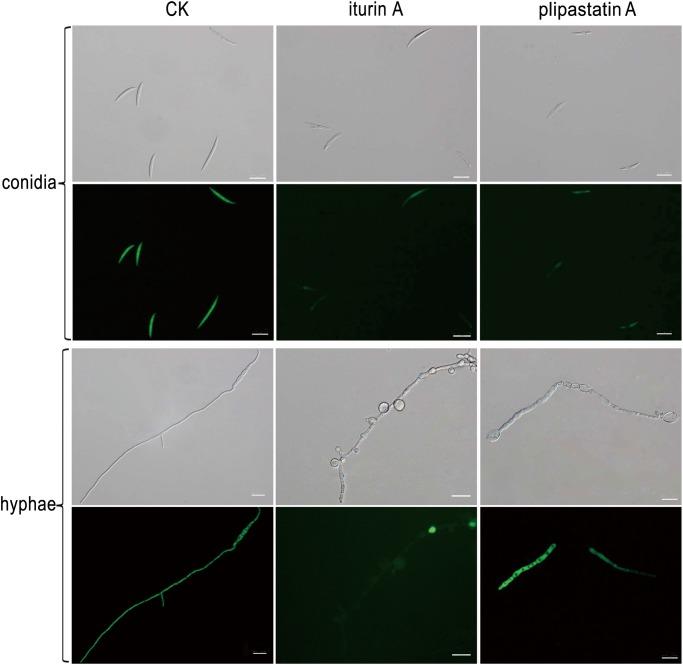
Controlling toxigenic Fusarium graminearum (FG) is challenging. A bacterial strain (S76-3, identified as Bacillus amyloliquefaciens) that was isolated from diseased wheat spikes in the field displayed strong antifungal activity against FG. Reverse-phase high performance liquid chromatography and electrospray ionization mass spectrometry analyses revealed that S76-3 produced three classes of cyclic lipopeptides including iturin, plipastatin and surfactin. Each class consisted of several different molecules. The iturin and plipastatin fractions strongly inhibited FG; the surfactin fractions did not. The most abundant compound that had antagonistic activity from the iturin fraction was iturin A (m/z 1043.35); the most abundant active compound from the plipastatin fraction was plipastatin A (m/z 1463.90). These compounds were analyzed with collision-induced dissociation mass spectrometry. The two purified compounds displayed strong fungicidal activity, completely killing conidial spores at the minimal inhibitory concentration range of 50 µg/ml (iturin A) and 100 µg/ml (plipastatin A). Optical and fluorescence microscopy analyses revealed severe morphological changes in conidia and substantial distortions in FG hyphae treated with iturin A or plipastatin A. Iturin A caused leakage and/or inactivation of FG cellular contents and plipastatin A caused vacuolation. Time-lapse imaging of dynamic antagonistic processes illustrated that iturin A caused distortion and conglobation along hyphae and inhibited branch formation and growth, while plipastatin A caused conglobation in young hyphae and branch tips. Transmission electron microscopy analyses demonstrated that the cell walls of conidia and hyphae of iturin A and plipastatin A treated FG had large gaps and that their plasma membranes were severely damaged and separated from cell walls.
控制产毒素的禾谷镰刀菌(FG)具有挑战性。从田间患病小麦穗中分离出的一株细菌菌株(S76 - 3,鉴定为解淀粉芽孢杆菌)对FG表现出强大的抗真菌活性。反相高效液相色谱和电喷雾电离质谱分析表明,S76 - 3产生了三类环状脂肽,包括伊枯草菌素、多粘菌素和表面活性素。每一类都由几种不同的分子组成。伊枯草菌素和多粘菌素部分强烈抑制FG;表面活性素部分则没有。伊枯草菌素部分中具有拮抗活性的最丰富化合物是伊枯草菌素A(m/z 1043.35);多粘菌素部分中最丰富的活性化合物是多粘菌素A(m/z 1463.90)。这些化合物用碰撞诱导解离质谱进行了分析。两种纯化的化合物表现出强大的杀真菌活性,在50 µg/ml(伊枯草菌素A)和100 µg/ml(多粘菌素A)的最小抑菌浓度范围内完全杀死分生孢子。光学和荧光显微镜分析显示,用伊枯草菌素A或多粘菌素A处理的FG分生孢子出现严重的形态变化,菌丝体出现大量扭曲。伊枯草菌素A导致FG细胞内容物泄漏和/或失活,多粘菌素A导致液泡化。动态拮抗过程的延时成像表明,伊枯草菌素A导致菌丝体扭曲和团聚,并抑制分支形成和生长,而多粘菌素A导致幼菌丝和分支尖端团聚。透射电子显微镜分析表明,经伊枯草菌素A和多粘菌素A处理的FG分生孢子和菌丝体的细胞壁有大的间隙,其质膜严重受损并与细胞壁分离。



 Zotero 插件