Manda Gina, Mocanu Mihaela Andreea, Marin Daniela Eliza, Taranu Ionelia
Cellular and Molecular Medicine Department, "Victor Babes" National Institute of Pathology, 99-101 Splaiul Independentei, Bucharest 050096, Romania.
Laboratory of Animal Biology, National Institute for Research and Development for Biology and Animal Nutrition, Calea Bucuresti No. 1, Balotesti, Ilfov 077015, Romania.
Toxins (Basel). 2015 Feb 16;7(2):593-603. doi: 10.3390/toxins7020593.
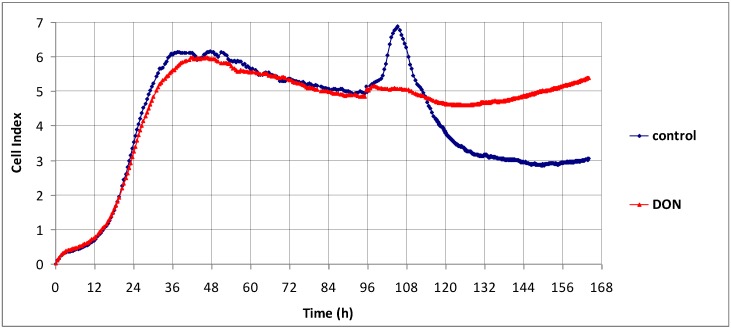
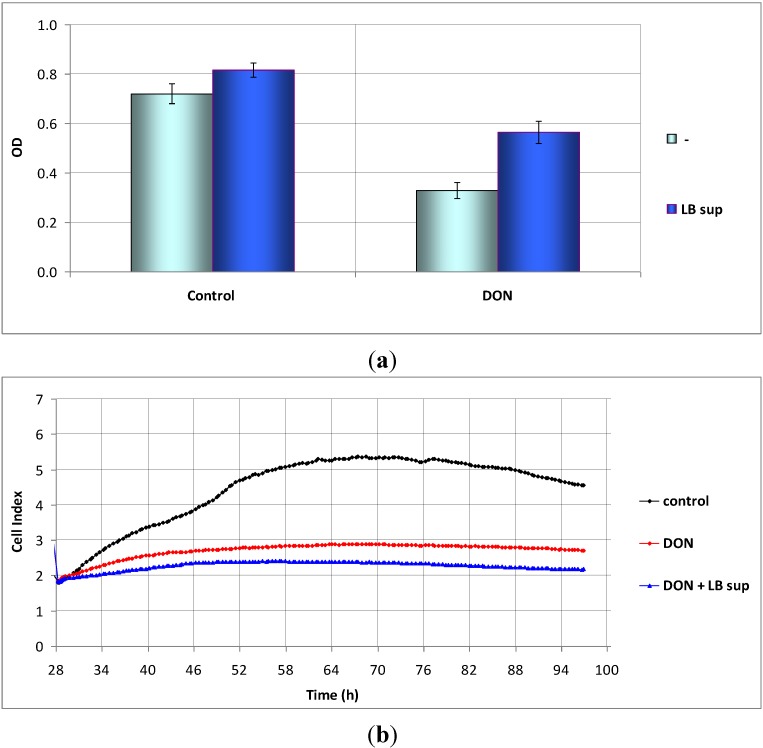
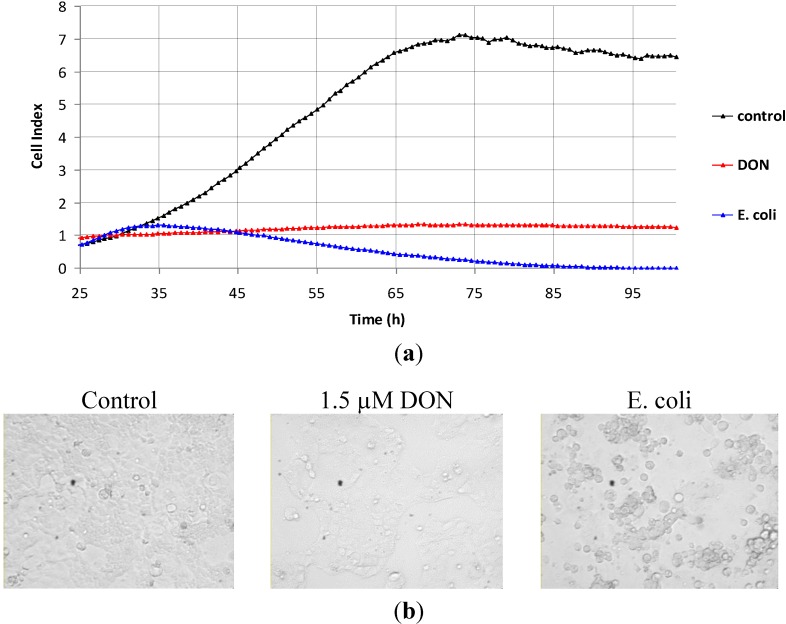
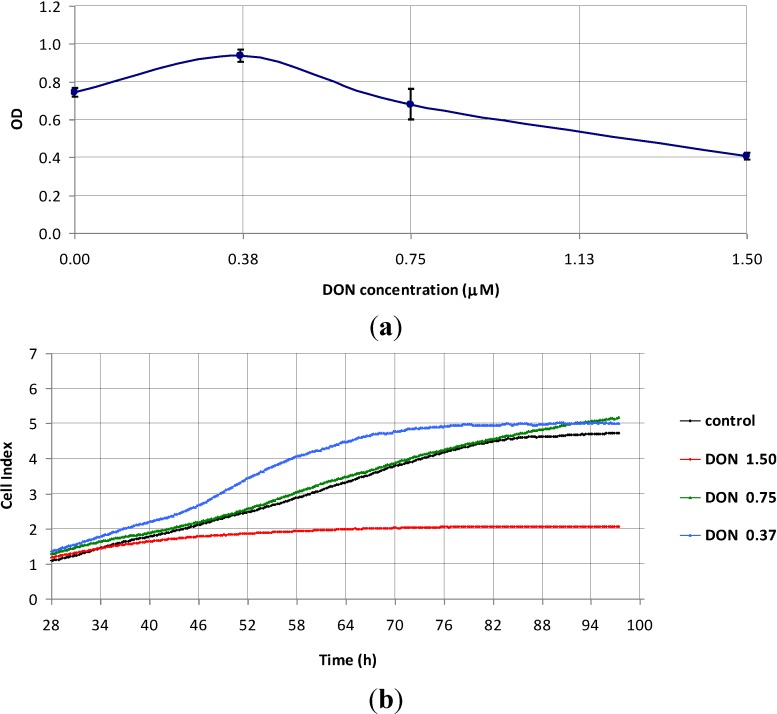
Contamination of crops used for food and feed production with Fusarium mycotoxins, such as deoxynivalenol (DON), raise important health and economic issues all along the food chain. Acute exposure to high DON concentrations can alter the intestinal barrier, while chronic exposure to lower doses may exert more subtle effects on signal transduction pathways, leading to disturbances in cellular homeostasis. Using real-time cellular impedance measurements, we studied the effects exerted in vitro by low concentrations of DON (0.37-1.50 μM), relevant for mycotoxin-contaminated food, on the proliferation of undifferentiated Caco-2 cells presenting a tumorigenic phenotype. A 1.5 μM concentration of DON maintained cell adherence of non-proliferating Caco-2 cells, whilst arresting the growth of actively proliferating cells compared with control Caco-2 cells in vitro. At 0.37 μM, DON enhanced Caco-2 cell metabolism, thereby triggering a moderate increase in cell proliferation. The results of the current study suggested that low concentrations of DON commonly detected in food may either limit or sustain the proliferation of colon cancer cells, depending on their proliferation status and on DON concentration. Soluble factors released by Lactobacillus strains can partially counteract the inhibitory action of DON on actively proliferating colon cancer cells. The study also emphasized that real-time cellular impedance measurements were a valuable tool for investigating the dynamics of cellular responses to xenobiotics.
用于食品和饲料生产的农作物被镰刀菌霉菌毒素污染,如脱氧雪腐镰刀菌烯醇(DON),这在整个食物链中引发了重要的健康和经济问题。急性暴露于高浓度的DON会改变肠道屏障,而长期暴露于低剂量的DON可能会对信号转导通路产生更微妙的影响,导致细胞内稳态紊乱。我们使用实时细胞阻抗测量技术,研究了低浓度DON(0.37 - 1.50 μM)在体外对具有致瘤表型的未分化Caco - 2细胞增殖的影响,该浓度与被霉菌毒素污染的食物相关。与对照Caco - 2细胞相比,1.5 μM浓度的DON维持了非增殖Caco - 2细胞的细胞黏附,同时抑制了活跃增殖细胞的生长。在0.37 μM时,DON增强了Caco - 2细胞的代谢,从而引发细胞增殖适度增加。当前研究结果表明,食品中常见的低浓度DON可能会限制或维持结肠癌细胞的增殖,这取决于它们的增殖状态和DON浓度。乳酸杆菌菌株释放的可溶性因子可以部分抵消DON对活跃增殖结肠癌细胞的抑制作用。该研究还强调,实时细胞阻抗测量是研究细胞对外源化合物反应动态的有价值工具。