Riest Carina, Jorschick Annett B, de Ruiter Jan P
Faculty for Linguistics and Literary Studies, Bielefeld University Bielefeld, Germany.
Front Psychol. 2015 Feb 2;6:89. doi: 10.3389/fpsyg.2015.00089. eCollection 2015.
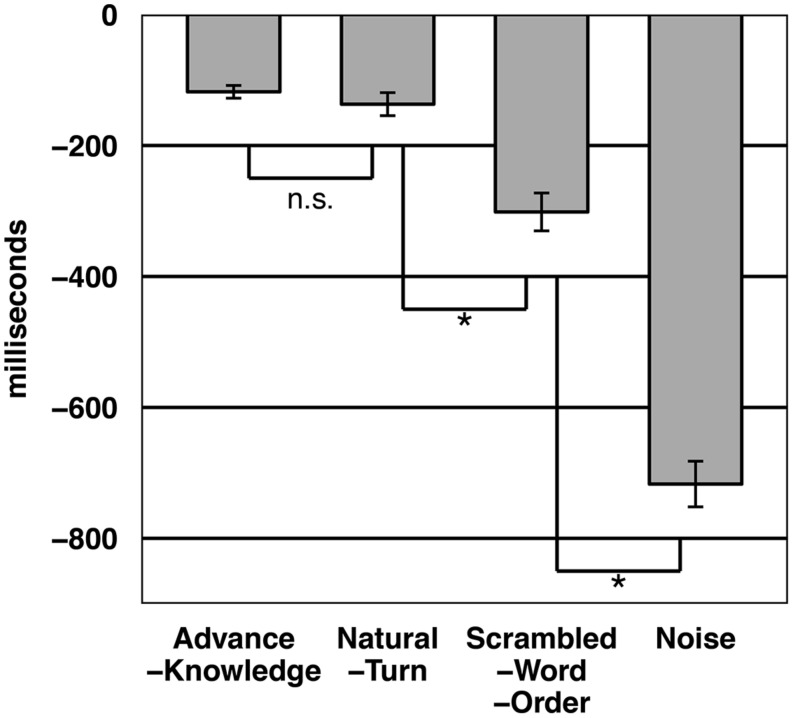
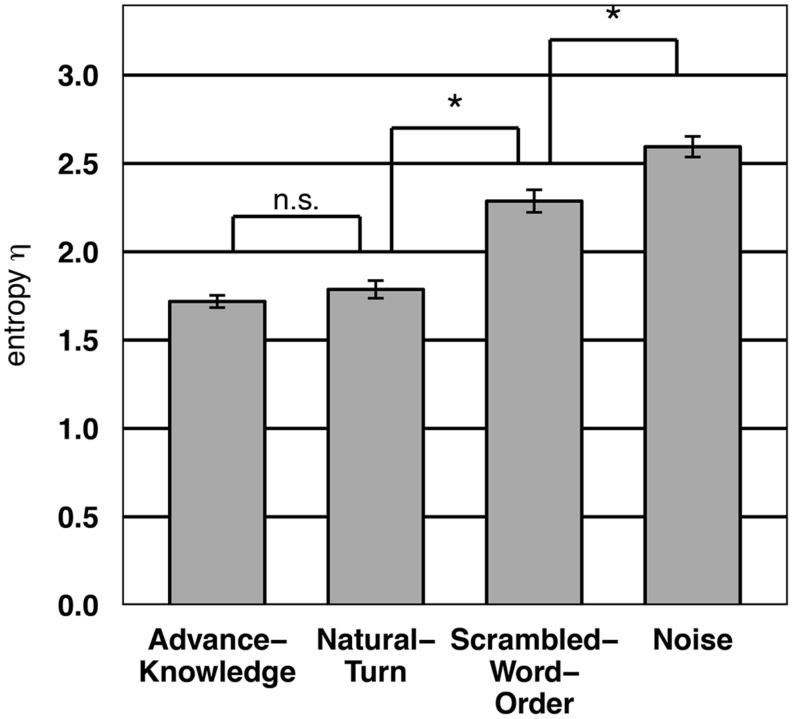
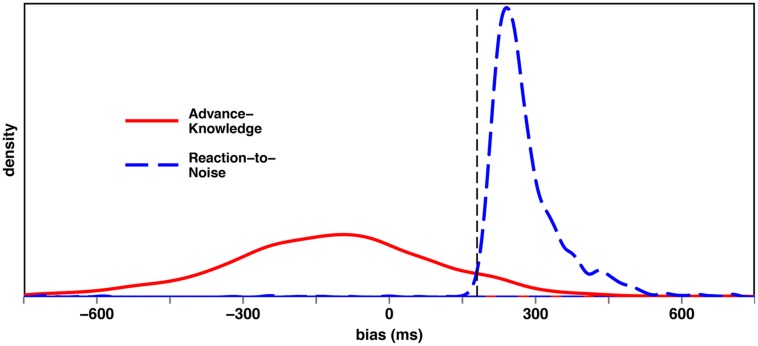
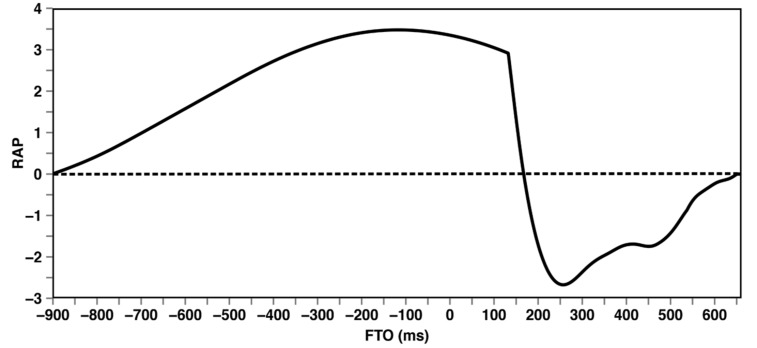
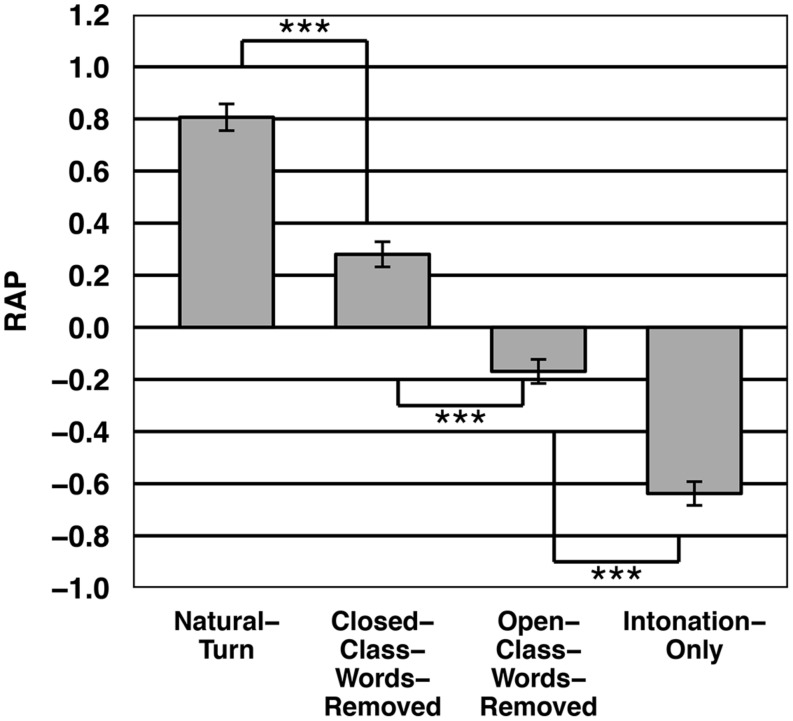
During conversations participants alternate smoothly between speaker and hearer roles with only brief pauses and overlaps. There are two competing types of accounts about how conversationalists accomplish this: (a) the signaling approach and (b) the anticipatory ('projection') approach. We wanted to investigate, first, the relative merits of these two accounts, and second, the relative contribution of semantic and syntactic information to the timing of next turn initiation. We performed three button-press experiments using turn fragments taken from natural conversations to address the following questions: (a) Is turn-taking predominantly based on anticipation or on reaction, and (b) what is the relative contribution of semantic and syntactic information to accurate turn-taking. In our first experiment we gradually manipulated the information available for anticipation of the turn end (providing information about the turn end in advance to completely removing linguistic information). The results of our first experiment show that the distribution of the participants' estimation of turn-endings for natural turns is very similar to the distribution for pure anticipation. We conclude that listeners are indeed able to anticipate a turn-end and that this strategy is predominantly used in turn-taking. In Experiment 2 we collected purely reacted responses. We used the distributions from Experiments 1 and 2 together to estimate a new dependent variable called Reaction Anticipation Proportion. We used this variable in our third experiment where we manipulated the presence vs. absence of semantic and syntactic information by low-pass filtering open-class and closed class words in the turn. The results suggest that for turn-end anticipation, both semantic and syntactic information are needed, but that the semantic information is a more important anticipation cue than syntactic information.
在对话过程中,参与者能够在说话者和倾听者角色之间平稳交替,仅有短暂的停顿和重叠。关于对话者如何做到这一点,存在两种相互竞争的解释:(a)信号方法和(b)预期(“投射”)方法。我们首先想要探究这两种解释的相对优点,其次探究语义和句法信息对下一轮开始时机的相对贡献。我们进行了三项按键实验,使用从自然对话中提取的轮次片段来回答以下问题:(a)轮流发言主要是基于预期还是反应,以及(b)语义和句法信息对准确轮流发言的相对贡献是什么。在我们的第一个实验中,我们逐渐操控可用于预期轮次结束的信息(从提前提供轮次结束信息到完全去除语言信息)。我们第一个实验的结果表明,参与者对自然轮次结束的估计分布与纯预期的分布非常相似。我们得出结论,倾听者确实能够预期轮次结束,并且这种策略在轮流发言中被主要使用。在实验2中,我们收集了纯粹的反应性回答。我们将实验1和2的分布结合起来,以估计一个名为反应预期比例的新因变量。我们在第三个实验中使用了这个变量,在该实验中,我们通过对轮次中的开放类词和封闭类词进行低通滤波来操控语义和句法信息的有无。结果表明,对于轮次结束的预期,语义和句法信息都需要,但语义信息比句法信息是更重要的预期线索。