Fang Jia-Yan, Zhu Lin, Yi Tao, Zhang Jian-Ye, Yi Ling, Liang Zhi-Tao, Xia Li, Feng Jia-Fu, Xu Jun, Tang Yi-Na, Zhao Zhong-Zhen, Chen Hu-Biao
School of Chinese Medicine, Hong Kong Baptist University, Hong Kong Special Administrative Region, Hong Kong, People's Republic of China.
School of Pharmaceutical Sciences, Guangzhou Medical University, Guangzhou, 510182 People's Republic of China.
Chin Med. 2015 Feb 10;10:2. doi: 10.1186/s13020-015-0031-3. eCollection 2015.
Rhizoma Chuanxiong (RC) is the dried rhizome of Ligusticum chuanxiong Hort., and various types of processed Rhizoma Chuanxiong (PRC) are widely used in China. However, quality assurance and quality control of these processed medicines remain challenging. This study aims to investigate the chemical compositions of various PRC preparations by a high-performance liquid chromatography (HPLC) coupled with diode array detection (DAD) method.
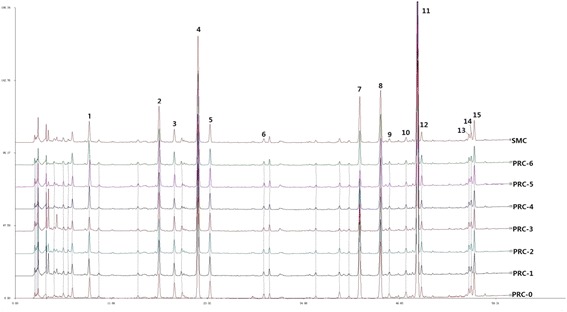
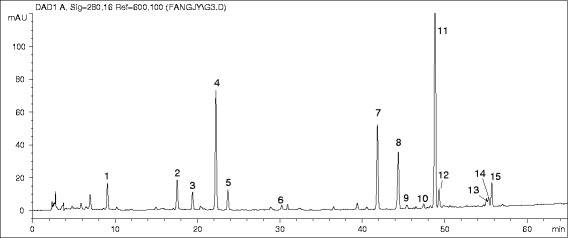
A HPLC-DAD method with validation was developed for PRC samples. Seven batches of plant samples from two processing methods, stir-frying and steaming, were analyzed by the HPLC-DAD method. Common peaks in PRC chromatograms were chosen to calculate their relative retention time (RRT) and relative peak area (RPA), and similarity analyses of the chromatographic fingerprints were conducted by Similarity Evaluation System for Chromatographic Fingerprint of Traditional Chinese Medicine software (Version 2004 A).
In the 24-h stability test, the relative standard deviation for the RRT and RPA was less than 0.07% and 2.57%, respectively. The precision was less than 0.08% for the RRT and 2.48% for the RPA. The repeatability for the RRT and RPA was less than 0.03% and 2.64%, respectively. The similarities between the seven PRC batches were range from 0.956 to 0.990. After stir-frying or steaming, the amount of ferulic acid in PRC was much higher than that in the raw material.
The fingerprint analysis of PRC by different processing methods was feasible by HPLC-DAD.
川芎是伞形科植物川芎的干燥根茎,多种炮制品在中国广泛应用。然而,这些炮制品的质量保证和质量控制仍具挑战性。本研究旨在通过高效液相色谱(HPLC)结合二极管阵列检测(DAD)法研究各种川芎炮制品的化学成分。
建立了一种经验证的用于川芎炮制品样品的HPLC-DAD方法。采用HPLC-DAD法对来自炒法和蒸法两种炮制方法的7批植物样品进行分析。选取川芎炮制品色谱图中的共有峰计算其相对保留时间(RRT)和相对峰面积(RPA),并使用《中药色谱指纹图谱相似度评价系统》软件(2004 A版)进行色谱指纹图谱相似度分析。
在24小时稳定性试验中,RRT和RPA的相对标准偏差分别小于0.07%和2.57%。RRT的精密度小于0.08%,RPA的精密度小于2.48%。RRT和RPA的重复性分别小于0.03%和2.64%。7批川芎炮制品之间的相似度范围为0.956至0.990。经过炒或蒸后,川芎炮制品中阿魏酸的含量远高于原料中的含量。
采用HPLC-DAD法对不同炮制方法的川芎炮制品进行指纹图谱分析是可行的。