Macri Christophe, Wang Fengjuan, Tasset Inmaculada, Schall Nicolas, Page Nicolas, Briand Jean-Paul, Cuervo Ana Maria, Muller Sylviane
a CNRS; Immunopathologie et chimie thérapeutique/Laboratory of excellence Medalis ; Institut de Biologie Moléculaire et Cellulaire ; Strasbourg , France.
Autophagy. 2015;11(3):472-86. doi: 10.1080/15548627.2015.1017179.
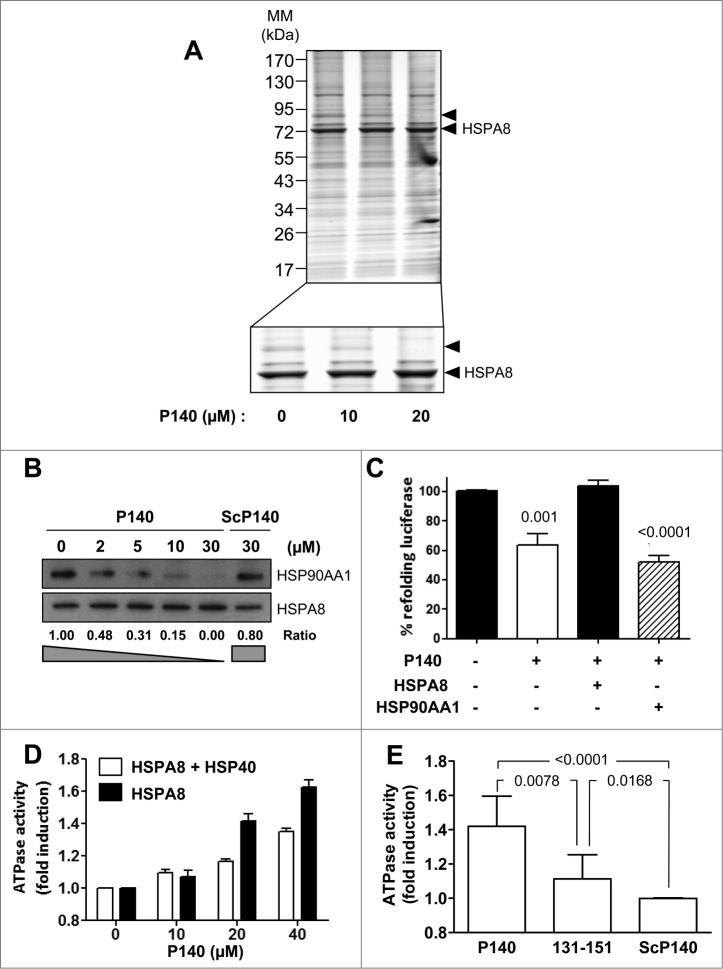
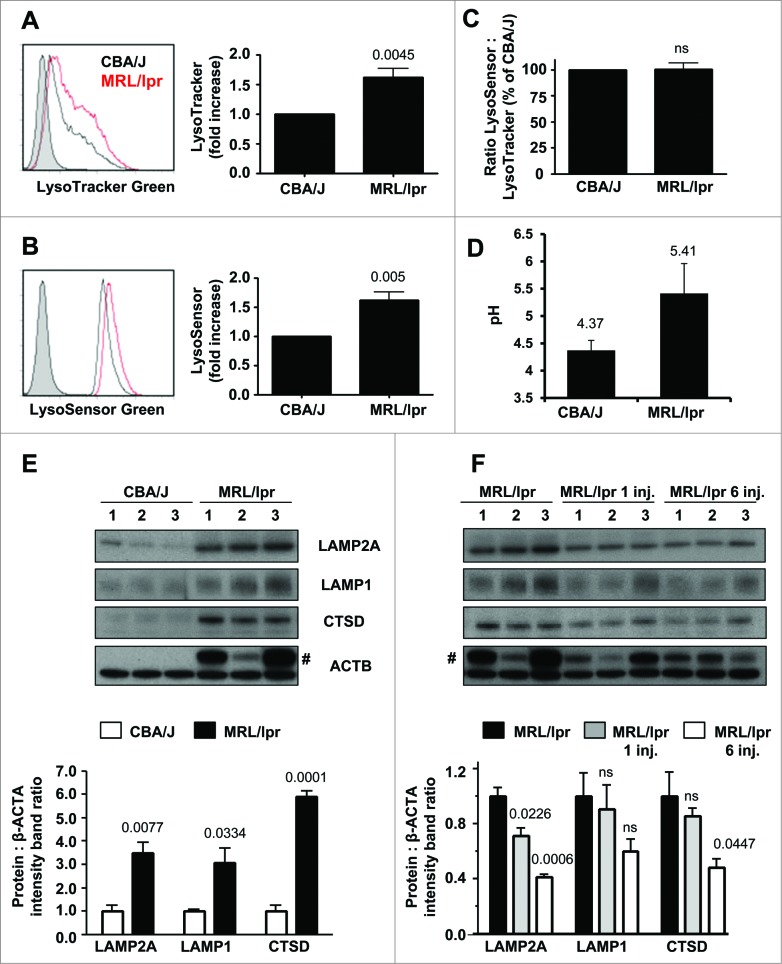
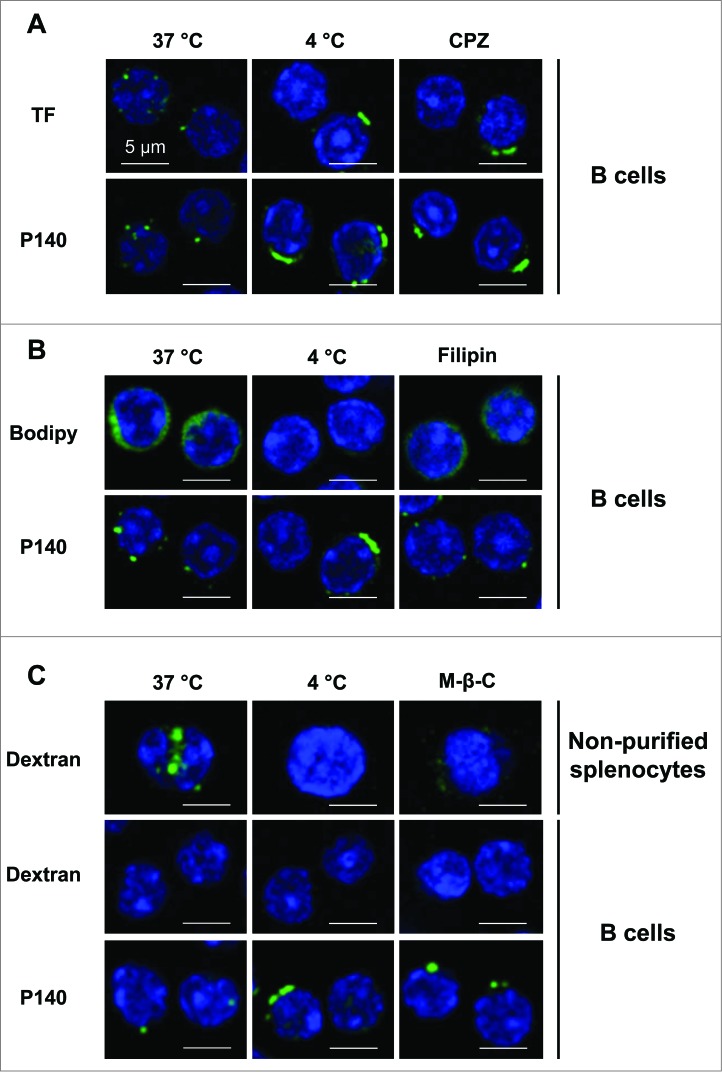
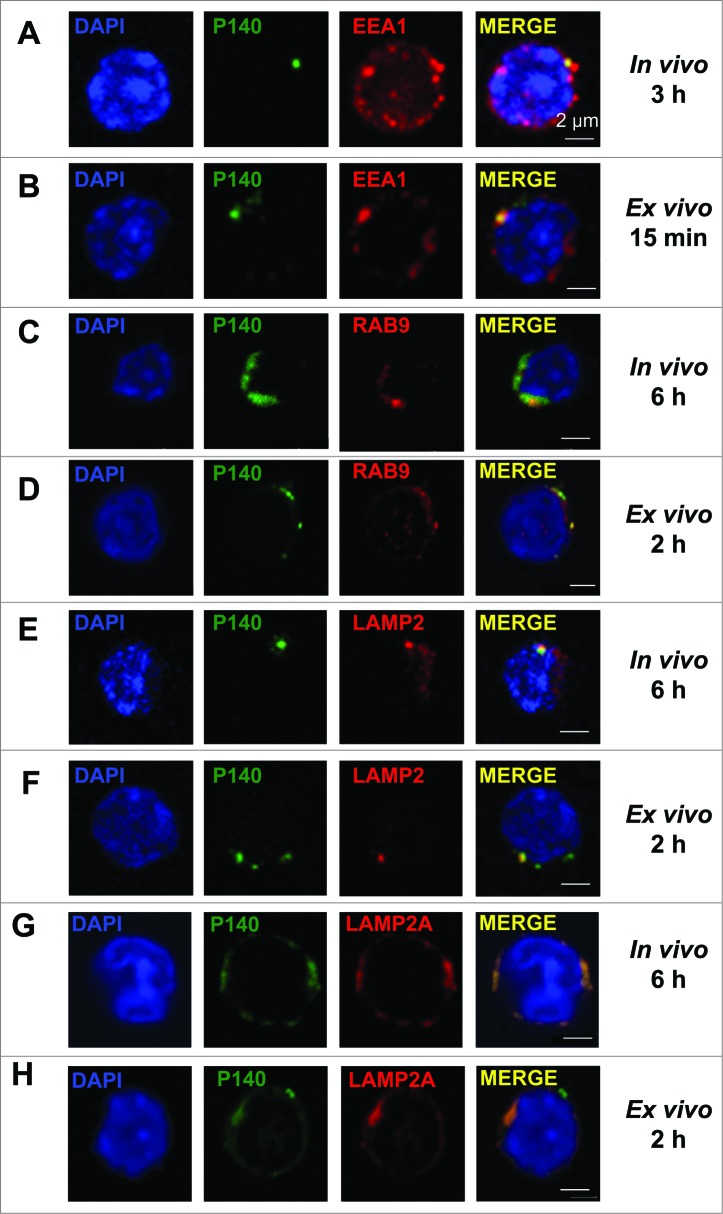
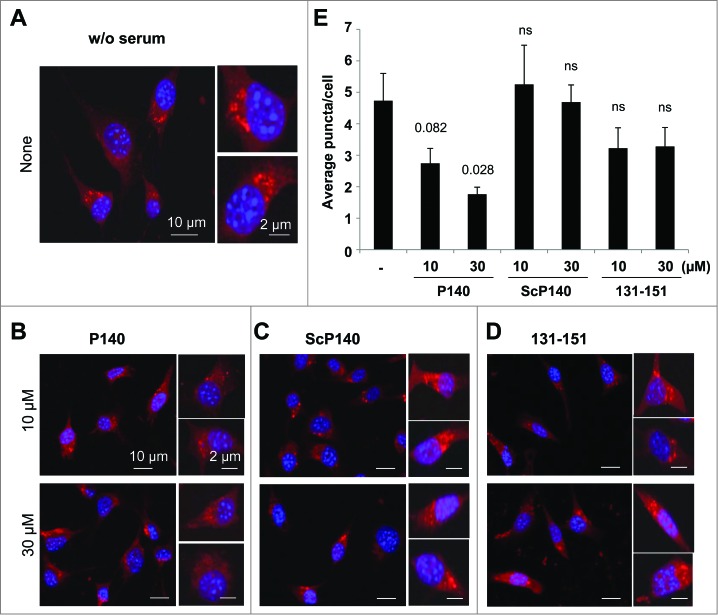
The P140 peptide, a 21-mer linear peptide (sequence 131-151) generated from the spliceosomal SNRNP70/U1-70K protein, contains a phosphoserine residue at position 140. It significantly ameliorates clinical manifestations in autoimmune patients with systemic lupus erythematosus and enhances survival in MRL/lpr lupus-prone mice. Previous studies showed that after P140 treatment, there is an accumulation of autophagy markers sequestosome 1/p62 and MAP1LC3-II in MRL/lpr B cells, consistent with a downregulation of autophagic flux. We now identify chaperone-mediated autophagy (CMA) as a target of P140 and demonstrate that its inhibitory effect on CMA is likely tied to its ability to alter the composition of HSPA8/HSC70 heterocomplexes. As in the case of HSPA8, expression of the limiting CMA component LAMP2A, which is increased in MRL/lpr B cells, is downregulated after P140 treatment. We also show that P140, but not the unphosphorylated peptide, uses the clathrin-dependent endo-lysosomal pathway to enter into MRL/lpr B lymphocytes and accumulates in the lysosomal lumen where it may directly hamper lysosomal HSPA8 chaperoning functions, and also destabilize LAMP2A in lysosomes as a result of its effect on HSP90AA1. This dual effect may interfere with the endogenous autoantigen processing and loading to major histocompatibility complex class II molecules and as a consequence, lead to lower activation of autoreactive T cells. These results shed light on mechanisms by which P140 can modulate lupus disease and exert its tolerogenic activity in patients. The unique selective inhibitory effect of the P140 peptide on CMA may be harnessed in other pathological conditions in which reduction of CMA activity would be desired.
P140肽是一种由剪接体snRNP70/U1 - 70K蛋白产生的21聚体线性肽(序列131 - 151),在第140位含有一个磷酸丝氨酸残基。它能显著改善系统性红斑狼疮自身免疫患者的临床表现,并提高MRL/lpr狼疮易感小鼠的存活率。先前的研究表明,P140处理后,MRL/lpr B细胞中自噬标志物聚集体蛋白1/p62和微管相关蛋白1轻链3-II(MAP1LC3-II)会积累,这与自噬通量的下调一致。我们现在确定伴侣介导的自噬(CMA)是P140的作用靶点,并证明其对CMA的抑制作用可能与其改变热休克蛋白家族A成员8(HSPA8)/热休克同源蛋白70(HSC70)异源复合物组成的能力有关。与HSPA8的情况一样,在MRL/lpr B细胞中表达增加的CMA限速成分溶酶体相关膜蛋白2A(LAMP2A)在P140处理后表达下调。我们还表明,P140肽(而非未磷酸化的肽)利用网格蛋白依赖的内吞-溶酶体途径进入MRL/lpr B淋巴细胞,并在溶酶体腔中积累,在那里它可能直接阻碍溶酶体HSPA8的伴侣功能,并且由于其对热休克蛋白90α家族成员1(HSP90AA1)的作用,使溶酶体中的LAMP2A不稳定。这种双重作用可能会干扰内源性自身抗原的加工和加载到主要组织相容性复合体II类分子上,从而导致自身反应性T细胞的活化降低。这些结果揭示了P140调节狼疮疾病并在患者中发挥其免疫耐受活性的机制。P140肽对CMA的独特选择性抑制作用可能在其他需要降低CMA活性的病理条件中得到应用。