Kim Juryun, Kim Youngkyun, Yi Hyoju, Jung Hyerin, Rim Yeri Alice, Park Narae, Jung Seung Min, Park Sung-Hwan, Ju Ji Hyeon
Clinical Immunology and STEM (CiSTEM) Cell Laboratory, Convergent Research Consortium for Immunologic Disease, Seoul St. Mary's Hospital, College of Medicine, The Catholic University of Korea, Seoul, Korea.
Clinical Immunology and STEM (CiSTEM) Cell Laboratory, Convergent Research Consortium for Immunologic Disease, Seoul St. Mary's Hospital, College of Medicine, The Catholic University of Korea, Seoul, Korea. ; Division of Rheumatology, Department of Internal Medicine, Seoul St. Mary's Hospital, College of Medicine, The Catholic University of Korea, Seoul, Korea.
J Korean Med Sci. 2015 Mar;30(3):233-9. doi: 10.3346/jkms.2015.30.3.233. Epub 2015 Feb 16.
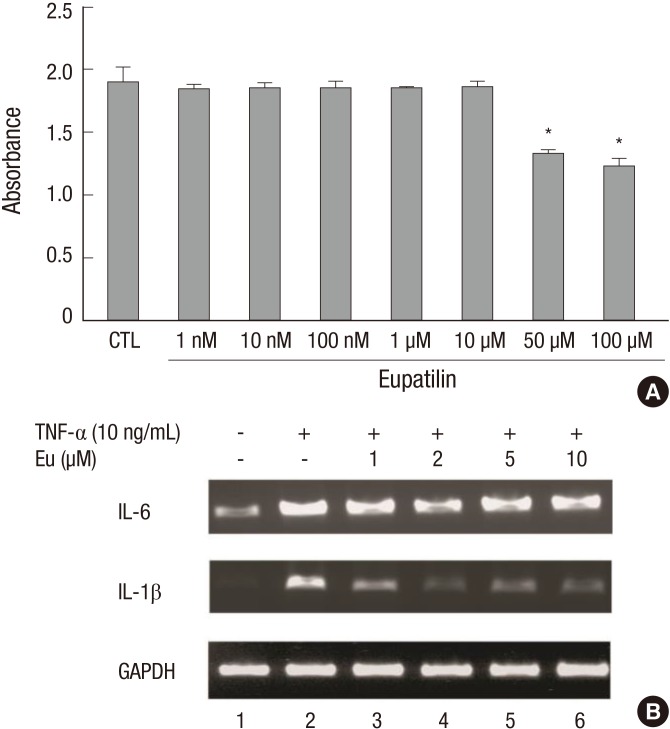
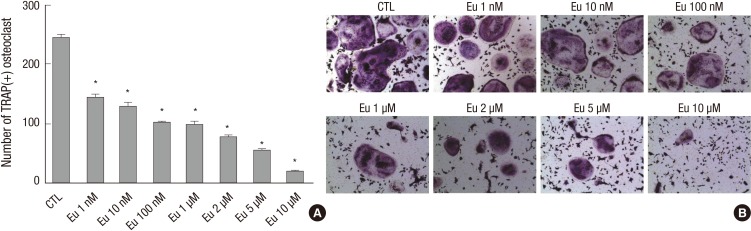
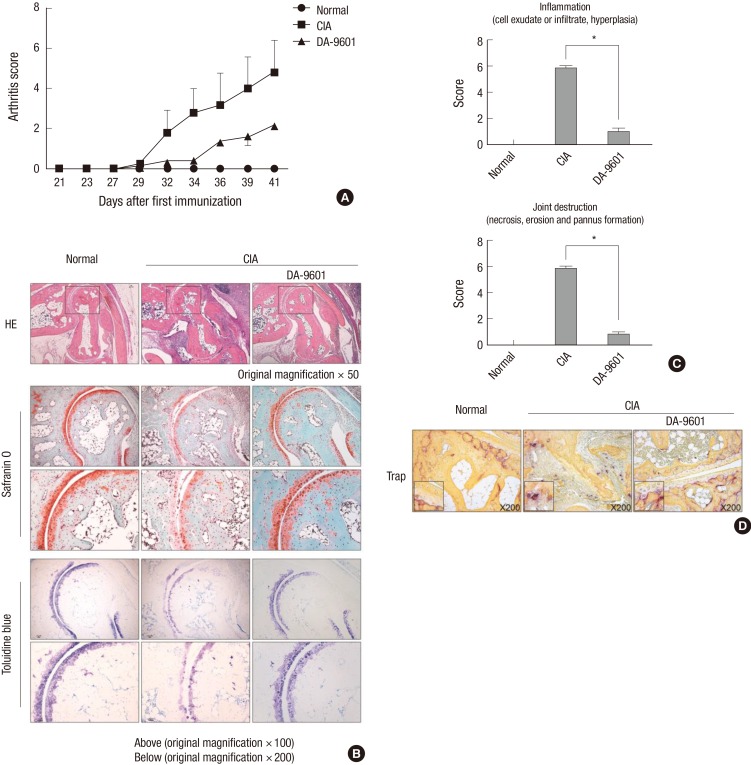
Eupatilin is the main active component of DA-9601, an extract from Artemisia. Recently, eupatilin was reported to have anti-inflammatory properties. We investigated the anti-arthritic effect of eupatilin in a murine arthritis model and human rheumatoid synoviocytes. DA-9601 was injected into collagen-induced arthritis (CIA) mice. Arthritis score was regularly evaluated. Mouse monocytes were differentiated into osteoclasts when eupatilin was added simultaneously. Osteoclasts were stained with tartrate-resistant acid phosphatase and then manually counted. Rheumatoid synoviocytes were stimulated with TNF-α and then treated with eupatilin, and the levels of IL-6 and IL-1β mRNA expression in synoviocytes were measured by RT-PCR. Intraperitoneal injection of DA-9601 reduced arthritis scores in CIA mice. TNF-α treatment of synoviocytes increased the expression of IL-6 and IL-1β mRNAs, which was inhibited by eupatilin. Eupatilin decreased the number of osteoclasts in a concentration dependent manner. These findings, showing that eupatilin and DA-9601 inhibited the expression of inflammatory cytokines and the differentiation of osteoclasts, suggest that eupatilin and DA-9601 is a candidate anti-inflammatory agent.
灯盏乙素是DA - 9601的主要活性成分,DA - 9601是一种从艾草中提取的物质。最近,有报道称灯盏乙素有抗炎特性。我们在小鼠关节炎模型和人类类风湿性滑膜细胞中研究了灯盏乙素的抗关节炎作用。将DA - 9601注射到胶原诱导的关节炎(CIA)小鼠体内。定期评估关节炎评分。当同时添加灯盏乙素时,小鼠单核细胞分化为破骨细胞。用抗酒石酸酸性磷酸酶对破骨细胞进行染色,然后人工计数。用肿瘤坏死因子-α(TNF-α)刺激类风湿性滑膜细胞,然后用灯盏乙素处理,通过逆转录聚合酶链反应(RT-PCR)测量滑膜细胞中白细胞介素-6(IL-6)和白细胞介素-1β(IL-1β)mRNA的表达水平。腹腔注射DA - 9601可降低CIA小鼠的关节炎评分。TNF-α处理滑膜细胞会增加IL-6和IL-1β mRNA的表达,而灯盏乙素可抑制这种增加。灯盏乙素以浓度依赖性方式减少破骨细胞的数量。这些结果表明灯盏乙素和DA - 9601可抑制炎性细胞因子的表达和破骨细胞的分化,提示灯盏乙素和DA - 9601是一种潜在的抗炎药物。