Van Den Broucke Steven, Kanobana Kirezi, Polman Katja, Soentjens Patrick, Vekemans Marc, Theunissen Caroline, Vlieghe Erika, Van Esbroeck Marjan, Jacobs Jan, Van Den Enden Erwin, Van Den Ende Jef, Van Gompel Alfons, Clerinx Jan, Bottieau Emmanuel
Department of Clinical Sciences, Institute of Tropical Medicine, Antwerp, Belgium.
Department of Biomedical Sciences, Institute of Tropical Medicine, Antwerp, Belgium.
PLoS Negl Trop Dis. 2015 Mar 6;9(3):e0003559. doi: 10.1371/journal.pntd.0003559. eCollection 2015 Mar.
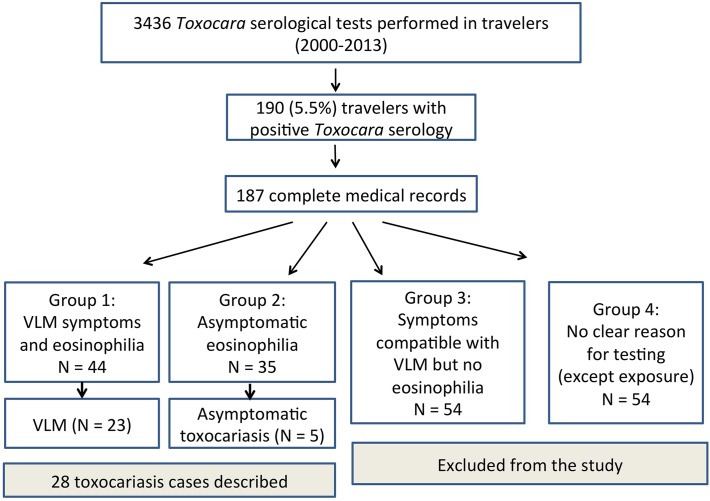
Although infection with Toxocara canis or T. catis (commonly referred as toxocariasis) appears to be highly prevalent in (sub)tropical countries, information on its frequency and presentation in returning travelers and migrants is scarce. In this study, we reviewed all cases of asymptomatic and symptomatic toxocariasis diagnosed during post-travel consultations at the reference travel clinic of the Institute of Tropical Medicine, Antwerp, Belgium. Toxocariasis was considered as highly probable if serum Toxocara-antibodies were detected in combination with symptoms of visceral larva migrans if present, elevated eosinophil count in blood or other relevant fluid and reasonable exclusion of alternative diagnosis, or definitive in case of documented seroconversion. From 2000 to 2013, 190 travelers showed Toxocara-antibodies, of a total of 3436 for whom the test was requested (5.5%). Toxocariasis was diagnosed in 28 cases (23 symptomatic and 5 asymptomatic) including 21 highly probable and 7 definitive. All but one patients were adults. Africa and Asia were the place of acquisition for 10 and 9 cases, respectively. Twelve patients (43%) were short-term travelers (< 1 month). Symptoms, when present, developed during travel or within 8 weeks maximum after return, and included abdominal complaints (11/23 symptomatic patients, 48%), respiratory symptoms and skin abnormalities (10 each, 43%) and fever (9, 39%), often in combination. Two patients were diagnosed with transverse myelitis. At presentation, the median blood eosinophil count was 1720/μL [range: 510-14160] in the 21 symptomatic cases without neurological complication and 2080/μL [range: 1100-2970] in the 5 asymptomatic individuals. All patients recovered either spontaneously or with an anti-helminthic treatment (mostly a 5-day course of albendazole), except both neurological cases who kept sequelae despite repeated treatments and prolonged corticotherapy. Toxocariasis has to be considered in travelers returning from a (sub)tropical stay with varying clinical manifestations or eosinophilia. Prognosis appears favorable with adequate treatment except in case of neurological involvement.
尽管犬弓首线虫或猫弓首线虫感染(通常称为弓首线虫病)在(亚)热带国家似乎非常普遍,但关于其在归国旅行者和移民中的感染频率及表现的信息却很少。在本研究中,我们回顾了比利时安特卫普热带医学研究所参考旅行诊所旅行后咨询期间诊断出的所有无症状和有症状的弓首线虫病病例。如果检测到血清弓首线虫抗体,同时伴有内脏幼虫移行症的症状(若有)、血液或其他相关液体中嗜酸性粒细胞计数升高且合理排除其他诊断,或者有血清学转换记录,则认为弓首线虫病极有可能;若确诊则为确诊病例。2000年至2013年期间,在总共3436名接受检测的旅行者中,有190人显示出弓首线虫抗体(5.5%)。共诊断出28例弓首线虫病(23例有症状,5例无症状),其中21例极有可能,7例确诊。除1例患者外,其余均为成年人。非洲和亚洲分别是10例和9例的感染地。12名患者(43%)为短期旅行者(<1个月)。出现症状时,症状在旅行期间或返回后最多8周内出现,包括腹部不适(11/23例有症状患者,48%)、呼吸道症状和皮肤异常(各10例,43%)以及发热(9例,39%),通常合并出现。2例患者被诊断为横贯性脊髓炎。就诊时,21例无神经系统并发症的有症状病例的血液嗜酸性粒细胞计数中位数为1720/μL[范围:510 - 14160],5例无症状个体的为2080/μL[范围:1100 - 2970]。除2例神经系统病例外,所有患者均自发康复或接受抗蠕虫治疗(大多为5天的阿苯达唑疗程),这2例神经系统病例尽管反复治疗和长期使用皮质类固醇疗法仍留有后遗症。对于从(亚)热带地区归来、有不同临床表现或嗜酸性粒细胞增多的旅行者,必须考虑弓首线虫病。除神经系统受累外,适当治疗后预后似乎良好。