Kidia Khameer, Machando Debra, Bere Tarisai, Macpherson Kirsty, Nyamayaro Primrose, Potter Lucy, Makadzange Tariro, Munjoma Ronald, Marufu Marshall, Araya Ricardo, Safren Steven, O'Cleirigh Conall, Chibanda Dixon, Abas Melanie
Arnhold Global Health Institute, Icahn School of Medicine at Mount Sinai, New York, NY, USA.
University of Zimbabwe College of Health Sciences, Harare, Zimbabwe.
Trop Med Int Health. 2015 Jul;20(7):903-13. doi: 10.1111/tmi.12502. Epub 2015 Mar 23.
To document the lived experiences of people with both poor mental health and suboptimal adherence to antiretroviral therapy in high HIV prevalence settings.
In-depth qualitative interviews were conducted with 47 (female = 31) HIV-positive adults who scored above the cut-point on a locally validated scale for common mental disorders (CMDs). Purposive sampling was used to recruit participants with evidence of poor adherence. Six additional key informant interviews (female = 6) were conducted with healthcare workers. Data were collected and analysed inductively by an interdisciplinary coding team.
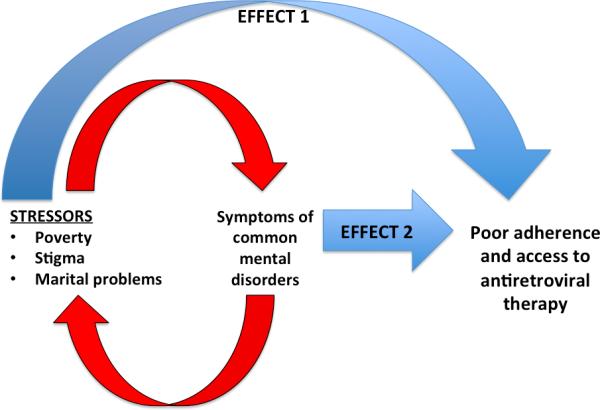
The major challenges faced by participants were stressors (poverty, stigma, marital problems) and symptoms of CMDs ('thinking too much', changes to appetite and sleep, 'burdened heart' and low energy levels). Thinking too much, which appears closely related to rumination, was the symptom with the greatest negative impact on adherence to antiretroviral therapy among HIV-positive adults with CMDs. In turn, thinking too much was commonly triggered by the stressors faced by people living with HIV/AIDS, especially poverty. Finally, participants desired private counselling, access to income-generating activities and family engagement in mental health care.
Better understanding of the local expression of mental disorders and of underlying stressors can inform the development of culturally sensitive interventions to reduce CMDs and poor adherence to antiretroviral therapy.
记录在高艾滋病毒流行率环境中,心理健康状况不佳且抗逆转录病毒疗法依从性欠佳的人群的生活经历。
对47名(女性31名)艾滋病毒呈阳性的成年人进行了深入的定性访谈,这些成年人在当地经过验证的常见精神障碍(CMD)量表上得分高于临界点。采用目的抽样法招募有依从性差证据的参与者。另外对6名医护人员(女性6名)进行了关键 informant 访谈。数据由一个跨学科编码团队进行归纳收集和分析。
参与者面临的主要挑战是压力源(贫困、耻辱感、婚姻问题)和CMD症状(“想得太多”、食欲和睡眠改变、“心累”和精力水平低下)。“想得太多”似乎与沉思密切相关,是对患有CMD的艾滋病毒呈阳性成年人抗逆转录病毒疗法依从性产生最大负面影响的症状。反过来,“想得太多”通常由艾滋病毒/艾滋病感染者面临的压力源引发,尤其是贫困。最后,参与者希望获得私人咨询、有创收活动的机会以及家人参与精神卫生保健。
更好地理解精神障碍的当地表现形式和潜在压力源,可为制定具有文化敏感性的干预措施提供信息,以减少CMD和抗逆转录病毒疗法依从性差的情况。