Bosdriesz Evert, Molenaar Douwe, Teusink Bas, Bruggeman Frank J
Systems Bioinformatics, VU University, Amsterdam, The Netherlands.
FEBS J. 2015 May;282(10):2029-44. doi: 10.1111/febs.13258. Epub 2015 Mar 26.
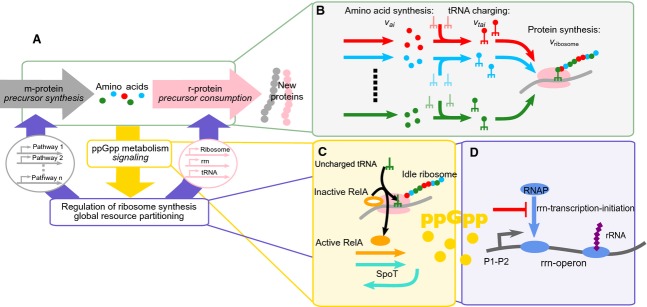
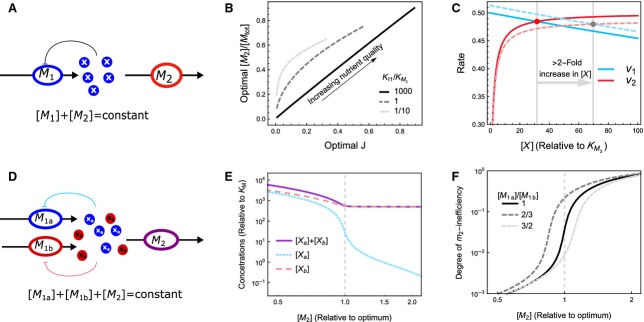
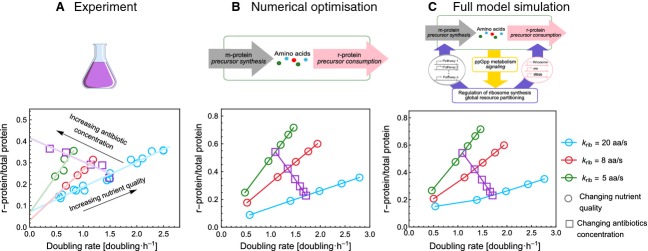
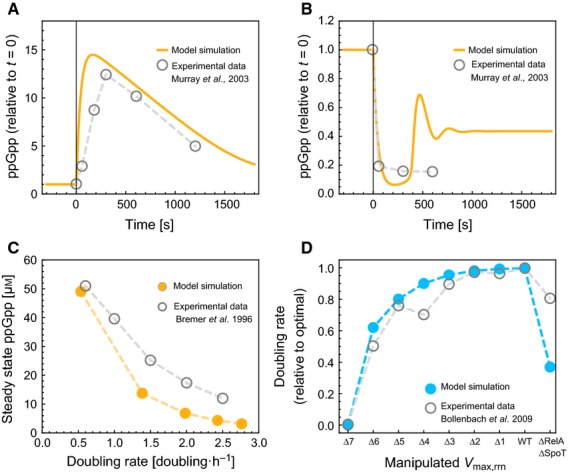
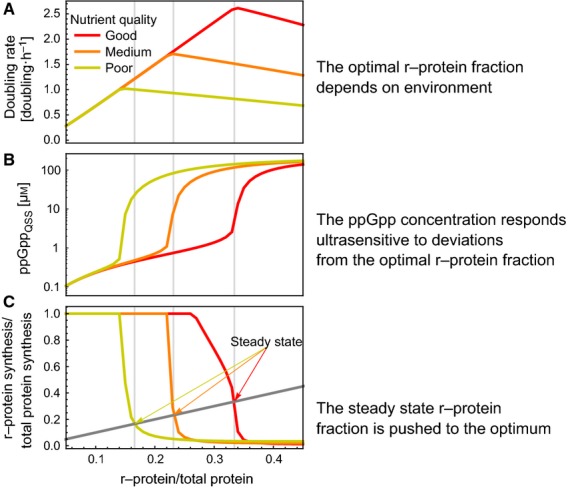
Maximization of growth rate is an important fitness strategy for bacteria. Bacteria can achieve this by expressing proteins at optimal concentrations, such that resources are not wasted. This is exemplified for Escherichia coli by the increase of its ribosomal protein-fraction with growth rate, which precisely matches the increased protein synthesis demand. These findings and others have led to the hypothesis that E. coli aims to maximize its growth rate in environments that support growth. However, what kind of regulatory strategy is required for a robust, optimal adjustment of the ribosome concentration to the prevailing condition is still an open question. In the present study, we analyze the ppGpp-controlled mechanism of ribosome expression used by E. coli and show that this mechanism maintains the ribosomes saturated with its substrates. In this manner, overexpression of the highly abundant ribosomal proteins is prevented, and limited resources can be redirected to the synthesis of other growth-promoting enzymes. It turns out that the kinetic conditions for robust, optimal protein-partitioning, which are required for growth rate maximization across conditions, can be achieved with basic biochemical interactions. We show that inactive ribosomes are the most suitable 'signal' for tracking the intracellular nutritional state and for adjusting gene expression accordingly, as small deviations from optimal ribosome concentration cause a huge fractional change in ribosome inactivity. We expect to find this control logic implemented across fast-growing microbial species because growth rate maximization is a common selective pressure, ribosomes are typically highly abundant and thus costly, and the required control can be implemented by a small, simple network.
最大化生长速率是细菌的一种重要适应性策略。细菌可以通过以最佳浓度表达蛋白质来实现这一点,从而避免资源浪费。以大肠杆菌为例,其核糖体蛋白比例随生长速率增加,这恰好与蛋白质合成需求的增加相匹配。这些发现以及其他一些发现引发了这样一种假说,即大肠杆菌旨在在支持生长的环境中最大化其生长速率。然而,对于将核糖体浓度稳健且最优地调整到当前条件需要何种调控策略,仍然是一个悬而未决的问题。在本研究中,我们分析了大肠杆菌使用的由鸟苷四磷酸(ppGpp)控制的核糖体表达机制,并表明该机制使核糖体保持底物饱和状态。通过这种方式,可防止高丰度核糖体蛋白的过表达,有限的资源能够被重新导向其他促进生长的酶的合成。结果表明,通过基本的生化相互作用就可以实现跨条件最大化生长速率所需的稳健、最优蛋白质分配的动力学条件。我们表明,无活性核糖体是追踪细胞内营养状态并据此调整基因表达的最合适“信号”,因为与最佳核糖体浓度的微小偏差会导致核糖体无活性的巨大分数变化。我们预计会在快速生长的微生物物种中发现这种控制逻辑,因为生长速率最大化是一种常见的选择压力,核糖体通常高度丰富因而成本高昂,并且所需的控制可以通过一个小型、简单的网络来实现。