Scott Matthew, Klumpp Stefan, Mateescu Eduard M, Hwa Terence
Department of Applied Mathematics, University of Waterloo, Waterloo, ON, Canada
Max Planck Institute of Colloids and Interfaces, Potsdam, Germany.
Mol Syst Biol. 2014 Aug 22;10(8):747. doi: 10.15252/msb.20145379.
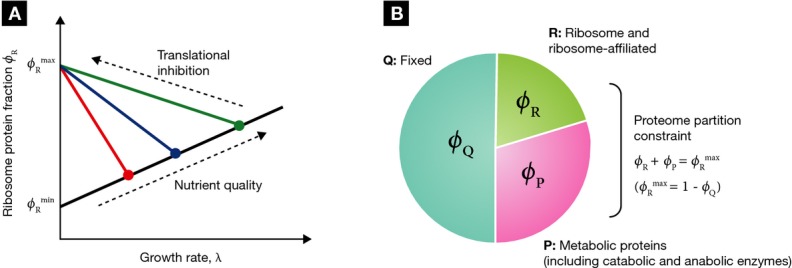
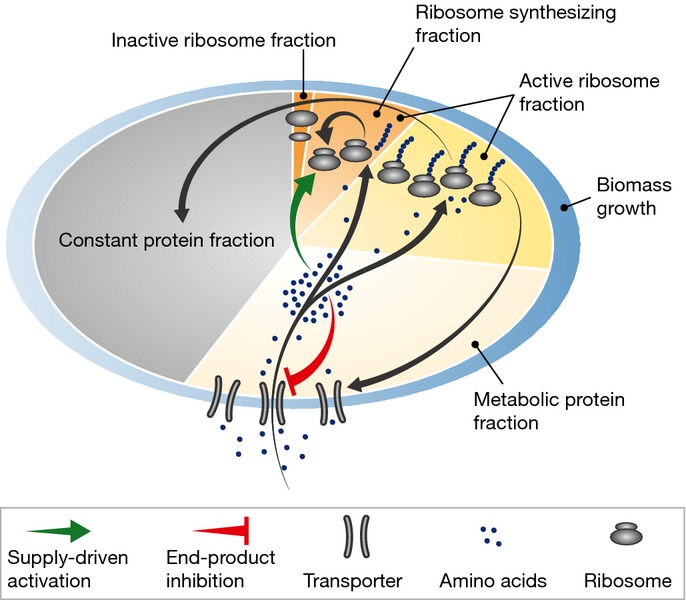
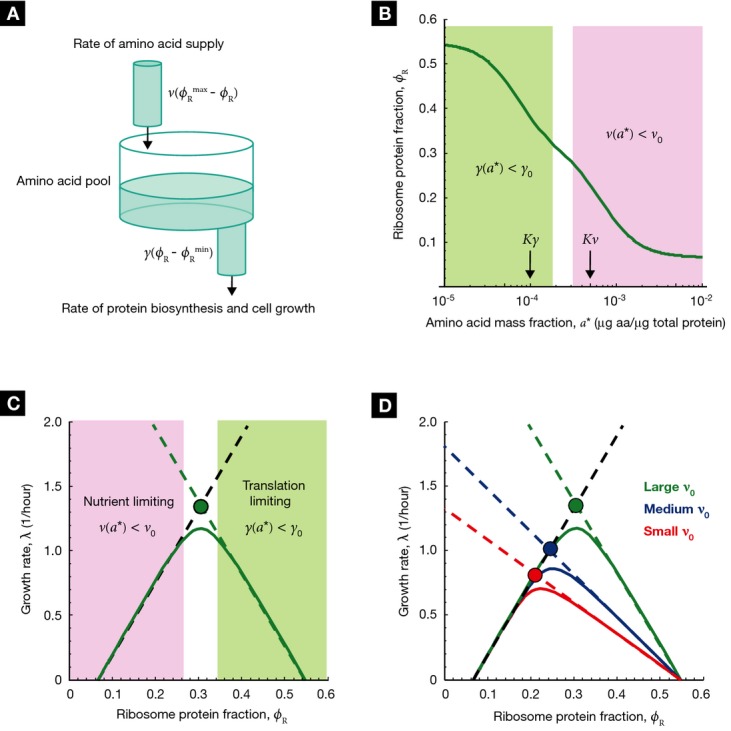
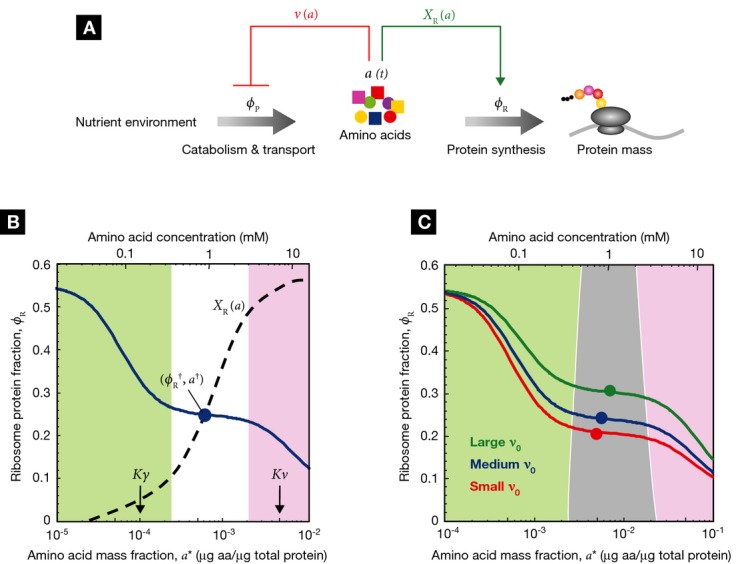
Bacteria must constantly adapt their growth to changes in nutrient availability; yet despite large-scale changes in protein expression associated with sensing, adaptation, and processing different environmental nutrients, simple growth laws connect the ribosome abundance and the growth rate. Here, we investigate the origin of these growth laws by analyzing the features of ribosomal regulation that coordinate proteome-wide expression changes with cell growth in a variety of nutrient conditions in the model organism Escherichia coli. We identify supply-driven feedforward activation of ribosomal protein synthesis as the key regulatory motif maximizing amino acid flux, and autonomously guiding a cell to achieve optimal growth in different environments. The growth laws emerge naturally from the robust regulatory strategy underlying growth rate control, irrespective of the details of the molecular implementation. The study highlights the interplay between phenomenological modeling and molecular mechanisms in uncovering fundamental operating constraints, with implications for endogenous and synthetic design of microorganisms.
细菌必须不断调整其生长以适应营养物质可用性的变化;然而,尽管与感知、适应和处理不同环境营养物质相关的蛋白质表达发生了大规模变化,但简单的生长规律将核糖体丰度与生长速率联系起来。在这里,我们通过分析核糖体调控的特征来研究这些生长规律的起源,这些特征在模式生物大肠杆菌的各种营养条件下,将全蛋白质组的表达变化与细胞生长协调起来。我们确定核糖体蛋白合成的供应驱动前馈激活是最大化氨基酸通量并自主引导细胞在不同环境中实现最佳生长的关键调控基序。生长规律自然地源于生长速率控制背后强大的调控策略,而与分子实施的细节无关。这项研究突出了现象学建模与分子机制在揭示基本操作限制方面的相互作用,对微生物的内源和合成设计具有启示意义。