Khedri Javad, Radfar Mohammad Hossein, Borji Hassan, Azizzadeh Mohammad, Akhtardanesh Baharak
Dept. of Pathobiology, School of Veterinary Medicine, Bahonar University of Kerman, Kerman, Iran.
Dept. of Pathobiology, School of Veterinary Medicine, Ferdowsi University of Mashhad, Mashhad, Iran.
Iran J Parasitol. 2014 Oct-Dec;9(4):560-7.
Heartworm (Dirofilaria immitis) is mosquito-borne filarial nematode capable of causing serious cardiopulmonary disease in canines and felines, and pulmonary dirofilariasis in man. This research was conducted with the objectives of determining the incidence and assessing possible risk factors of canine heartworm in the southeast of Iran.
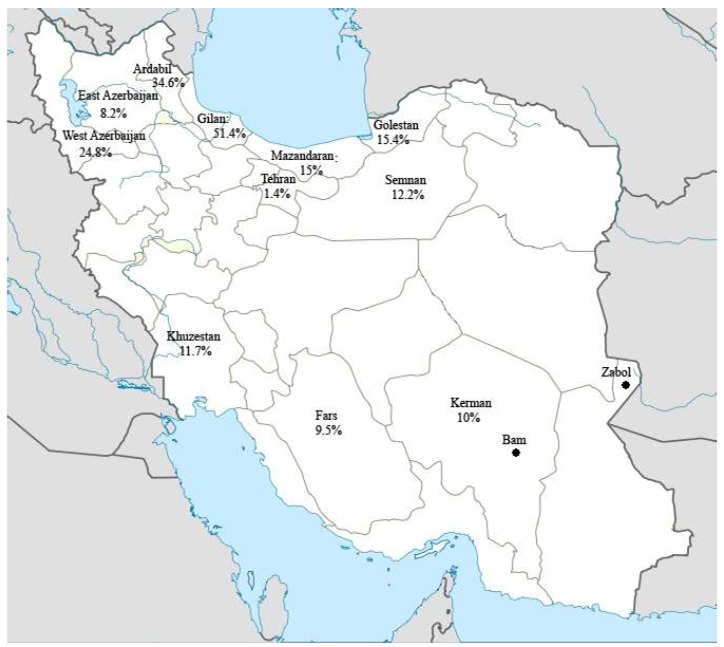
From October 2012 to September 2013, blood samples from 87 dogs from Zabol area in Sistan and Baluchestan and 33 dogs from Bam area in Kerman Province were examined for detection of Dirofilaria immitis using modified knott test and serology.
Out of 120 dogs, 29 (24.2%; 95%CI: 16.6-31.8%) were positive, serologically. The overall seroprevalence of D. immitis in dog in Zabol and Bam was 27.5% (95% CI: 24.7-32.5%) and 15.15% (95% CI: 12.3-20.7%), respectively. 28.8% of stray dogs and 20.6% of housed dogs in the study areas were seropositive. Seroprevalence of D. immitis was not significantly different between stray and housed dogs (P = 0.295). Investigation of seasonal dynamic of infection with D. immitis in stray and housed dog showed that the proportion of infected dog in spring and summer was greater than colder season (autumn and winter) which was not significant. The prevalence of infection with D. immitis in >5 years old stray dogs (53.8%) was greater than other age categories while in housed dogs infection rate was greater in 3-5 years old (27.3%).
It is important to point out the increased incidence of canine heatrworm in Iran. In order to stop the spread of canine heartworm, preventive measures must be taken now.
犬心丝虫(恶丝虫)是一种通过蚊子传播的丝状线虫,可在犬类和猫类中引起严重的心肺疾病,并在人类中导致肺恶丝虫病。本研究旨在确定伊朗东南部犬心丝虫的发病率并评估可能的危险因素。
2012年10月至2013年9月,对来自锡斯坦-俾路支斯坦省扎博勒地区的87只狗和克尔曼省巴姆地区的33只狗采集血样,采用改良克诺特氏试验和血清学方法检测恶丝虫。
120只狗中,29只(24.2%;95%置信区间:16.6 - 31.8%)血清学检测呈阳性。扎博勒和巴姆地区犬恶丝虫的总体血清阳性率分别为27.5%(95%置信区间:24.7 - 32.5%)和15.15%(95%置信区间:12.3 - 20.7%)。研究区域内28.8%的流浪狗和20.6%的家养狗血清学呈阳性。流浪狗和家养狗的恶丝虫血清阳性率无显著差异(P = 0.295)。对流浪狗和家养狗恶丝虫感染的季节性动态调查显示,春季和夏季感染狗的比例高于较寒冷季节(秋季和冬季),但差异不显著。5岁以上流浪狗的恶丝虫感染率(53.8%)高于其他年龄组,而家养狗中3 - 5岁的感染率更高(27.3%)。
需要指出的是,伊朗犬心丝虫的发病率有所上升。为阻止犬心丝虫的传播,现在必须采取预防措施。