Mohseni Mona, Vafa Mohamad Reza, Hajimiresmail Seyed Javad, Zarrati Mitra, Rahimi Forushani Abbas, Bitarafan Vida, Shidfar Farzad
Department of Nutrition, School of Public Health, Iran University of Medical Sciences, Tehran, IR Iran.
Cardiology Division, Department of Internal Medicine, School of Medicine, Iran University of Medical Sciences, Tehran, IR Iran.
Iran Red Crescent Med J. 2014 Oct 5;16(10):e16433. doi: 10.5812/ircmj.16433. eCollection 2014 Oct.
Low plasma concentrations of coenzyme Q10 (CoQ10) have been associated with concentration of lipoproteins and other factors contributing to coronary heart diseases.
The present investigation aimed to improve the blood pressure and serum lipoproteins concentration in patients with myocardial infarction (MI) by CoQ10 supplementation.
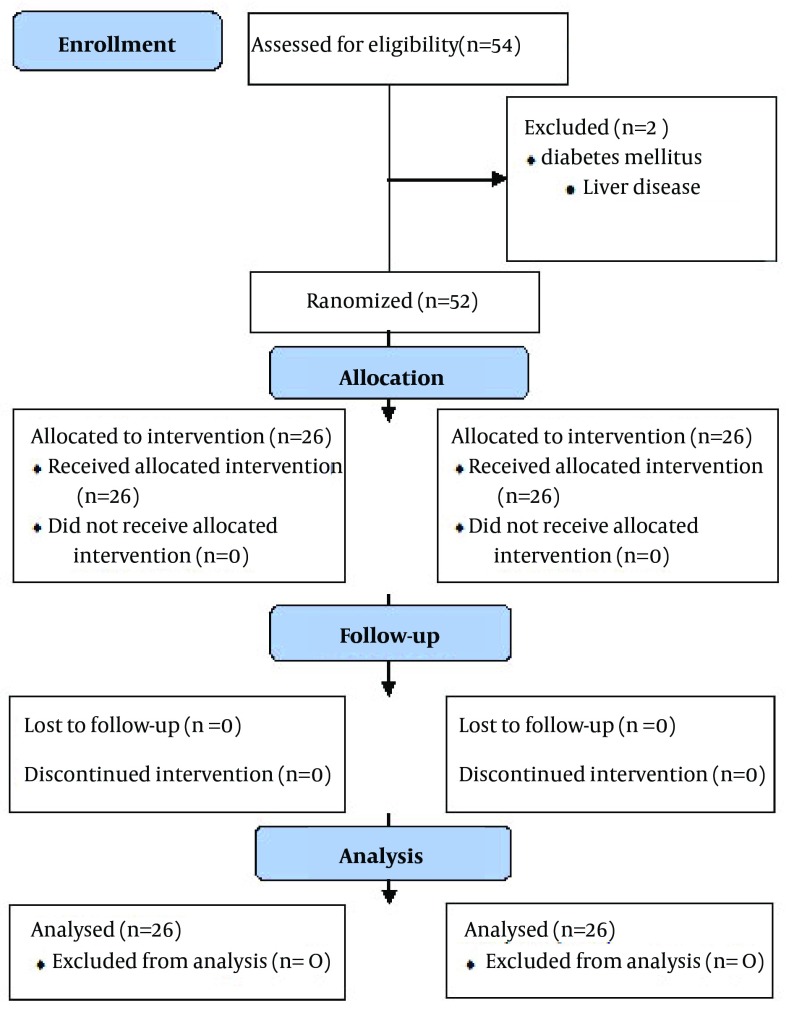
In this randomized double-blinded controlled clinical trial, 52 Iranian patients with hyperlipidemia and MI were recruited to examine the effect of CoQ10 on serum total cholesterol (TC), LDL-C, HDL-C, triglyceride (TG), LDL-C/HDL-C ratio, TC/HDL-C ratio, fibrinogen, systolic blood pressure (SBP) and diastolic blood pressure (DBP). Individuals were randomly allocated to two groups for receiving either 200 mg/d of CoQ10 or placebo for 12 weeks.
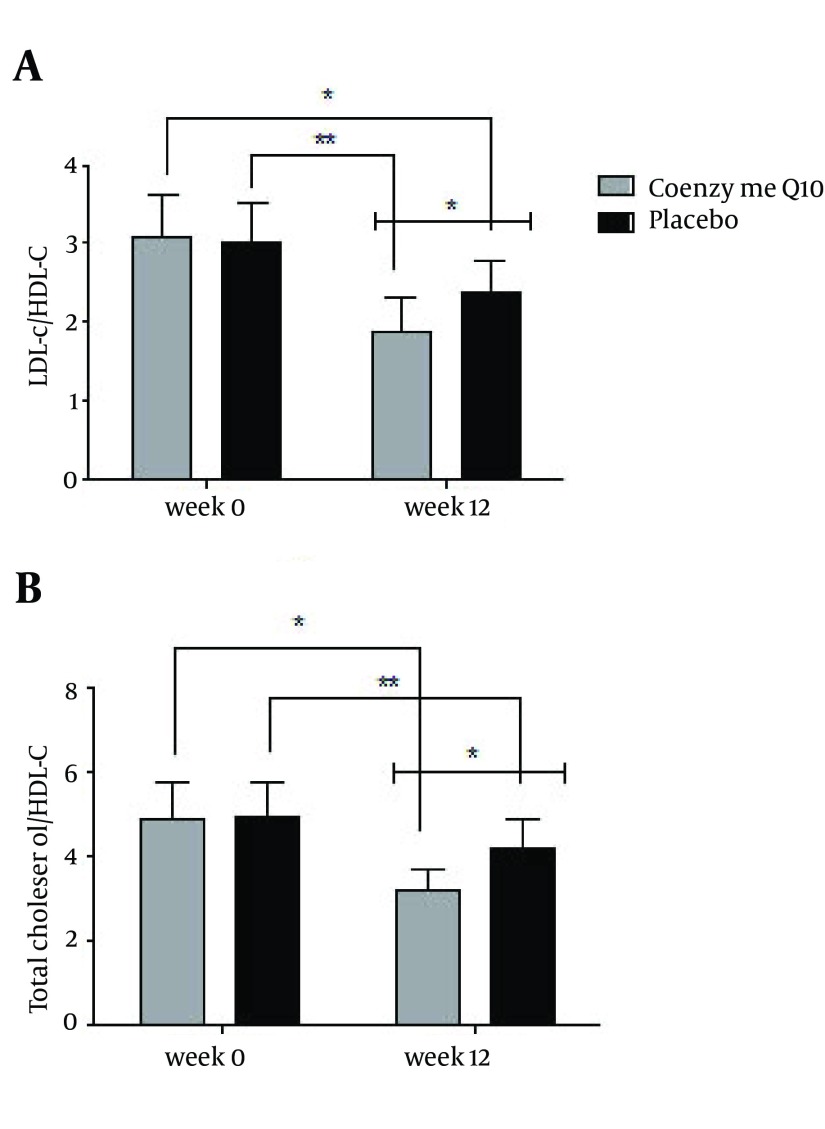
There were not significant differences in serum LDL-C (2.70 ± 0.31 vs. 2.70 ± 0.35 mmol/L), TC (4.47 ± 0.33 vs. 4.93 ± 0.57 mmol/L), TG (2.48 ± 0.12 vs. 2.25 ± 0.69 mmol/L), and fibrinogen (2.08 ± 0.99 vs. 38.7 ± 0.64 mg/dL) between CoQ10 and placebo groups. After 12 weeks, a significant enhancement in serum HDL-C (1.44 ± 0.18 vs. 1.14 ± 0.18 mmol/L) level was observed between groups after the supplementation (P < 0.001). A significant reduction of TC, LDL-C, and fibrinogen and a significant increase in HDL-C concentration was observed in CoQ10 group after intervention (P < 0.001). Our assessment demonstrated statistically significant differences between the two groups in SBP and DBP after intervention (P < 0.001). ANCOVA also revealed significant differences in the ratio of LDL-C/HDL-C and TC/HDL-C between the two groups (1.89 ± 0.42 vs. 2.39 ± 0.38, P = 0.002; and 3.2 ± 0.5 vs. 4.24 ± 0.66, P = 0.01, respectively). A significant reduction of LDL-C/HDL-C and TC/HDL-C was observed in CoQ10 group (P < 0.001).
Twelve-week supplementation with CoQ10 in patients with hyperlipidemia and MI can improve blood pressure, serum HDL-C as well as LDL-C/HDL-C and TC/HDL-C ratios; therefore, it might decrease the risk of frequent MI.
血浆辅酶Q10(CoQ10)浓度较低与脂蛋白浓度及其他导致冠心病的因素有关。
本研究旨在通过补充CoQ10改善心肌梗死(MI)患者的血压和血清脂蛋白浓度。
在这项随机双盲对照临床试验中,招募了52名患有高脂血症和MI的伊朗患者,以研究CoQ10对血清总胆固醇(TC)、低密度脂蛋白胆固醇(LDL-C)、高密度脂蛋白胆固醇(HDL-C)、甘油三酯(TG)、LDL-C/HDL-C比值、TC/HDL-C比值、纤维蛋白原、收缩压(SBP)和舒张压(DBP)的影响。将个体随机分为两组,分别接受200mg/d的CoQ10或安慰剂,为期12周。
CoQ10组和安慰剂组在血清LDL-C(2.70±0.31 vs. 2.70±0.35mmol/L)、TC(4.47±0.33 vs. 4.93±0.57mmol/L)、TG(2.48±0.12 vs. 2.25±0.69mmol/L)和纤维蛋白原(2.08±0.99 vs. 38.7±0.64mg/dL)方面无显著差异。补充后12周,两组间血清HDL-C水平有显著提高(1.44±0.18 vs. 1.14±0.18mmol/L)(P<0.001)。干预后CoQ10组的TC、LDL-C和纤维蛋白原有显著降低,HDL-C浓度有显著升高(P<0.001)。我们的评估显示干预后两组间SBP和DBP有统计学显著差异(P<0.001)。协方差分析还显示两组间LDL-C/HDL-C和TC/HDL-C比值有显著差异(分别为1.89±0.42 vs. 2.39±0.38,P = 0.002;3.2±0.5 vs. 4.24±0.66,P = 0.01)。CoQ10组的LDL-C/HDL-C和TC/HDL-C有显著降低(P<0.001)。
高脂血症和MI患者补充CoQ10十二周可改善血压及血清HDL-C以及LDL-C/HDL-C和TC/HDL-C比值;因此,可能降低频繁发生MI的风险。