Sidama Zone Social and Labour Affairs, Southern Nation, Nationality and People Regional State, Hawassa, Ethiopia.
Department of Reproductive Health, Institute of Public Health, University of Gondar, Gondar, Ethiopia.
BMC Nurs. 2015 Mar 3;14:9. doi: 10.1186/s12912-015-0062-1. eCollection 2015.
The rising rate of workplace violence in health care facilities has become a major problem for health care providers including nurses. However, evidences are lacking in Ethiopia particularly in the study area. The aim of this study is to assess the prevalence and associated factors of workplace violence among nurses working at health care facilities in Hawassa City Administration, Southern Ethiopia.
An institution-based cross-sectional study was conducted on 660 randomly selected nurses working at public health facilities in Hawassa City Administration in April 2014. A pre-tested and structured questionnaire was used to collect the data. Data were entered using EPI-Info and exported to SPSS for further analysis. Descriptive statistics were done. Logistic regression analyses were used to see the association between different variables and the outcome variable. Odds ratios with 95% Confidence Interval (CI) were computed to determine the presence and strength of the association.
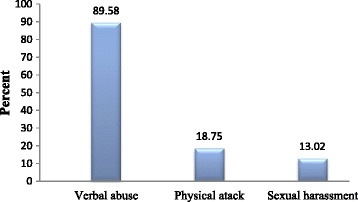
In this study, the prevalence of workplace violence was 29.9% [95% CI: 26.5, 33.5)] of which physical violence accounted for 36 (18.22%), verbal abuse for 172 (89.58%) and sexual harassment for 25 (13.02%). Female sex [AOR=2.00, 95% CI: (1.28, 2.39)], short work experience [AOR=8.86, 95% CI: (3.47, 22.64)], age group of 22-25 [AOR=4.17, 95% CI: (2.46, 7.08)], age group of (26-35) [AOR=1.9, 95% CI (1.16, 3.1)], work in emergency [(AOR=4.28, 95% CI: (1.39, 4.34)] and work in the Inpatient Department [(AOR=2.11, 95% CI: (1.98, 2.64)] were the factors positively associated with workplace violence.
A significant proportion of nurses faced violence while providing care at in public health facilities. Being female, younger age, short work experience, and assignment in emergency and inpatient departments were positively associated with workplace violence. Policy makers and stakeholders should focus on workplace violence prevention strategies.
医疗机构中工作场所暴力的发生率不断上升,已成为包括护士在内的医疗保健提供者的一个主要问题。然而,在埃塞俄比亚,特别是在研究区域,缺乏相关证据。本研究旨在评估在 Hawassa 市行政区域内工作的护士在工作场所遭受暴力的发生率及其相关因素。
2014 年 4 月,对 Hawassa 市行政区域内公共卫生机构的 660 名随机抽取的护士进行了一项基于机构的横断面研究。使用经过预测试和结构化的问卷收集数据。使用 EPI-Info 录入数据,并将其导出到 SPSS 进行进一步分析。进行描述性统计。使用逻辑回归分析来观察不同变量与结果变量之间的关联。计算比值比及其 95%置信区间(CI),以确定关联的存在和强度。
在本研究中,工作场所暴力的发生率为 29.9%(95%CI:26.5%,33.5%),其中物理暴力占 36 例(18.22%),言语虐待占 172 例(89.58%),性骚扰占 25 例(13.02%)。女性(AOR=2.00,95%CI:(1.28,2.39))、工作经验短(AOR=8.86,95%CI:(3.47,22.64))、22-25 岁年龄组(AOR=4.17,95%CI:(2.46,7.08))、(26-35)岁年龄组(AOR=1.9,95%CI(1.16,3.1))、在急诊部门工作(AOR=4.28,95%CI:(1.39,4.34))和在住院部门工作(AOR=2.11,95%CI:(1.98,2.64))是与工作场所暴力呈正相关的因素。
在公共卫生机构提供护理的过程中,相当一部分护士面临暴力。女性、年龄较小、工作经验较短、在急诊部门和住院部门工作与工作场所暴力呈正相关。政策制定者和利益相关者应关注工作场所暴力预防策略。