Oligschlaeger Yvonne, Miglianico Marie, Chanda Dipanjan, Scholz Roland, Thali Ramon F, Tuerk Roland, Stapleton David I, Gooley Paul R, Neumann Dietbert
From the Department of Molecular Genetics, CARIM School of Cardiovascular Diseases, Maastricht University, 6200 MD Maastricht, The Netherlands.
the Institute of Cell Biology, ETH Zurich, 8093 Zurich, Switzerland, and.
J Biol Chem. 2015 May 1;290(18):11715-28. doi: 10.1074/jbc.M114.633271. Epub 2015 Mar 19.
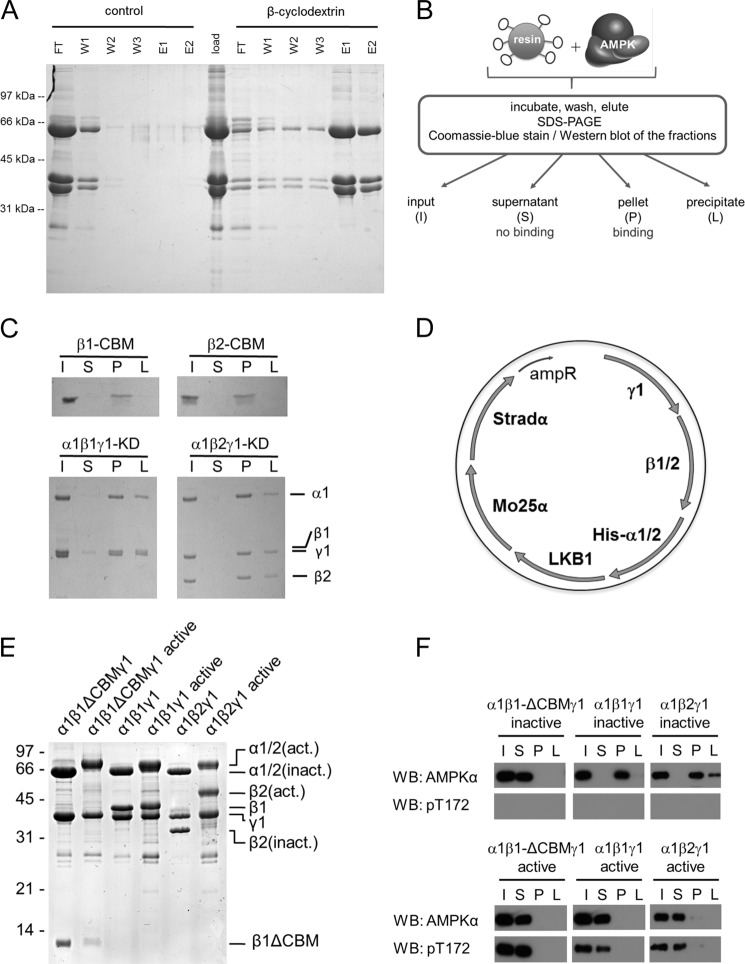
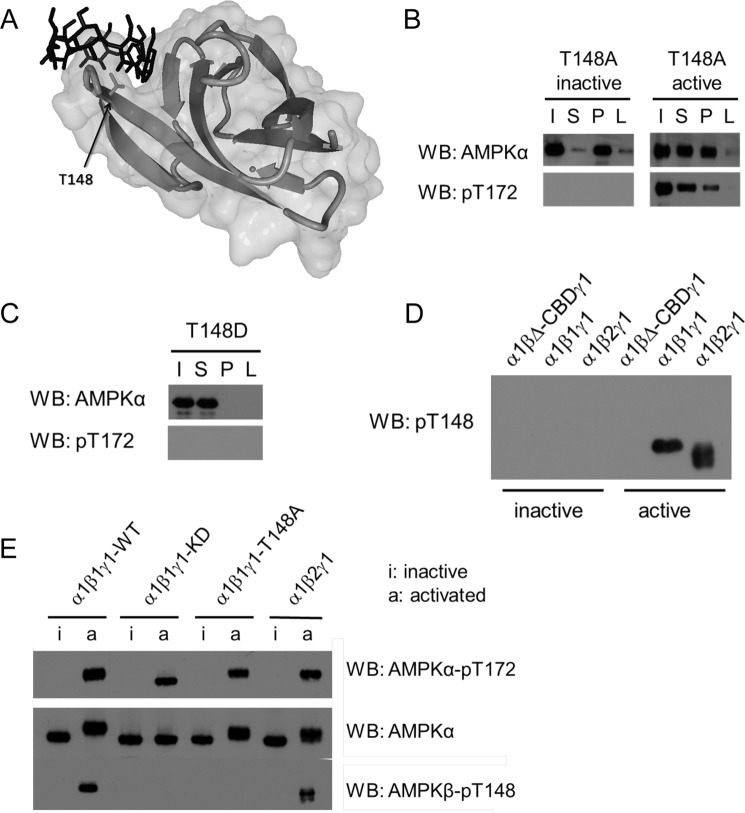
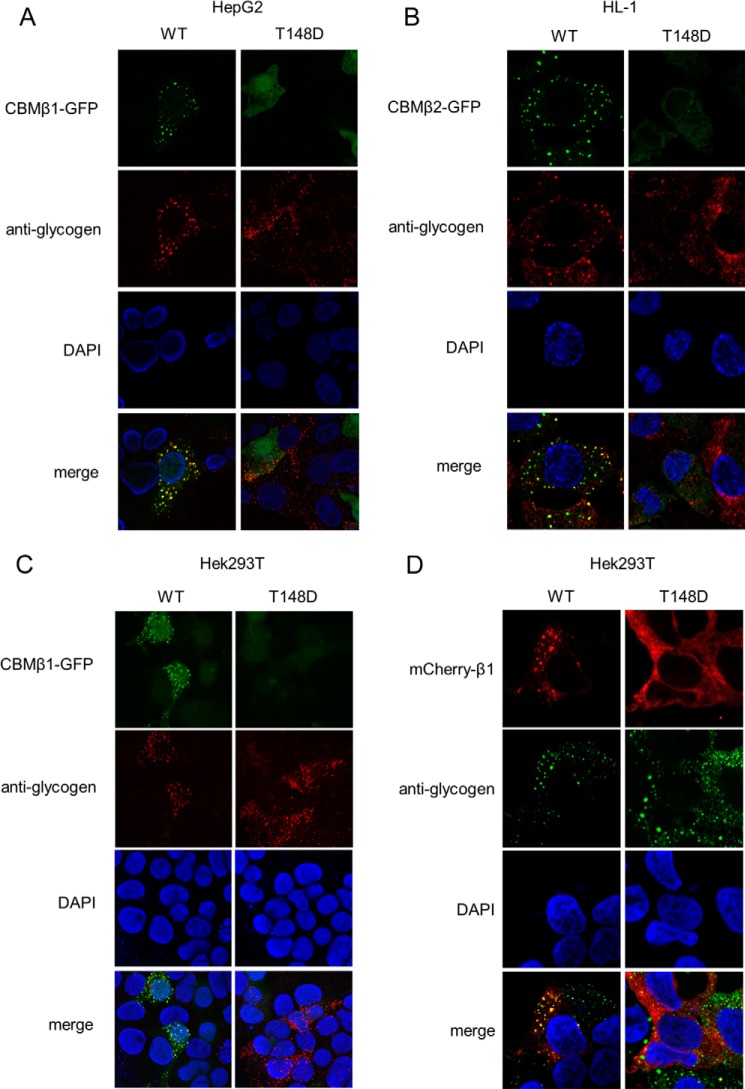
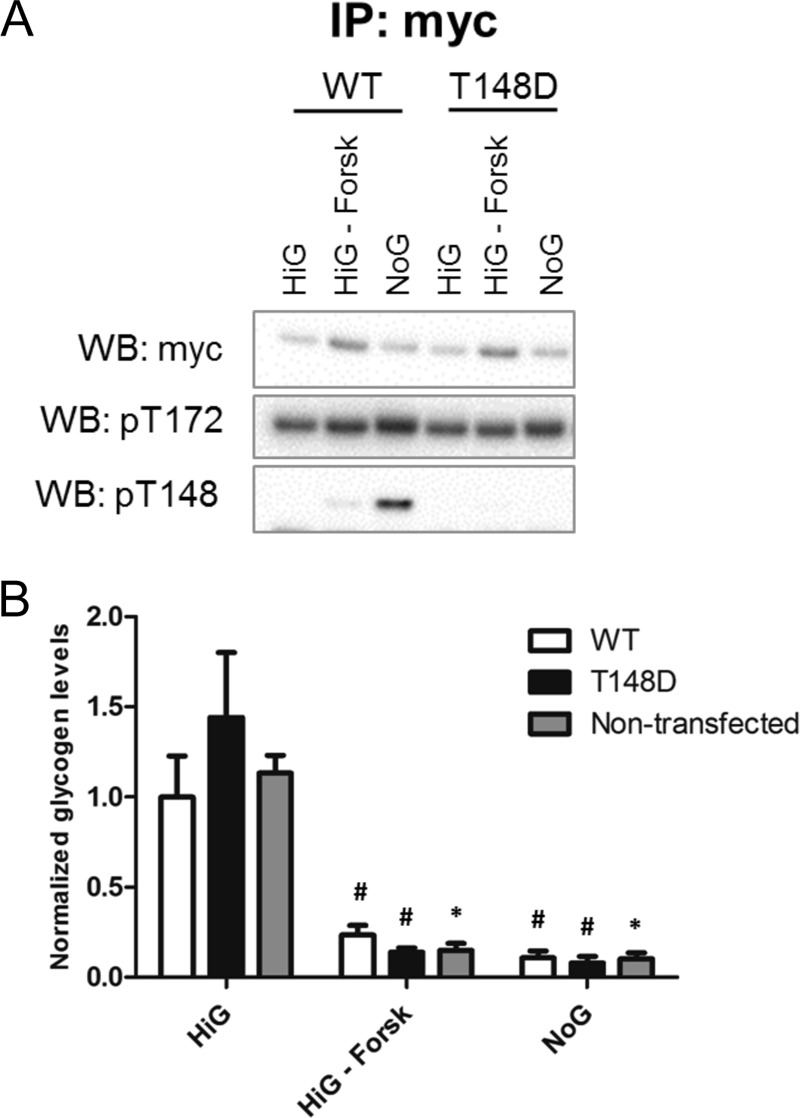
The mammalian AMP-activated protein kinase (AMPK) is an obligatory αβγ heterotrimeric complex carrying a carbohydrate-binding module (CBM) in the β-subunit (AMPKβ) capable of attaching AMPK to glycogen. Nonetheless, AMPK localizes at many different cellular compartments, implying the existence of mechanisms that prevent AMPK from glycogen binding. Cell-free carbohydrate binding assays revealed that AMPK autophosphorylation abolished its carbohydrate-binding capacity. X-ray structural data of the CBM displays the central positioning of threonine 148 within the binding pocket. Substitution of Thr-148 for a phospho-mimicking aspartate (T148D) prevents AMPK from binding to carbohydrate. Overexpression of isolated CBM or β1-containing AMPK in cellular models revealed that wild type (WT) localizes to glycogen particles, whereas T148D shows a diffuse pattern. Pharmacological AMPK activation and glycogen degradation by glucose deprivation but not forskolin enhanced cellular Thr-148 phosphorylation. Cellular glycogen content was higher if pharmacological AMPK activation was combined with overexpression of T148D mutant relative to WT AMPK. In summary, these data show that glycogen-binding capacity of AMPKβ is regulated by Thr-148 autophosphorylation with likely implications in the regulation of glycogen turnover. The findings further raise the possibility of regulated carbohydrate-binding function in a wider variety of CBM-containing proteins.
哺乳动物的AMP激活蛋白激酶(AMPK)是一种必需的αβγ异源三聚体复合物,其β亚基(AMPKβ)带有一个碳水化合物结合模块(CBM),能够将AMPK附着于糖原。尽管如此,AMPK定位于许多不同的细胞区室,这意味着存在防止AMPK与糖原结合的机制。无细胞碳水化合物结合试验表明,AMPK的自磷酸化消除了其碳水化合物结合能力。CBM的X射线结构数据显示苏氨酸148在结合口袋中的中心位置。将苏氨酸148替换为模拟磷酸化的天冬氨酸(T148D)可阻止AMPK与碳水化合物结合。在细胞模型中过表达分离的CBM或含β1的AMPK表明,野生型(WT)定位于糖原颗粒,而T148D呈现弥散分布模式。通过葡萄糖剥夺而非福斯可林进行的药理学AMPK激活和糖原降解增强了细胞中苏氨酸148的磷酸化。与野生型AMPK相比,如果药理学AMPK激活与T148D突变体的过表达相结合,细胞糖原含量会更高。总之,这些数据表明,AMPKβ的糖原结合能力受苏氨酸148自磷酸化的调节,这可能对糖原周转的调节有影响。这些发现进一步增加了在更多含CBM的蛋白质中存在受调控的碳水化合物结合功能的可能性。