Exercise and Nutrition Research Program, Mary MacKillop Institute for Health Research, Australian Catholic University, Level 5, 215 Spring Street, Melbourne, Victoria 3000, Australia.
Exercise and Nutrition Research Program, Mary MacKillop Institute for Health Research, Australian Catholic University, Level 5, 215 Spring Street, Melbourne, Victoria 3000, Australia.
Mol Metab. 2020 Nov;41:101048. doi: 10.1016/j.molmet.2020.101048. Epub 2020 Jun 29.
Glycogen is a major energy reserve in liver and skeletal muscle. The master metabolic regulator AMP-activated protein kinase (AMPK) associates with glycogen via its regulatory β subunit carbohydrate-binding module (CBM). However, the physiological role of AMPK-glycogen binding in energy homeostasis has not been investigated in vivo. This study aimed to determine the physiological consequences of disrupting AMPK-glycogen interactions.
Glycogen binding was disrupted in mice via whole-body knock-in (KI) mutation of either the AMPK β1 (W100A) or β2 (W98A) isoform CBM. Systematic whole-body, tissue and molecular phenotyping was performed in KI and respective wild-type (WT) mice.
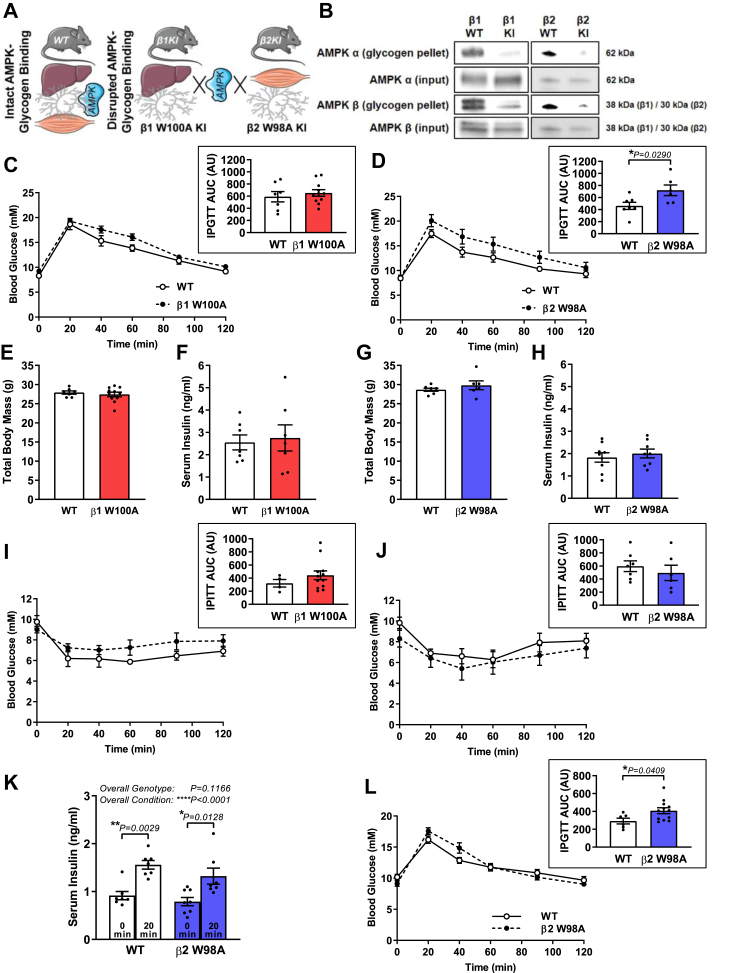
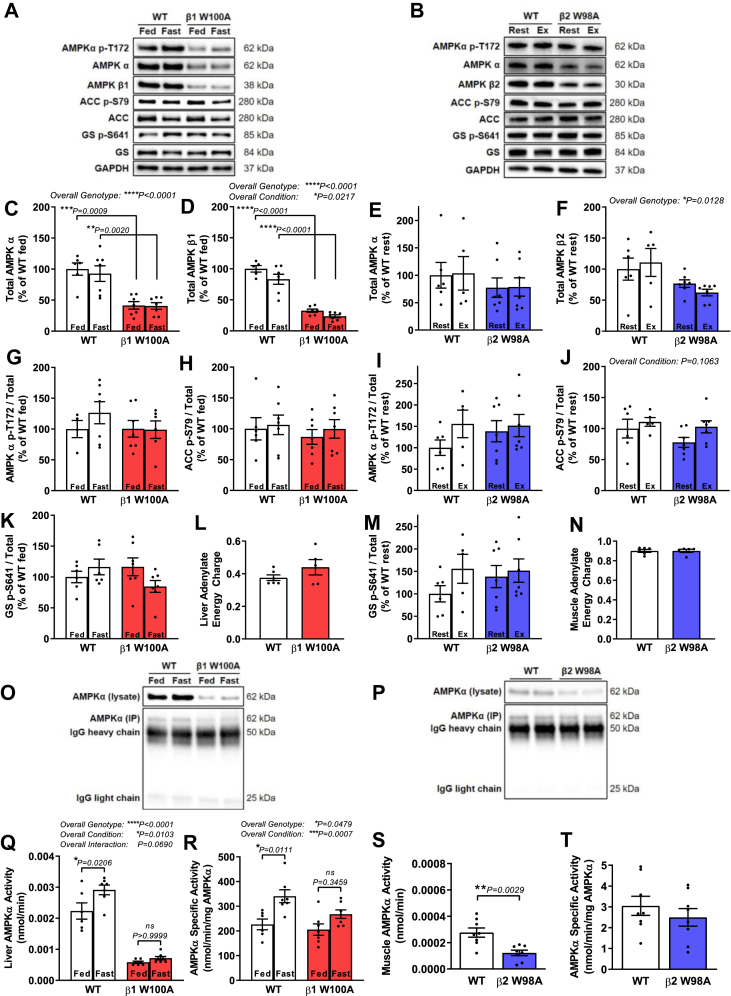
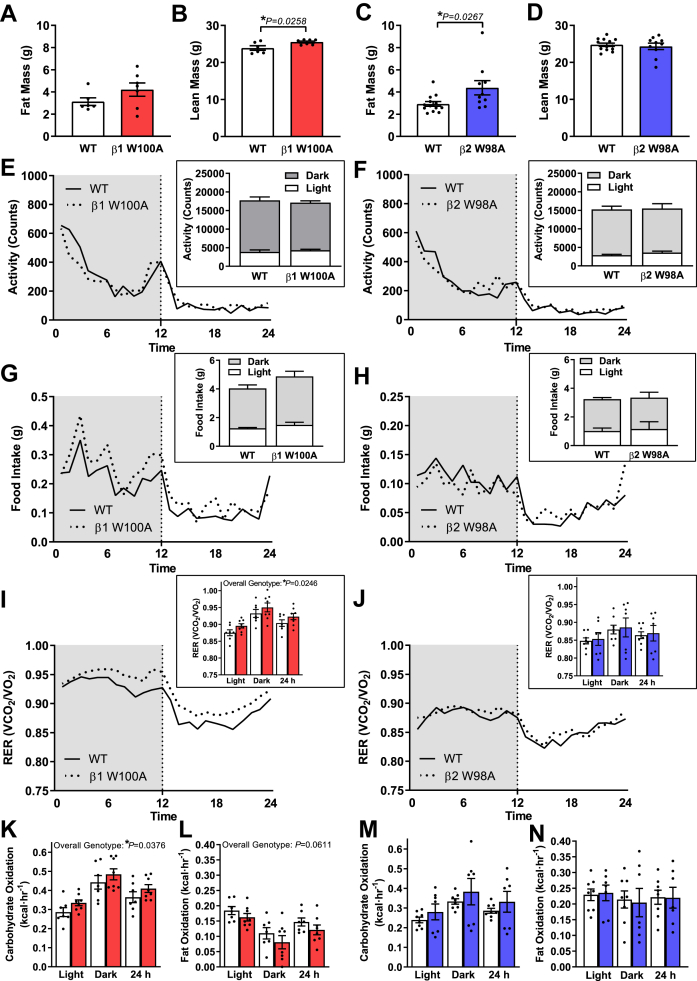
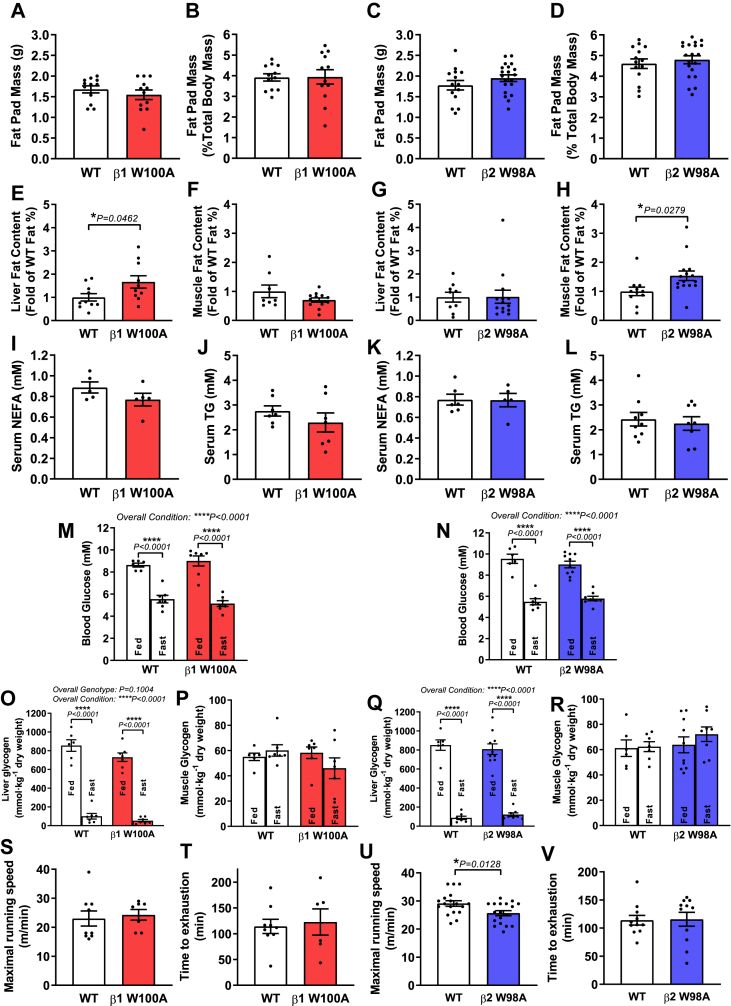
While β1 W100A KI did not affect whole-body metabolism or exercise capacity, β2 W98A KI mice displayed increased adiposity and impairments in whole-body glucose handling and maximal exercise capacity relative to WT. These KI mutations resulted in reduced total AMPK protein and kinase activity in liver and skeletal muscle of β1 W100A and β2 W98A, respectively, versus WT mice. β1 W100A mice also displayed loss of fasting-induced liver AMPK total and α-specific kinase activation relative to WT. Destabilisation of AMPK was associated with increased fat deposition in β1 W100A liver and β2 W98A skeletal muscle versus WT.
These results demonstrate that glycogen binding plays critical roles in stabilising AMPK and maintaining cellular, tissue and whole-body energy homeostasis.
糖原是肝脏和骨骼肌中主要的能量储备。主代谢调节剂 AMP 激活的蛋白激酶(AMPK)通过其调节β亚基碳水化合物结合模块(CBM)与糖原结合。然而,在体内,AMPK-糖原结合在能量稳态中的生理作用尚未得到研究。本研究旨在确定破坏 AMPK-糖原相互作用的生理后果。
通过全身敲入(KI)突变 AMPKβ1(W100A)或β2(W98A)同工型 CBM,在小鼠中破坏糖原结合。在 KI 和各自的野生型(WT)小鼠中进行系统的全身、组织和分子表型分析。
虽然β1 W100A KI 不影响全身代谢或运动能力,但β2 W98A KI 小鼠表现出肥胖增加,以及全身葡萄糖处理和最大运动能力受损,与 WT 相比。这些 KI 突变导致与 WT 相比,β1 W100A 和β2 W98A 的肝和骨骼肌中总 AMPK 蛋白和激酶活性分别降低。与 WT 相比,β1 W100A 小鼠还显示出禁食诱导的肝 AMPK 总蛋白和α特异性激酶激活的丧失。AMPK 的不稳定性与β1 W100A 肝和β2 W98A 骨骼肌中脂肪沉积增加有关。
这些结果表明,糖原结合在稳定 AMPK 和维持细胞、组织和全身能量稳态方面起着关键作用。