Saeidi Saeide, Amini Boroujeni Negar, Ahmadi Hassan, Hassanshahian Mehdi
Agricultural Biotechnology Research Institute, Zabol University, Zabol, IR Iran.
Department of Microbiology, Science and Research Branch, Islamic Azad University, Kerman, IR Iran.
Jundishapur J Microbiol. 2015 Feb 3;8(2):e15434. doi: 10.5812/jjm.15434. eCollection 2015 Feb.
The extended-spectrum beta-lactamase (ESBL) -producing Escherichia coli isolates make many serious infections, especially urinary tract infections.
The purpose of this study was to determine the antibacterial activities of some natural plant extracts against ESBL-producing E. coli isolates, which harbor the TEM gene in urine samples of the patients who have urinary tract infections.
Evaluation has to be exactly determined for both methods of disk diffusion test and polymerase chain reaction (PCR), separately. We evaluated 120 strains of E. coli isolates from the urine culture of the patients in Boo-Ali Hospital (Zahedan, south-eastern Iran) who were suffering from urinary tract infections. The ESBL-producing E. coli isolates were evaluated by disk diffusion test and PCR through TEM gene detection. The minimal inhibitory concentration (MIC) of commonly used antibiotics including ceftazidime, ceftriaxon, amikacin, gentamicin and ciprofloxacin along with the MIC of the alcoholic extract of different natural plants including Myrtus communis L (Myrtaceae), Amaranthus retraflexus (Amaranthaceae), Cyminum cuminum L (Apiaceae), Marrubium vulgare (Laminaceae) and Peganum. harmala (Zygrophyllaceae) against the ESBL-producing E. coli isolates, which harbor the TEM genes, were determined using the microdulition method.
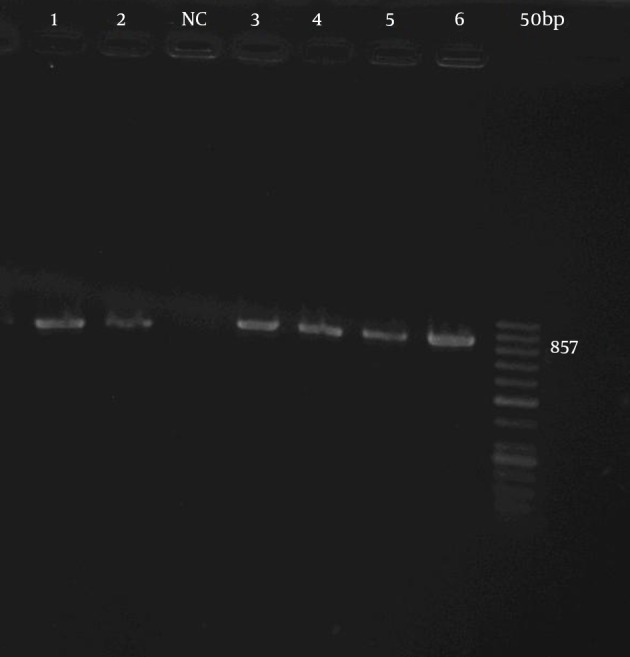
Results of this study showed that in disk diffusion method, 80 samples of E. coli produced ESBLs. In PCR method, the TEM gene distribution in the isolated ESBL-producing organisms was 50 (41.6%). Amikacin was the most effective anti-bacterial agent and ciprofloxacin was the least effective against E. coli isolates. All the natural plant extracts mentioned above, especially P. harmala, were effective against the selected isolates of ESBL-producing E. coli. The most frequent ESBL rate producing E. coli isolates (32 out of 50) had MIC of 2.5 mg/mL in ethanol extract of P. harmala.
The alcoholic extract of P. harmala was very effective against the selected ESBL-producing E. coli isolates harboring the TEM gene. Therefore, it could be suggested as an antibacterial agent in the future. More researches are necessary for detecting the mechanism of this plant's behavior and its pharmacological effects.
产超广谱β-内酰胺酶(ESBL)的大肠埃希菌分离株可引发多种严重感染,尤其是尿路感染。
本研究旨在确定某些天然植物提取物对产ESBL大肠埃希菌分离株的抗菌活性,这些分离株存在于患有尿路感染患者的尿液样本中,且携带TEM基因。
必须分别对纸片扩散法和聚合酶链反应(PCR)这两种方法进行准确评估。我们评估了来自伊朗东南部扎黑丹布阿里医院尿路感染患者尿液培养物中的120株大肠埃希菌分离株。通过纸片扩散法和PCR检测TEM基因来评估产ESBL的大肠埃希菌分离株。使用微量稀释法测定常用抗生素(包括头孢他啶、头孢曲松、阿米卡星、庆大霉素和环丙沙星)以及不同天然植物(包括桃金娘科的香桃木、苋科的反枝苋、伞形科的孜然芹、唇形科的药用夏至草和蒺藜科的骆驼蓬)乙醇提取物对携带TEM基因的产ESBL大肠埃希菌分离株的最低抑菌浓度(MIC)。
本研究结果表明,在纸片扩散法中,80份大肠埃希菌样本产ESBLs。在PCR法中,分离出的产ESBL生物中TEM基因的分布率为50(41.6%)。阿米卡星是对大肠埃希菌分离株最有效的抗菌剂,环丙沙星最无效。上述所有天然植物提取物,尤其是骆驼蓬,对所选产ESBL大肠埃希菌分离株均有效。产ESBL大肠埃希菌分离株中最常见的比例(50株中有32株)在骆驼蓬乙醇提取物中的MIC为2.5mg/mL。
骆驼蓬乙醇提取物对所选携带TEM基因的产ESBL大肠埃希菌分离株非常有效。因此,未来可将其作为一种抗菌剂。有必要进行更多研究以检测该植物的作用机制及其药理作用。