• 文献检索
  • 文档翻译
  • 深度研究
  • 学术资讯
  • Suppr Zotero 插件Zotero 插件
  • 邀请有礼
  • 套餐&价格
  • 历史记录
应用&插件
Suppr Zotero 插件Zotero 插件浏览器插件Mac 客户端Windows 客户端微信小程序
定价
高级版会员购买积分包购买API积分包
服务
文献检索文档翻译深度研究API 文档MCP 服务
关于我们
关于 Suppr公司介绍联系我们用户协议隐私条款
关注我们

Suppr 超能文献

核心技术专利:CN118964589B侵权必究
粤ICP备2023148730 号-1Suppr @ 2026

文献检索

告别复杂PubMed语法,用中文像聊天一样搜索,搜遍4000万医学文献。AI智能推荐,让科研检索更轻松。

立即免费搜索

文件翻译

保留排版,准确专业,支持PDF/Word/PPT等文件格式,支持 12+语言互译。

免费翻译文档

深度研究

AI帮你快速写综述,25分钟生成高质量综述,智能提取关键信息,辅助科研写作。

立即免费体验

呼吸作答:会话中反应计划的时间进程。

Breathing for answering: the time course of response planning in conversation.

机构信息

Language and Cognition Department, Max Planck Institute for Psycholinguistics Nijmegen, Netherlands.

Language and Cognition Department, Max Planck Institute for Psycholinguistics Nijmegen, Netherlands ; Donders Institute for Brain, Cognition and Behaviour, Radboud University Nijmegen, Netherlands.

出版信息

Front Psychol. 2015 Mar 12;6:284. doi: 10.3389/fpsyg.2015.00284. eCollection 2015.

DOI:10.3389/fpsyg.2015.00284
PMID:25814976
原文链接:https://pmc.ncbi.nlm.nih.gov/articles/PMC4357202/
Abstract

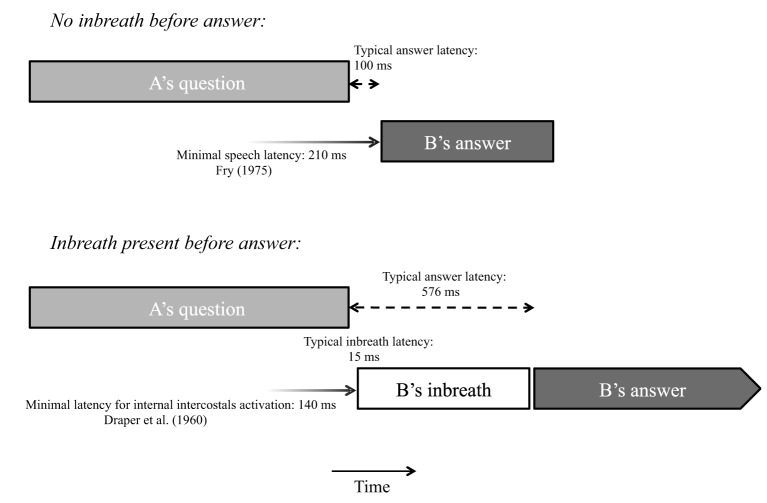
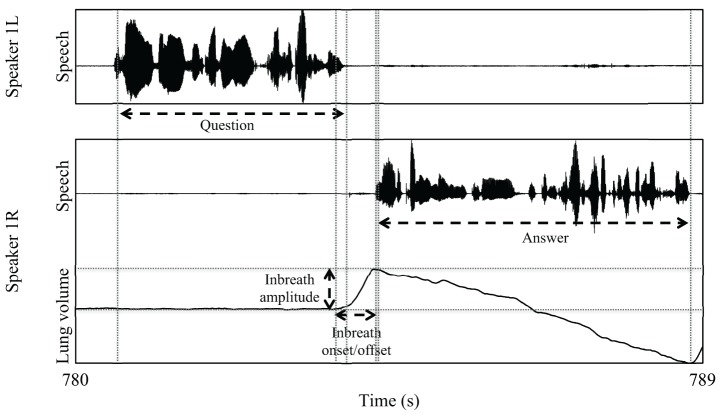
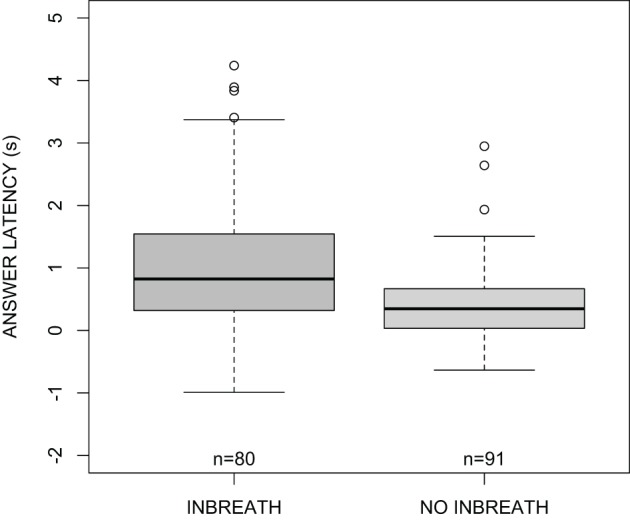
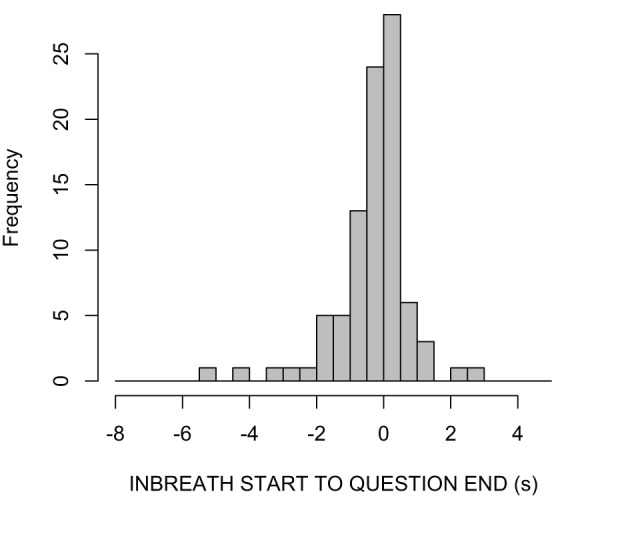
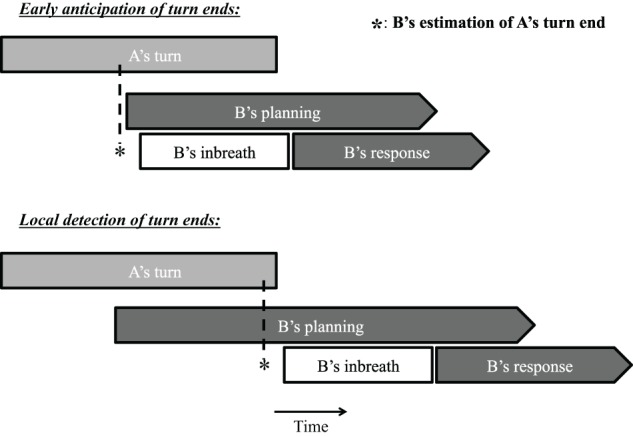
We investigate the timing of pre-answer inbreaths in order to shed light on the time course of response planning and execution in conversational turn-taking. Using acoustic and inductive plethysmography recordings of seven dyadic conversations in Dutch, we show that pre-answer inbreaths in conversation typically begin briefly after the end of questions. We also show that the presence of a pre-answer inbreath usually co-occurs with substantially delayed answers, with a modal latency of 576 vs. 100 ms for answers not preceded by an inbreath. Based on previously reported minimal latencies for internal intercostal activation and the production of speech sounds, we propose that vocal responses, either in the form of a pre-utterance inbreath or of speech proper when an inbreath is not produced, are typically launched in reaction to information present in the last portion of the interlocutor's turn. We also show that short responses are usually made on residual breath, while longer responses are more often preceded by an inbreath. This relation of inbreaths to answer length suggests that by the time an inbreath is launched, typically during the last few hundred milliseconds of the question, the length of the answer is often prepared to some extent. Together, our findings are consistent with a two-stage model of response planning in conversational turn-taking: early planning of content often carried out in overlap with the incoming turn, and late launching of articulation based on the identification of turn-final cues.

摘要

我们研究了预答吸气的时间,以便深入了解会话中回答规划和执行的时间进程。通过对荷兰 7 对对话的声学和感应体积描记法记录,我们表明,对话中的预答吸气通常在问题结束后不久开始。我们还表明,预答吸气的存在通常与回答的显著延迟同时发生,有吸气的回答的模态潜伏期为 576 毫秒,而没有吸气的回答的潜伏期为 100 毫秒。基于先前报道的肋间内激活和言语声音产生的最小潜伏期,我们提出,发声反应,无论是在吸气前的预发音吸气形式还是在没有吸气时的言语形式,通常是针对对话者话语的最后部分中的信息而启动的。我们还表明,短的回答通常在剩余的呼吸中完成,而较长的回答则更常以前吸为先导。吸气与回答长度的这种关系表明,到吸气启动时,通常在问题的最后几百毫秒内,回答的长度已经在一定程度上准备好了。总的来说,我们的发现与会话中回答规划的两阶段模型一致:内容的早期规划通常与传入的话语重叠进行,而后期的发音启动则基于对话语结束线索的识别。
https://cdn.ncbi.nlm.nih.gov/pmc/blobs/0e91/4357202/53ba7968fc46/fpsyg-06-00284-g0007.jpg
https://cdn.ncbi.nlm.nih.gov/pmc/blobs/0e91/4357202/014300072b43/fpsyg-06-00284-g0001.jpg
https://cdn.ncbi.nlm.nih.gov/pmc/blobs/0e91/4357202/036ed3818856/fpsyg-06-00284-g0002.jpg
https://cdn.ncbi.nlm.nih.gov/pmc/blobs/0e91/4357202/d0092867b6b5/fpsyg-06-00284-g0003.jpg
https://cdn.ncbi.nlm.nih.gov/pmc/blobs/0e91/4357202/f8c1e7554e4e/fpsyg-06-00284-g0004.jpg
https://cdn.ncbi.nlm.nih.gov/pmc/blobs/0e91/4357202/9e92b50b8d9a/fpsyg-06-00284-g0005.jpg
https://cdn.ncbi.nlm.nih.gov/pmc/blobs/0e91/4357202/4ae0b11d07bd/fpsyg-06-00284-g0006.jpg
https://cdn.ncbi.nlm.nih.gov/pmc/blobs/0e91/4357202/53ba7968fc46/fpsyg-06-00284-g0007.jpg
https://cdn.ncbi.nlm.nih.gov/pmc/blobs/0e91/4357202/014300072b43/fpsyg-06-00284-g0001.jpg
https://cdn.ncbi.nlm.nih.gov/pmc/blobs/0e91/4357202/036ed3818856/fpsyg-06-00284-g0002.jpg
https://cdn.ncbi.nlm.nih.gov/pmc/blobs/0e91/4357202/d0092867b6b5/fpsyg-06-00284-g0003.jpg
https://cdn.ncbi.nlm.nih.gov/pmc/blobs/0e91/4357202/f8c1e7554e4e/fpsyg-06-00284-g0004.jpg
https://cdn.ncbi.nlm.nih.gov/pmc/blobs/0e91/4357202/9e92b50b8d9a/fpsyg-06-00284-g0005.jpg
https://cdn.ncbi.nlm.nih.gov/pmc/blobs/0e91/4357202/4ae0b11d07bd/fpsyg-06-00284-g0006.jpg
https://cdn.ncbi.nlm.nih.gov/pmc/blobs/0e91/4357202/53ba7968fc46/fpsyg-06-00284-g0007.jpg

相似文献

1
Breathing for answering: the time course of response planning in conversation.呼吸作答:会话中反应计划的时间进程。
Front Psychol. 2015 Mar 12;6:284. doi: 10.3389/fpsyg.2015.00284. eCollection 2015.
2
Turn-timing in signed conversations: coordinating stroke-to-stroke turn boundaries.手语对话中的轮次转换:协调逐轮次的轮次界限
Front Psychol. 2015 Mar 24;6:268. doi: 10.3389/fpsyg.2015.00268. eCollection 2015.
3
Overrated gaps: Inter-speaker gaps provide limited information about the timing of turns in conversation.被高估的间隙:说话者之间的间隙提供的关于对话中轮次时间的信息有限。
Cognition. 2022 Jun;223:105037. doi: 10.1016/j.cognition.2022.105037. Epub 2022 Feb 2.
4
Variation in dual-task performance reveals late initiation of speech planning in turn-taking.双重任务表现的差异揭示了轮流对话中言语规划的延迟启动。
Cognition. 2015 Mar;136:304-24. doi: 10.1016/j.cognition.2014.10.008. Epub 2014 Dec 15.
5
Predicting One's Turn With Both Body and Mind: Anticipatory Speech Postures During Dyadic Conversation.身心并用预测轮到自己发言:双向对话中的预期言语姿势
Front Psychol. 2021 Jul 13;12:684248. doi: 10.3389/fpsyg.2021.684248. eCollection 2021.
6
The role of answer content and length when preparing answers to questions.准备回答问题时,答案内容和长度的作用。
Sci Rep. 2024 Jul 24;14(1):17110. doi: 10.1038/s41598-024-68253-6.
7
Next Speakers Plan Their Turn Early and Speak after Turn-Final "Go-Signals".接下来,发言者提前规划自己的发言时机,并在轮次结束的“开始信号”后发言。
Front Psychol. 2017 Apr 11;8:393. doi: 10.3389/fpsyg.2017.00393. eCollection 2017.
8
Ultrasound measurements of interactive turn-taking in question-answer sequences: Articulatory preparation is delayed but not tied to the response.问答序列中互动轮次的超声测量:发音准备被延迟,但与反应无关。
PLoS One. 2023 Jul 5;18(7):e0276470. doi: 10.1371/journal.pone.0276470. eCollection 2023.
9
Forgotten Little Words: How Backchannels and Particles May Facilitate Speech Planning in Conversation?被遗忘的小词汇:话语标记语和小品词如何在对话中促进言语计划?
Front Psychol. 2020 Nov 6;11:593671. doi: 10.3389/fpsyg.2020.593671. eCollection 2020.
10
Temporal Preparation for Speaking in Question-Answer Sequences.问答环节中发言的时间准备
Front Psychol. 2017 Feb 21;8:211. doi: 10.3389/fpsyg.2017.00211. eCollection 2017.

引用本文的文献

1
Central nervous system control of breathing in natural conversation turn-taking.自然对话轮流发言中呼吸的中枢神经系统控制。
Sci Rep. 2025 Aug 25;15(1):31276. doi: 10.1038/s41598-025-15776-1.
2
Ultrasound measurements of interactive turn-taking in question-answer sequences: Articulatory preparation is delayed but not tied to the response.问答序列中互动轮次的超声测量:发音准备被延迟,但与反应无关。
PLoS One. 2023 Jul 5;18(7):e0276470. doi: 10.1371/journal.pone.0276470. eCollection 2023.
3
Understanding Design Features of Music and Language: The Choric/Dialogic Distinction.

本文引用的文献

1
Take a breath and take the turn: how breathing meets turns in spontaneous dialogue.深呼吸,迎接转折:呼吸如何在自然对话中应对转折。
Philos Trans R Soc Lond B Biol Sci. 2014 Dec 19;369(1658):20130399. doi: 10.1098/rstb.2013.0399.
2
Sustained attention in language production: an individual differences investigation.语言产出中的持续注意力:一项个体差异研究。
Q J Exp Psychol (Hove). 2015;68(4):710-30. doi: 10.1080/17470218.2014.964736. Epub 2014 Nov 7.
3
The neurobiology of language beyond single words.语言的神经生物学:超越单个单词。
理解音乐与语言的设计特征:合唱/对话的区别。
Front Psychol. 2022 Apr 22;13:786899. doi: 10.3389/fpsyg.2022.786899. eCollection 2022.
4
Benefits of Adaptive Learning Transfer From Typing-Based Learning to Speech-Based Learning.自适应学习的益处:从基于打字的学习转移到基于语音的学习。
Front Artif Intell. 2021 Dec 7;4:780131. doi: 10.3389/frai.2021.780131. eCollection 2021.
5
Predicting One's Turn With Both Body and Mind: Anticipatory Speech Postures During Dyadic Conversation.身心并用预测轮到自己发言:双向对话中的预期言语姿势
Front Psychol. 2021 Jul 13;12:684248. doi: 10.3389/fpsyg.2021.684248. eCollection 2021.
6
Effects of Noise and Second Language on Conversational Dynamics in Task Dialogue.噪声和第二语言对任务对话中会话动态的影响。
Trends Hear. 2021 Jan-Dec;25:23312165211024482. doi: 10.1177/23312165211024482.
7
Breathing in Conversation.对话中的呼吸
Front Psychol. 2020 Oct 14;11:575566. doi: 10.3389/fpsyg.2020.575566. eCollection 2020.
8
Verbal Working Memory as Emergent from Language Comprehension and Production.作为从语言理解和产出中浮现的言语工作记忆。
Front Hum Neurosci. 2020 Mar 12;14:68. doi: 10.3389/fnhum.2020.00068. eCollection 2020.
9
Respiratory Constraints in Verbal and Non-verbal Communication.言语和非言语交流中的呼吸限制
Front Psychol. 2017 May 17;8:708. doi: 10.3389/fpsyg.2017.00708. eCollection 2017.
10
The N400 Effect during Speaker-Switch-Towards a Conversational Approach of Measuring Neural Correlates of Language.说话者切换过程中的N400效应——迈向测量语言神经关联的对话方法
Front Psychol. 2016 Nov 28;7:1854. doi: 10.3389/fpsyg.2016.01854. eCollection 2016.
Annu Rev Neurosci. 2014;37:347-62. doi: 10.1146/annurev-neuro-071013-013847. Epub 2014 Jun 2.
4
Prediction of turn-ends based on anticipation of upcoming words.基于对即将到来的单词的预测来预测转折词。
Front Psychol. 2012 Oct 1;3:376. doi: 10.3389/fpsyg.2012.00376. eCollection 2012.
5
Shared language: overlap and segregation of the neuronal infrastructure for speaking and listening revealed by functional MRI.共享语言:功能磁共振成像揭示的说话和倾听的神经元基础的重叠和分离。
Psychol Sci. 2011 Sep;22(9):1173-82. doi: 10.1177/0956797611418347. Epub 2011 Aug 12.
6
Universals and cultural variation in turn-taking in conversation.对话中轮流发言的普遍性与文化差异。
Proc Natl Acad Sci U S A. 2009 Jun 30;106(26):10587-92. doi: 10.1073/pnas.0903616106. Epub 2009 Jun 24.
7
The spatial and temporal signatures of word production components.词汇生成成分的时空特征。
Cognition. 2004 May-Jun;92(1-2):101-44. doi: 10.1016/j.cognition.2002.06.001.
8
Expiratory pressures and air flow during speech.言语过程中的呼气压力和气流
Br Med J. 1960 Jun 18;1(5189):1837-43. doi: 10.1136/bmj.1.5189.1837.
9
A theory of lexical access in speech production.言语产生中的词汇通达理论。
Behav Brain Sci. 1999 Feb;22(1):1-38; discussion 38-75. doi: 10.1017/s0140525x99001776.
10
What the eyes say about speaking.眼睛在说话方面所传达的信息。
Psychol Sci. 2000 Jul;11(4):274-9. doi: 10.1111/1467-9280.00255.