Alterio Vincenzo, Langella Emma, De Simone Giuseppina, Monti Simona Maria
Institute of Biostructures and Bioimaging-National Research Council (CNR), Via Mezzocannone 16, I-80134 Naples, Italy.
Mar Drugs. 2015 Mar 25;13(4):1688-97. doi: 10.3390/md13041688.
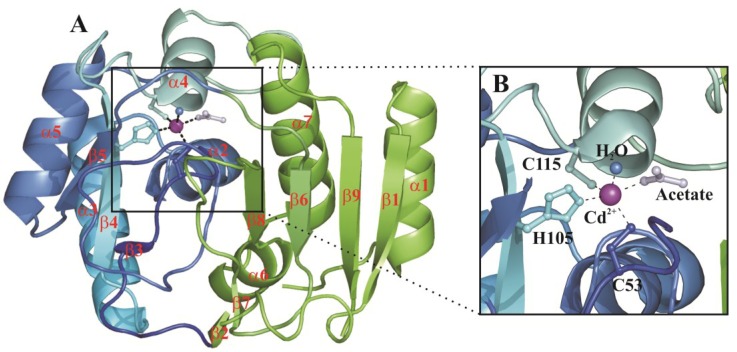
The Carbon Concentration Mechanism (CCM) allows phytoplakton species to accumulate the dissolved inorganic carbon (DIC) necessary for an efficient photosynthesis even under carbon dioxide limitation. In this mechanism of primary importance for diatoms, a key role is played by carbonic anhydrase (CA) enzymes which catalyze the reversible hydration of CO2, thus taking part in the acquisition of inorganic carbon for photosynthesis. A novel CA, named CDCA1, has been recently discovered in the marine diatom Thalassiosira weissflogii. CDCA1 is a cambialistic enzyme since it naturally uses Cd2+ as catalytic metal ion, but if necessary can spontaneously exchange Cd2+ to Zn2+. Here, the biochemical and structural features of CDCA1 enzyme will be presented together with its putative biotechnological applications for the detection of metal ions in seawaters.
碳浓缩机制(CCM)使浮游植物物种即使在二氧化碳受限的情况下也能积累高效光合作用所需的溶解无机碳(DIC)。在对硅藻至关重要的这一机制中,碳酸酐酶(CA)发挥着关键作用,该酶催化二氧化碳的可逆水合作用,从而参与光合作用中无机碳的获取。最近在海洋硅藻威氏海链藻中发现了一种名为CDCA1的新型CA。CDCA1是一种兼性酶,因为它天然使用Cd2+作为催化金属离子,但如有必要,它可以自发地将Cd2+交换为Zn2+。在此,将介绍CDCA1酶的生化和结构特征及其在检测海水中金属离子方面的潜在生物技术应用。